


























Views
Downloads
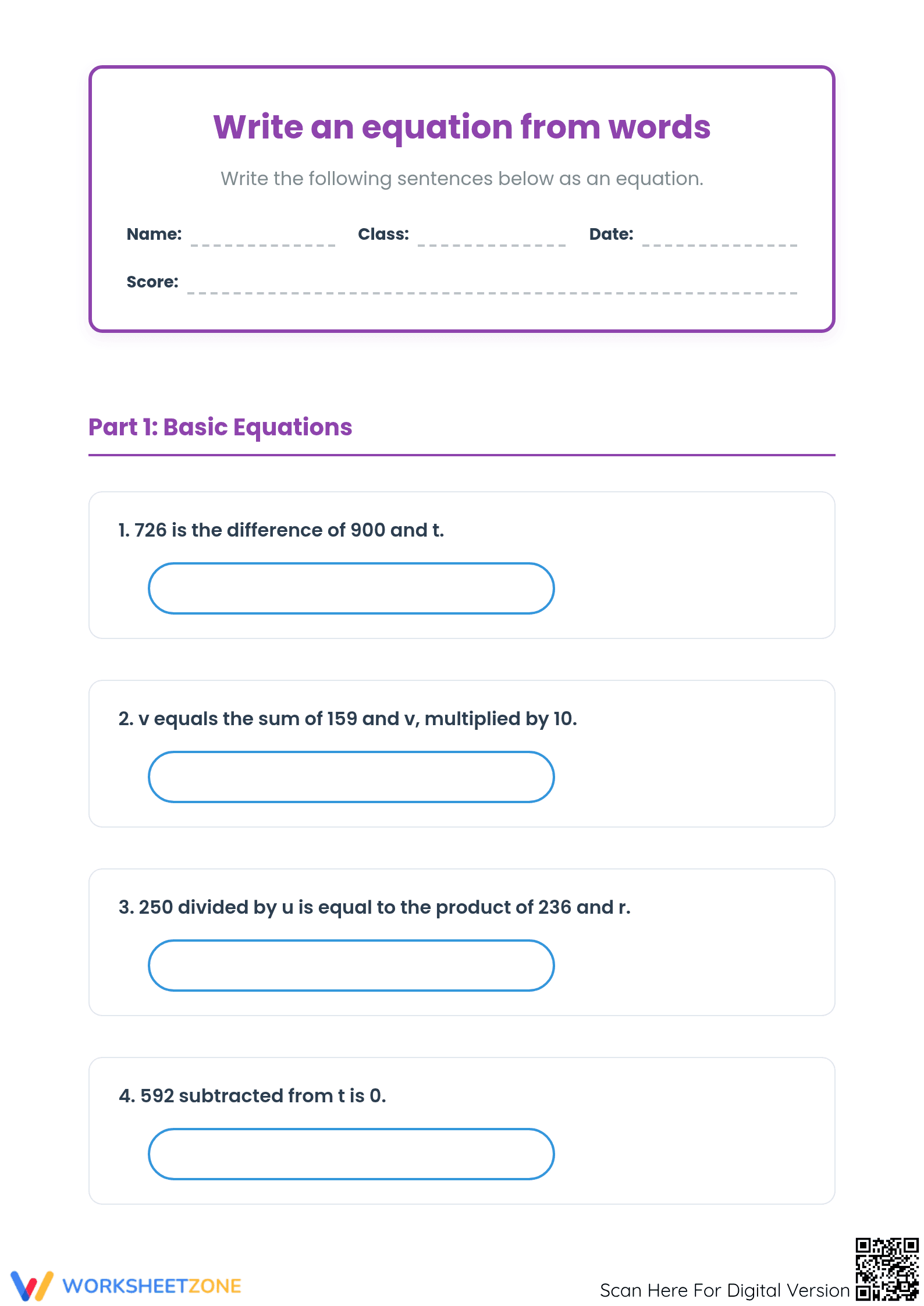
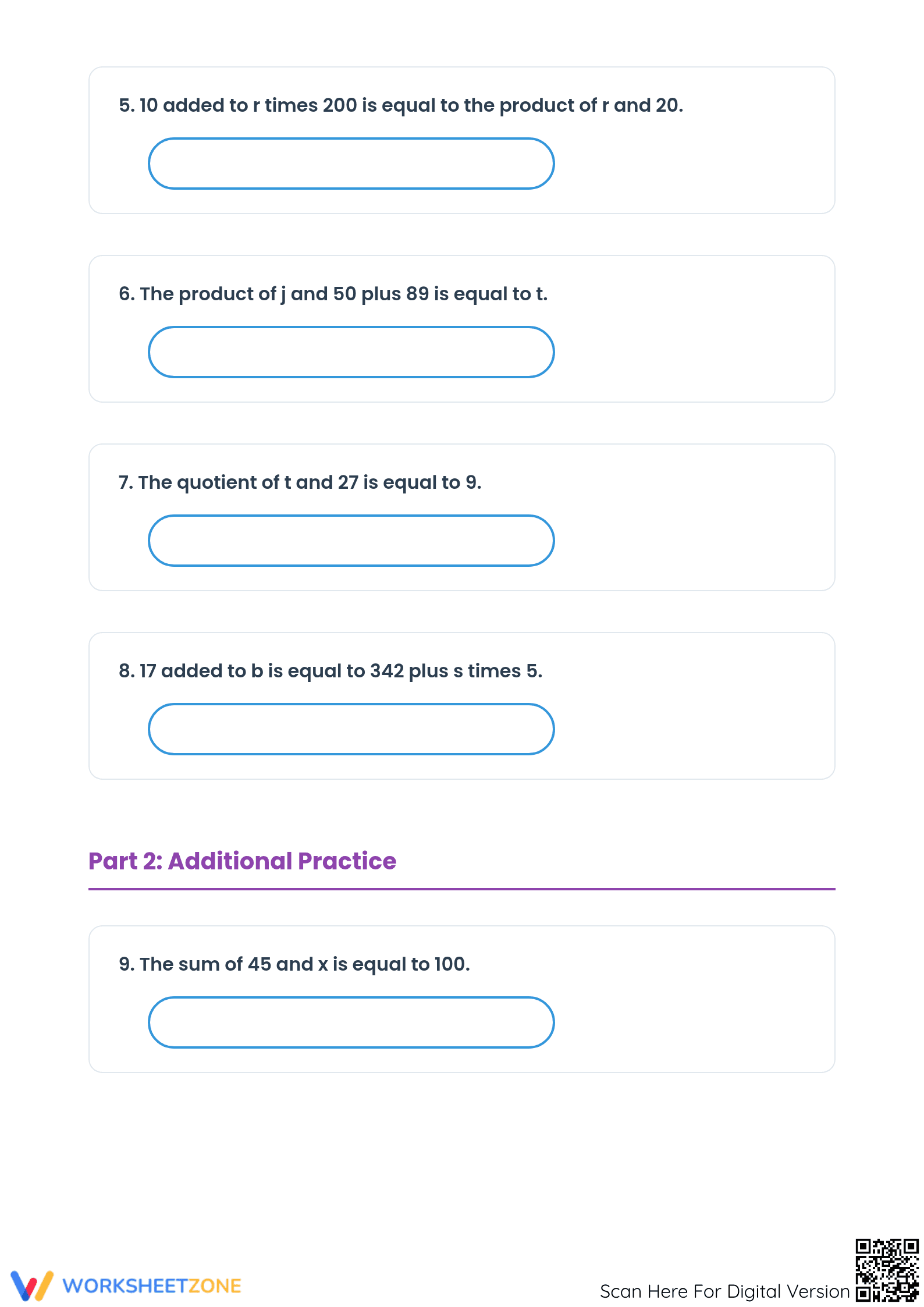
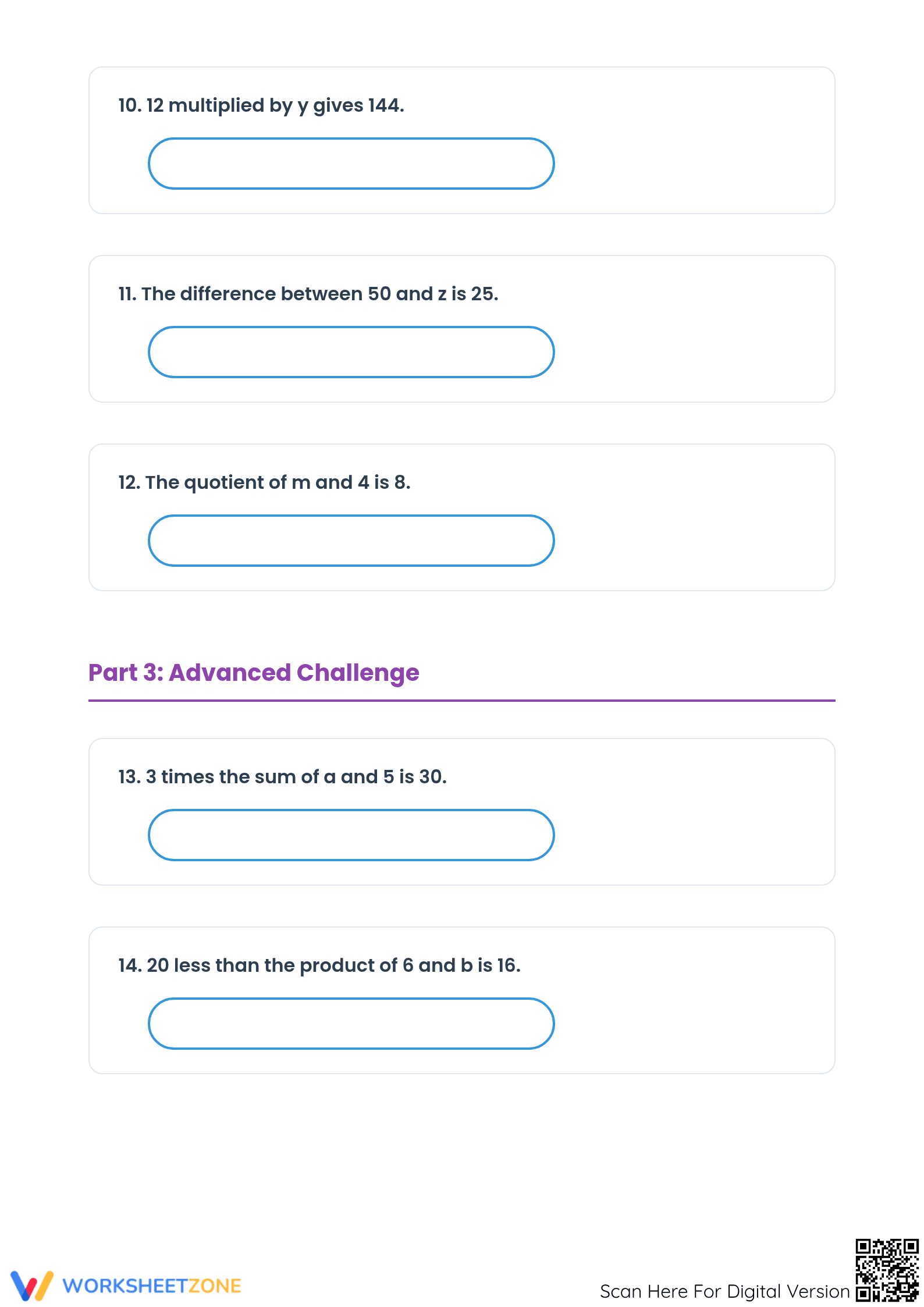


Essential Equation from Words Worksheet | Grade 7 Math
Paste this activity's link or code into your existing LMS (Google Classroom, Canvas, Teams, Schoology, Moodle, etc.).
Students can open and work on the activity right away, with no student login required.
You'll still be able to track student progress and results from your teacher account.
Mastering Algebraic Thinking by Translating Words to Equations
This worksheet provides targeted practice for a critical pre-algebra skill: translating written language into mathematical equations. Students read 12 distinct real-world scenarios and construct the corresponding algebraic equations, building a foundational understanding of how variables represent unknown quantities. It reinforces direct instruction on expressions and equations.
At a Glance
- Grade: 7 · Subject: Math
- Standard:
CCSS.MATH.CONTENT.7.EE.B.4— Construct and solve simple equations for real-world problems.- Skill Focus: Writing equations from word problems
- Format: 4 pages · 12 problems · Answer key included · PDF
- Best For: Independent practice, homework, or formative assessment
- Time: 20–30 minutes
What's Inside
This resource contains a four-page PDF. The first three pages feature 12 unique word problems, with ample space for students to show their work in setting up each equation. The problems involve clear, relatable scenarios, keeping the mathematical task in focus. The final page provides a complete answer key, allowing for efficient evaluation or student self-checking.
A Structured Skill Progression
The worksheet follows a gradual-release model to build student confidence. The design supports learners as they move from structured thinking to independent problem-solving through:
- Guided Practice: Initial problems involve simpler, single-step scenarios to apply the core concept.
- Supported Practice: Middle problems introduce slightly more complex sentences or two-step logic.
- Independent Practice: Final problems challenge students to apply skills to varied scenarios without direct prompting.
Standards Alignment for Your Lesson Plans
This worksheet directly aligns with Common Core State Standard CCSS.MATH.CONTENT.7.EE.B.4, which requires students to "Use variables to represent quantities in a real-world or mathematical problem, and construct simple equations and inequalities to solve problems by reasoning about the quantities." The tasks specifically target equation construction. Standard codes can be copied directly into lesson plans or curriculum mapping tools.
How to Use It in Your Classroom
This resource is versatile. Use it as an in-class independent practice activity after a mini-lesson on translating keywords into mathematical symbols. The expected completion time is 20-30 minutes. Alternatively, assign it as homework to reinforce learning. For formative assessment, observe which phrasing causes confusion to identify whether the difficulty lies in identifying the variable or the operation.
Who It's For
Designed for 7th-grade students beginning algebraic equations, it also serves as review for 8th graders or a challenge for advanced 6th graders. The clear layout and focused task make it accessible for a range of learners. For extra support, pair with an anchor chart of mathematical keywords. For an extension, ask students to solve the equations they've written.
This resource provides focused repetition to make the translation between verbal and algebraic language automatic. Such guided and independent practice is a cornerstone of effective instruction, consolidating new skills. Aligning directly to CCSS.MATH.CONTENT.7.EE.B.4, this worksheet evidences student mastery of a key middle-school mathematical concept. The ability to model real-world situations with equations is a fundamental component of quantitative reasoning, preparing students for more complex algebra and real-life problem-solving.


