


























Views
Downloads



Complete Break-Even Systems Worksheet | Grade 8 Math
Paste this activity's link or code into your existing LMS (Google Classroom, Canvas, Teams, Schoology, Moodle, etc.).
Students can open and work on the activity right away, with no student login required.
You'll still be able to track student progress and results from your teacher account.
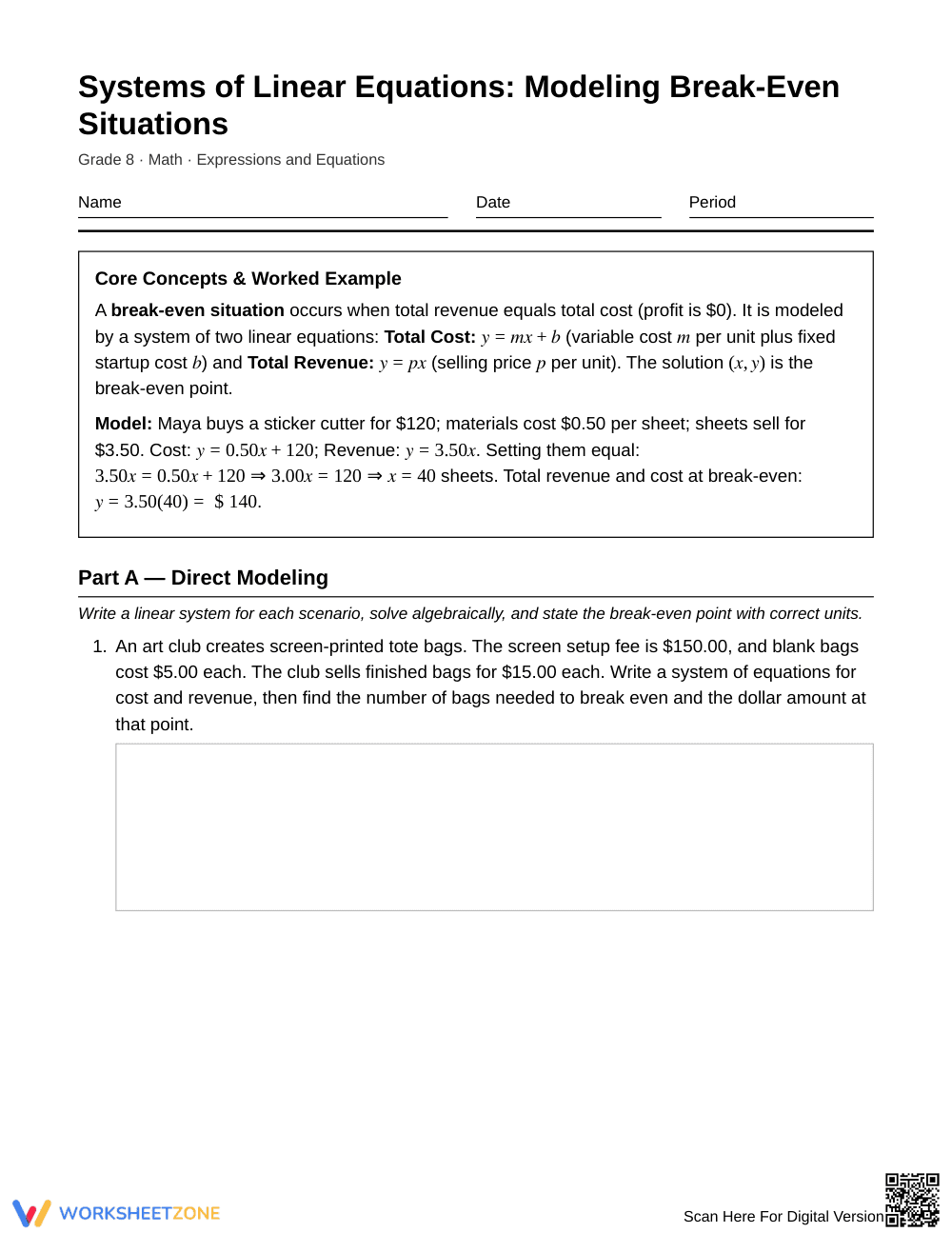
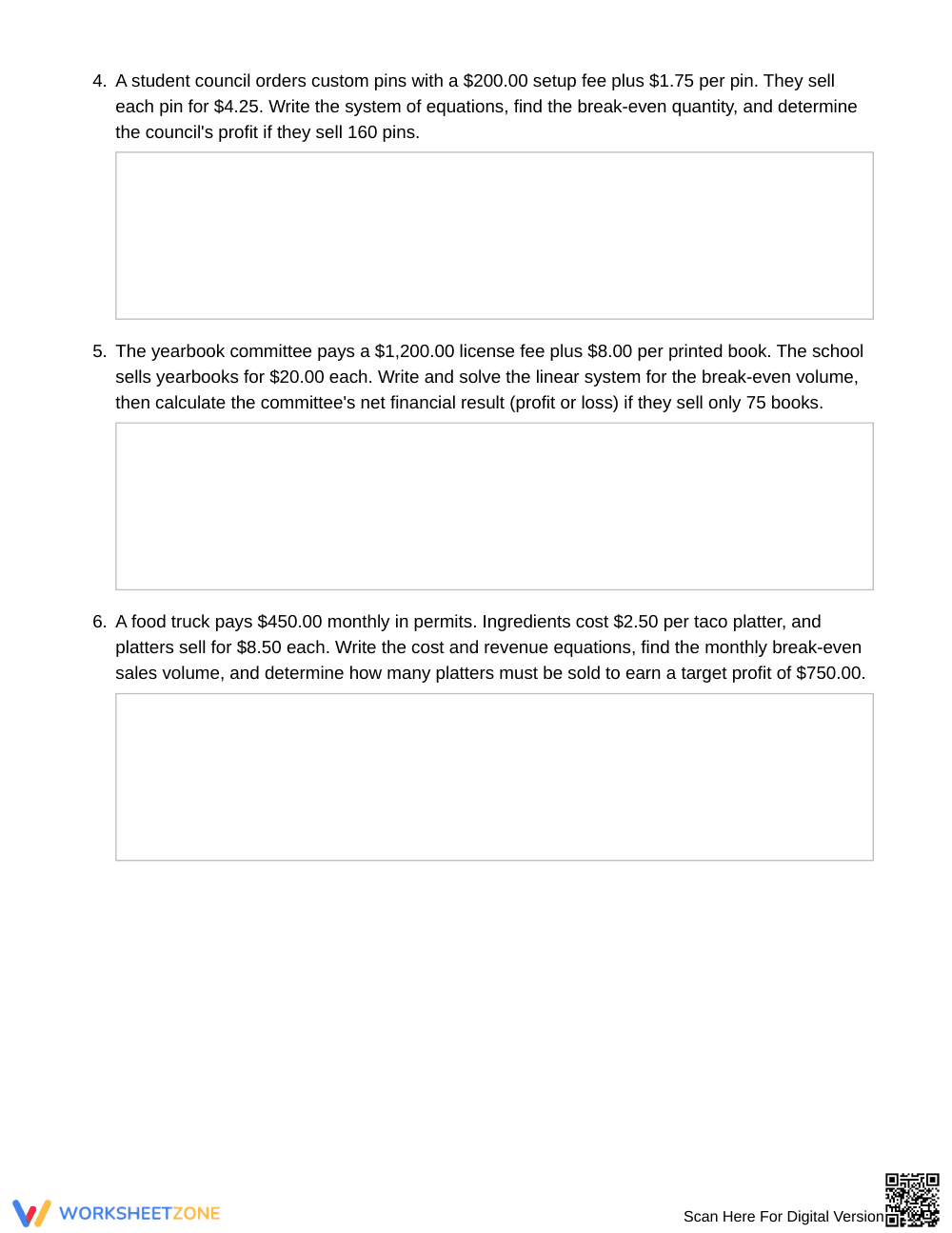
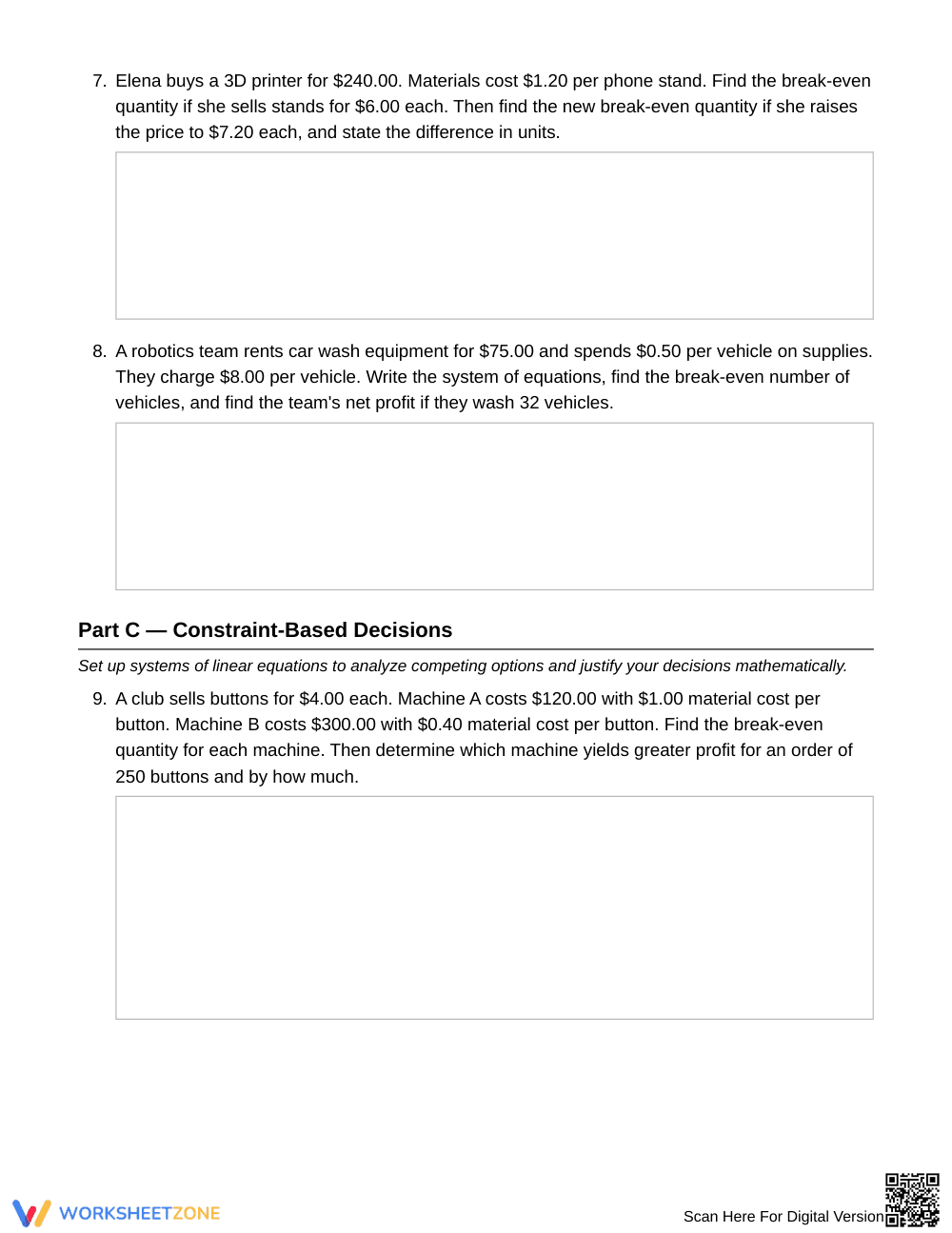
This Grade 8 linear systems worksheet equips students to construct, interpret, and solve real-world break-even situations using systems of two linear equations. Students define variables for cost and revenue, determine the break-even production quantity algebraically and graphically, and compute financial outcomes including target profits and production losses across 10 authentic scenarios.
At a Glance
- Grade: 8 · Subject: Math
- Standard: Solve real-world mathematical problems leading to two linear equations in two variables
- Skill Focus: Model a Break-Even Situation
- Format: 5 pages · 10 problems · Answer key included · PDF
- Best For: Real-world systems of equations practice
- Time: 45–60 minutes
What's Inside
This 5-page instructional resource contains a student-facing reference box featuring core definitions and an annotated worked example, followed by 10 multi-part mathematical tasks organized across three distinct tiers. The student packet spans 2 worksheet pages, followed by a comprehensive 3-page answer key that provides complete algebraic systems, step-by-step substitution work, graphical solutions, and final contextual interpretations with appropriate monetary and product units.
Skill Progression
- Guided Practice (Part A, Problems 1–2): Direct modeling tasks where students read a business scenario, define variables, formulate explicit cost and revenue equations, and solve for the break-even coordinate point with full unit labels.
- Supported Practice (Part B, Problems 3–8): Multi-step financial applications requiring students to interpret graphical data, compute exact profit margins beyond break-even points, calculate net losses, and adjust price parameters to determine shifts in break-even thresholds.
- Independent Practice (Part C, Problems 9–10): Complex constraint-based decision models where students write multiple systems to compare competing commercial plans, evaluate crossover volumes, and justify optimal business selections mathematically.
This sequential design follows the gradual-release framework (I Do, We Do, You Do), establishing firm equation-writing habits before asking students to justify competitive business decisions.
Standards Alignment
This worksheet aligns directly with Grade 8 standards requiring students to solve real-world and mathematical problems leading to two linear equations in two variables, interpreting solutions within contextual constraints. Supporting work connects directly to interpreting linear parameters, recognizing the slope as a unit rate or variable cost and the vertical intercept as an initial setup fee.
How to Use It
Deploy this worksheet after direct instruction on solving linear systems by substitution or graphing. As a mid-unit practice activity, have students complete Part A in pairs before tackling Part B independently. For formative assessment, inspect students' variable definitions and equation setups in Problem 4 before solving algebraically. The resource requires 45 to 60 minutes for full completion.
Who It's For
This resource serves general education Grade 8 math classrooms, accelerated Grade 7 pre-algebra classes, and early Algebra I review units. Pair this worksheet with a business financial literacy unit or an introductory anchor chart illustrating cost versus revenue graphs.
According to Fisher & Frey (2014), purposeful gradual-release structures enable middle school mathematics students to transfer conceptual understanding from teacher-modeled examples to independent algebraic modeling. This worksheet establishes contextual competence in modeling break-even situations by framing systems of linear equations around authentic business concepts, including fixed startup fees, unit production expenses, and revenue generation. Students move methodically from two-step algebraic systems to multi-tiered comparative evaluations involving cost-equivalent decision points. Empirical findings indicate that embedding mathematical problem-solving within concrete financial scenarios enhances student retention of linear relationships while developing foundational fluency in interpreting points of intersection. The explicit progression from guided parameter identification to open-ended economic justification builds sustained problem-solving confidence, ensuring students master the dual demands of symbolic equation manipulation and contextual reasoning across varied applied middle grades mathematics tasks and performance assessments.


