


























Views
Downloads




Systems of Equations Word Problems | Essential Grade 8 Math
Paste this activity's link or code into your existing LMS (Google Classroom, Canvas, Teams, Schoology, Moodle, etc.).
Students can open and work on the activity right away, with no student login required.
You'll still be able to track student progress and results from your teacher account.
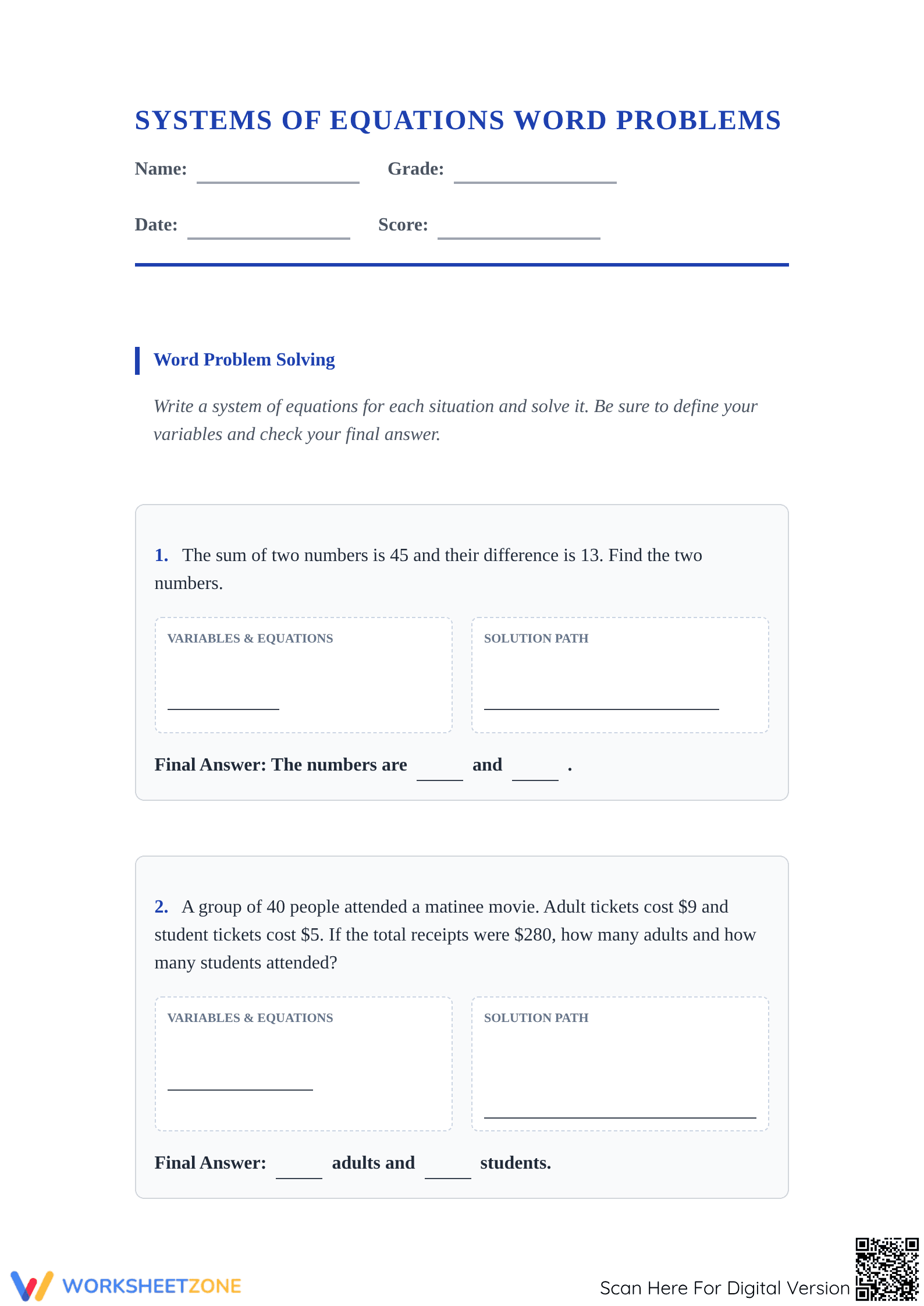
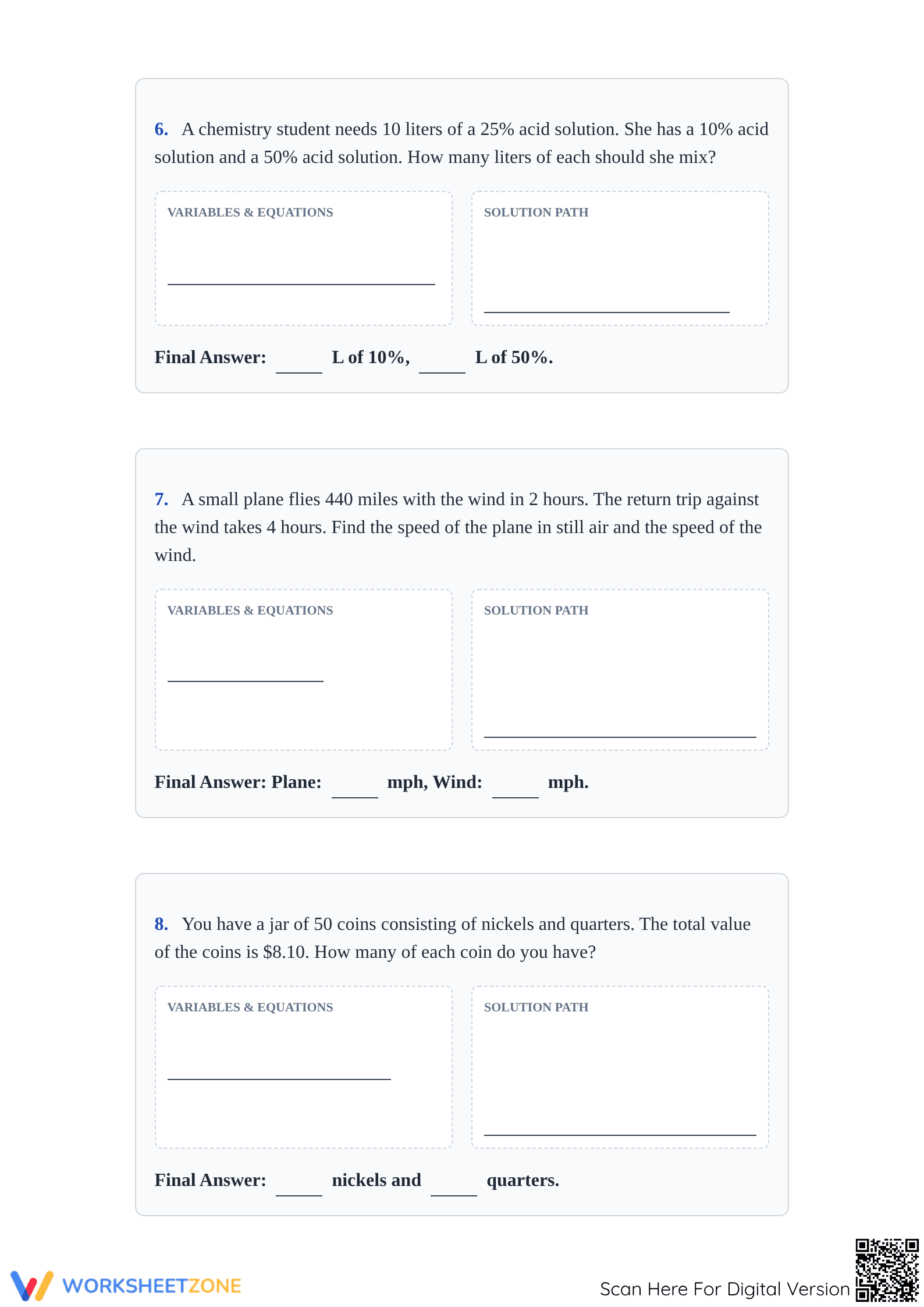
Solve real-world scenarios using systems of linear equations. Students identify variables, construct equations, and determine solution sets for mixture, motion, and interest problems. This printable resource ensures students move from conceptual understanding to procedural fluency by bridging algebraic notation with descriptive contexts. Each problem provides dedicated workspace for organized mathematical thinking.
At a Glance
- Grade: 8 · Subject: Math
- Standard:
8.EE.C.8.c— Solve real-world problems leading to two linear equations in two variables- Skill Focus: Systems of Equations Word Problems
- Format: 5 pages · 13 problems · Answer key included · PDF
- Best For: Algebra 1 and Grade 8 practice
- Time: 45–60 minutes
What's Inside
This comprehensive 5-page PDF features 13 unique word problems covering a wide spectrum of algebraic applications, including simple number sums, ticket sales, geometry perimeters, and complex mixture problems. Each problem provides dedicated workspace for "Variables & Equations" and a "Solution Path" to encourage organized mathematical thinking. A complete answer key is provided for immediate feedback and grading.
Skill Progression
- Guided Practice: The first three problems focus on simple sums and ticket costs, providing clear "Final Answer" prompts to scaffold the initial variable definition phase.
- Supported Practice: Middle-tier tasks introduce geometric perimeters and unit costs for cafe items, requiring students to manage multiple units of measurement simultaneously within their equations.
- Independent Practice: The final set of problems challenges students with interest rates, mixture percentages, and isosceles triangle properties, demanding high-level synthesis of disparate mathematical concepts.
This worksheet follows a gradual release of responsibility model, ensuring students build confidence before tackling multi-step applications.
Standards Alignment
This worksheet is aligned to the primary standard 8.EE.C.8.c: "Solve real-world and mathematical problems leading to two linear equations in two variables." This resource also supports HSA-REI.C.6 regarding the exact and approximate solutions of linear systems. Both standard codes can be copied directly into lesson plans, IEP goals, or district curriculum mapping tools.
How to Use It
Use this worksheet during the "You Do" phase of a lesson on linear systems to assess individual mastery. Alternatively, assign it as a structured review before a unit summative. Teachers should observe the "Variables & Equations" section to identify students who struggle with translating English phrases into algebraic expressions. Completion typically requires 50 minutes of focused work.
Who It's For
Designed for Grade 8 students and Algebra 1 learners, this resource is ideal for those needing focused practice on modeling real-world constraints. It pairs naturally with a graphic organizer for variable definitions or a direct instruction session on the substitution and elimination methods. It is an excellent choice for homework or sub plans.
According to the ScienceDirect TpT Analysis (2024), structured scaffolding in word problem worksheets, such as the "Variables & Equations" boxes seen here, significantly reduces cognitive load and improves the accuracy of algebraic modeling among middle school students. This worksheet directly addresses the requirements of CCSS.MATH.CONTENT.8.EE.C.8.c by requiring students to solve real-world problems leading to two linear equations in two variables. By forcing the explicit definition of variables before solving, the resource aligns with best practices in mathematical literacy, ensuring that students do not just compute answers but understand the underlying relationships between quantities. Research in math education suggests that the translation from text to symbols is the primary hurdle in secondary algebra; this worksheet provides the necessary repetition to overcome that barrier through thirteen diverse, high-interest scenarios. This tool is essential for evidence-based instruction in linear algebra.


