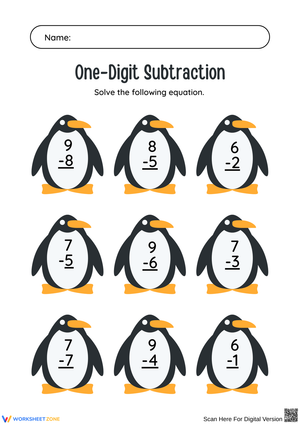
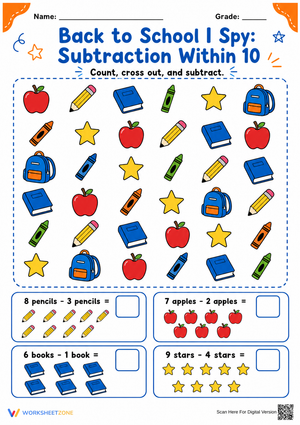
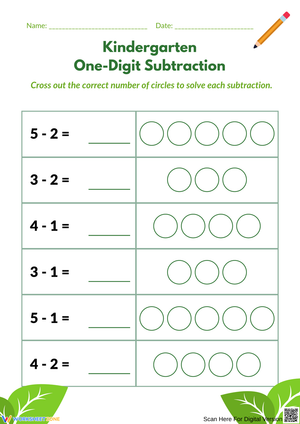
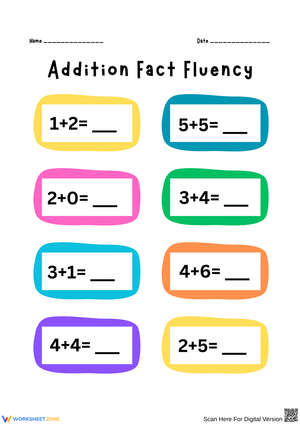
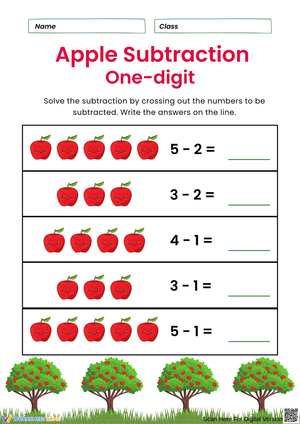
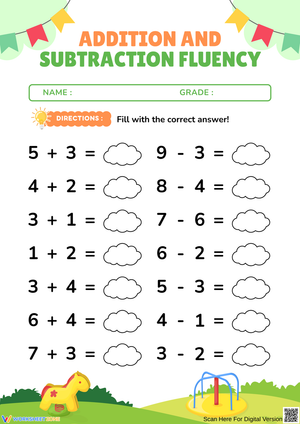
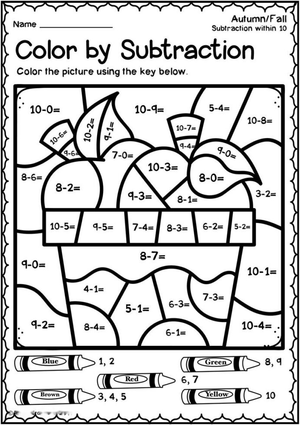
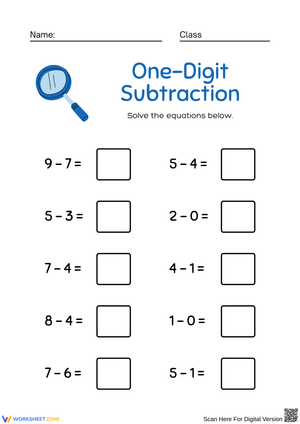
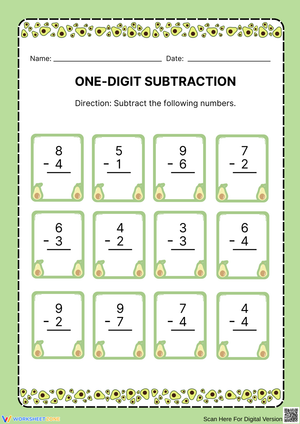
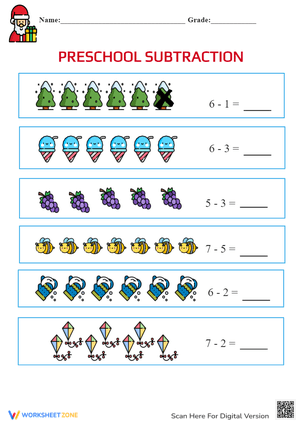
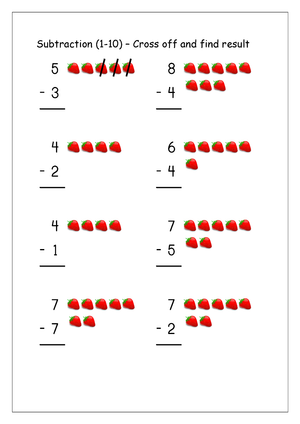
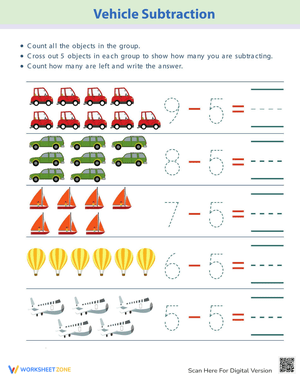
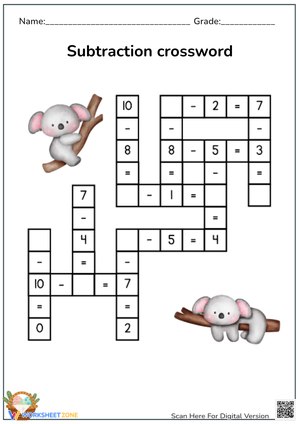
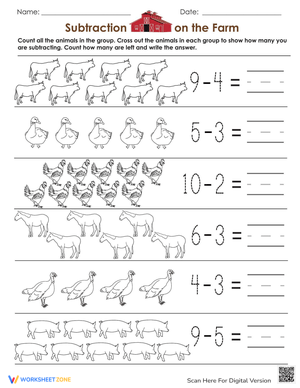
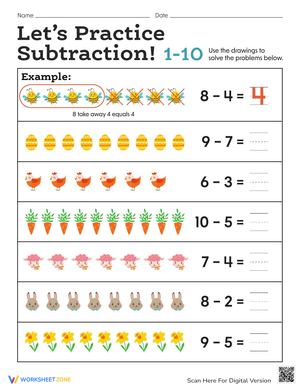
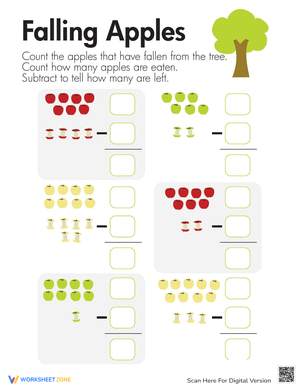
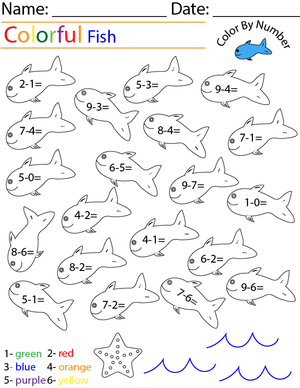
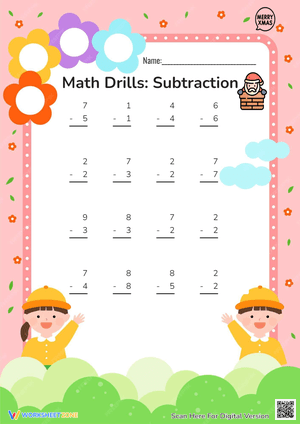
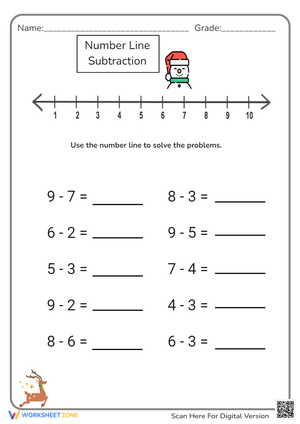
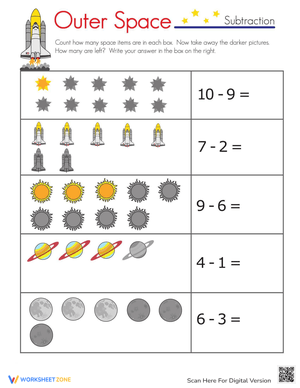
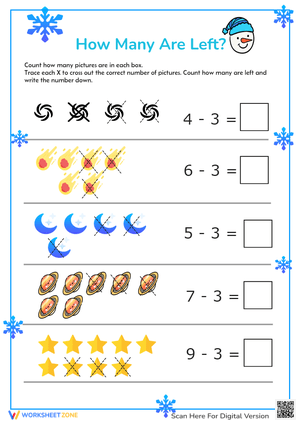
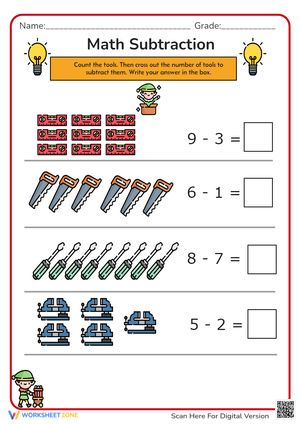
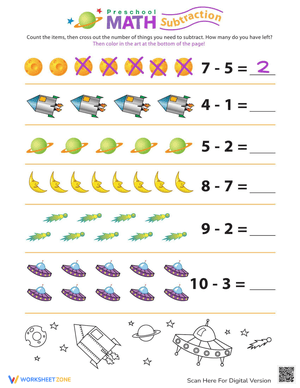
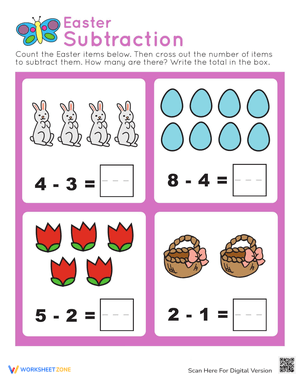
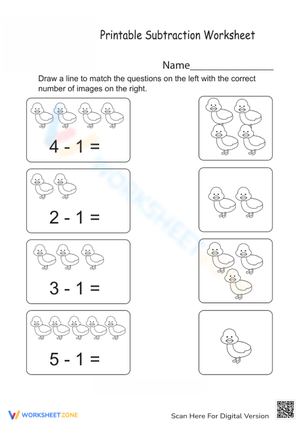
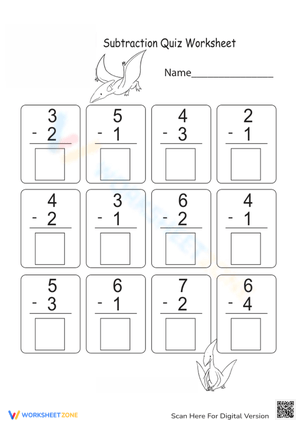
These kindergarten subtraction within 10 printable worksheets resources give teachers something concrete to hand a five-year-old who has counted forwards and is now being asked to think in reverse — which is a much harder cognitive shift than it sounds at that age. Each worksheet targets the "take from" and "take apart" models of subtraction using visual formats that keep the working memory demand low enough for early kindergarten learners to reason through a problem rather than just guess. Formats across the set include cross-out picture problems, ten-frame activities, number-line tasks, and bare equations, so teachers can match each worksheet to where students actually are.
The Specific Skills These Worksheets Target
Subtraction at the kindergarten level breaks into two distinct problem types that students need separate practice with. The "take from" model — start with a group, remove some, count what remains — is usually the one teachers introduce first because it maps directly onto physical experience. The "take apart" model, where students see a whole and identify its two hidden parts, comes later and is harder because the parts exist simultaneously rather than sequentially. Each worksheet in this set addresses one or both of these structures. Ten-frame problems, cross-out picture sequences, and number-line hops each place a different representational demand on the student, which is exactly the point.
Across the set, students practice:
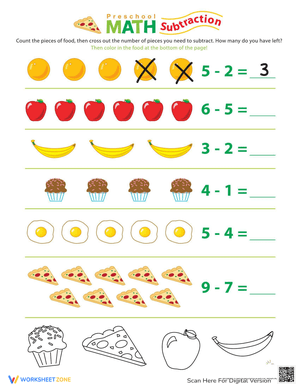
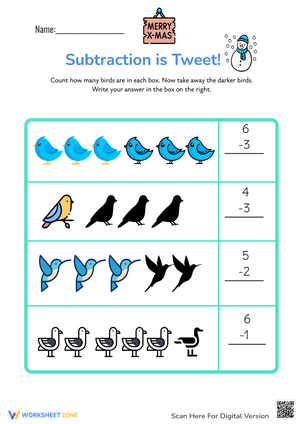
- Crossing out drawn objects and counting the remainder
- Filling in missing differences using ten-frame arrangements
- Moving backward along a number line from a given starting point
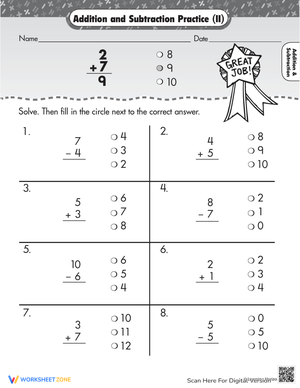
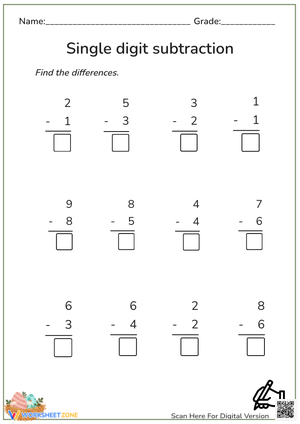
- Reading and writing bare equations with the minus and equals signs
- Matching a written equation to a picture showing the take-away action
- Solving simple picture-supported story problems and writing the corresponding equation
Errors Students Make That These Worksheets Help You Catch
The most consistent error on cross-out problems is that students cross out from the wrong end of the row. Given a row of seven fish and told to subtract three, a surprising number of kindergarteners mark the first three rather than any three — and then count all seven instead of the four remaining. They conflate "how many to cross out" with "which ones to mark first," which is a sequencing confusion rather than a number-sense failure. Watching where a student's pencil starts on a cross-out problem tells you immediately whether they understand the action or are just following a visual routine.
A second predictable error shows up on number-line tasks: students count the starting number as the first jump. When subtracting 2 from 6, they land on 5 instead of 4 because they count "six — one — two" rather than jumping away from 6. This off-by-one habit mirrors the identical error beginners make on addition number lines. Marking the starting dot before jumping — rather than counting the dot itself — is the correction that holds most reliably.
A third error specific to the equals sign: students at this age frequently read it as a prompt to write the answer, not as a symbol of balance. When an equation is presented as ___ = 8 – 3, many kindergarteners write 8, or leave the blank empty entirely, because the structure runs against their ingrained left-to-right reading habit. Worksheets that present equations in both orientations give teachers an immediate way to surface this misunderstanding before it calcifies.
Standard Alignment
CCSS.MATH.CONTENT.K.OA.A.1 asks kindergarteners to represent addition and subtraction using objects, fingers, mental images, drawings, sounds, verbal explanations, expressions, and equations. CCSS.MATH.CONTENT.K.OA.A.2 extends that to solving addition and subtraction word problems within 10, using objects or drawings alongside an equation. In practical classroom terms, K.OA.A.1 drives the whole-group introduction and small-group concrete work in the first weeks of a subtraction unit; K.OA.A.2 becomes the focus as students move into picture-supported story problems. The kindergarten subtraction within 10 printable worksheets resources in this set are sequenced to match that progression — visual, picture-heavy tasks first, with equations and less contextual support appearing toward the end of the sequence.
Building These Worksheets Into Your Lesson Plans
The most practical placement is as the independent follow-up to small-group concrete work. While the teacher pulls four or five students to a kidney table with counting bears or snap cubes, the rest of the class works through one worksheet on their own. That arrangement only holds if the worksheet format closely mirrors what students practiced concretely the lesson before. A ten-frame worksheet on the day after students used physical ten-frames keeps the transition smooth. Handing students a number-line worksheet when they have only ever worked with objects introduces a format shift they have to solve before they can even start the subtraction — and wastes the independent work time.
A second timing that works well is the eight or ten minutes at the close of math block before students rotate or transition. A single cross-out worksheet gives students a contained, completable task with a clear stopping point — students who finish early can write a "take-away story" in the margin; students who work more slowly aren't left mid-problem when the signal comes. For Monday warm-ups, one or two number-line problems from this set work as a quick retrieval prompt for whatever subtraction concept students left off with the Friday before. Low-stakes, short, concrete enough that early-morning foggy math thinking can still do something useful with it.
Adjusting These Worksheets for a Range of Learners
For students who are not yet tracking one-to-one correspondence reliably, reduce the problem scope rather than abandoning the worksheet format. Have them use a finger to physically touch each object as they count the remainder — the cross-out problems work well with that technique because the drawn objects are spaced far enough apart to point to individually. One further modification: give these students a sticky note to cover the portion of a problem they haven't reached yet, so only one cluster of objects is visible at a time. That reduces the visual noise without changing the math.
Students who are already fluent with single-step take-from problems can push toward the "take apart" orientation and toward generating their own equations from a picture rather than solving one already written. On any worksheet with a picture showing a subtraction action, those students can write the corresponding equation independently rather than filling in a provided frame — a small adjustment that raises the cognitive demand without requiring different materials. For the top of the range — students who have absorbed kindergarten subtraction within 10 printable worksheets practice thoroughly and are subtracting within 10 fluently — introduce the missing-subtrahend format: 7 – ___ = 4. That structure begins building algebraic reasoning at the kindergarten level without moving the numbers beyond 10.
Frequently Asked Questions
When is a kindergartener ready to move from picture support to bare equations?
When a student can look at a cross-out picture, describe what happened in their own words without prompting, and write the equation independently with no errors across three or four problems in a row — that's a reasonable threshold. The more reliable indicator is whether they can explain the logic out loud: "I started with five and took away two so now there are three." Correct answers on picture problems can happen through simply counting the remaining objects, which doesn't require subtraction understanding at all. Verbal explanation does.
How do I handle students who count crossed-out objects along with the rest?
This is one of the most common moves on cross-out worksheets: students mark the requested number and then count everything, including the marks, because crossing out feels like labeling rather than removing. Two adjustments help. First, have students cover the crossed-out objects with their hand before they begin counting. Second, ask them to double-mark each crossed-out item — tracing over the X with extra pressure — before counting the remaining objects. The physical emphasis shifts attention away from those items. If neither holds, return to removing actual objects from a group before coming back to the drawn format.
Should these worksheets count as a formal math grade in kindergarten?
In most kindergarten settings, no — and it's worth being clear about why. What a finished worksheet tells you is whether a student can operate within a specific visual format on a specific day. It does not tell you whether the student understands subtraction. Use the completed worksheets to inform small-group decisions and to flag who needs more concrete work with objects. They function best as formative checkpoints, not gradebook items.
Do the worksheets include written story problems, or only equations and pictures?
The picture-based worksheets function as visual story problems — the drawn scenario shows the take-from situation that the equation captures. For students ready for language-supported problems, the kindergarten subtraction within 10 printable worksheets set includes tasks where a short written sentence describes the situation and students draw or cross out objects to solve it. That intermediate step, between a pure equation and a full verbal word problem, is one the worksheets support explicitly through picture-to-equation matching tasks.













 Interactive Worksheet Maker
 Quiz Maker
 Word Search Maker
 Crossword Puzzle Maker
 Word Scramble Generator
 Sentence Scramble Generator
 Handwriting Worksheet Generator
 Name Tracing Generator
 Fill In The Blank Generator