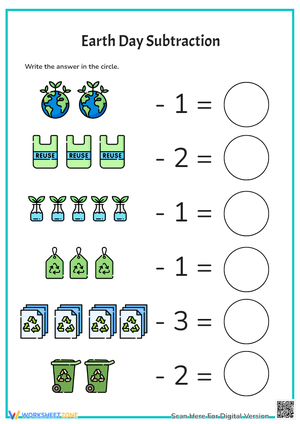
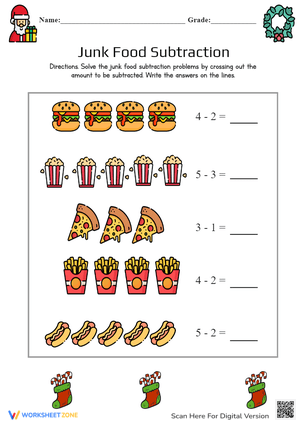
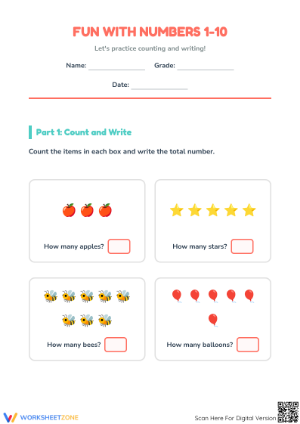
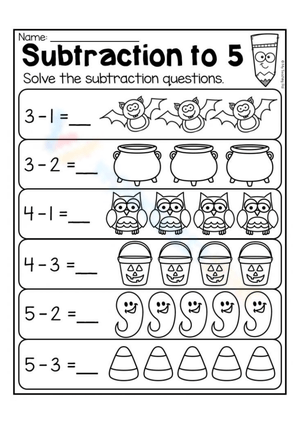
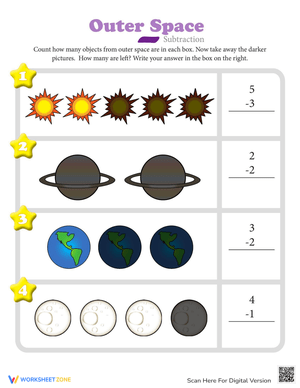
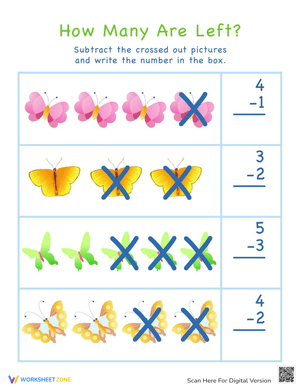
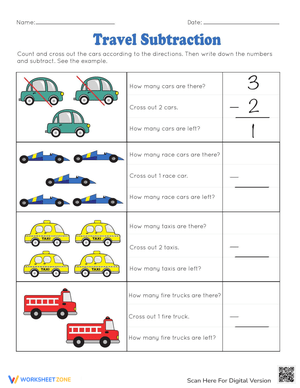
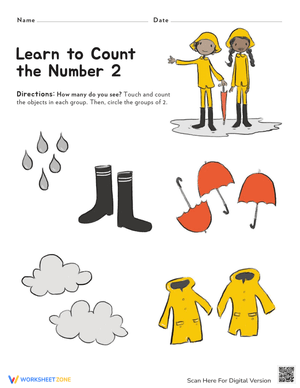
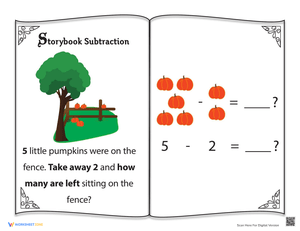
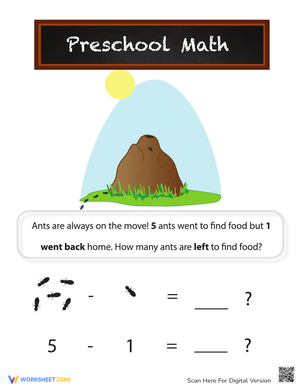
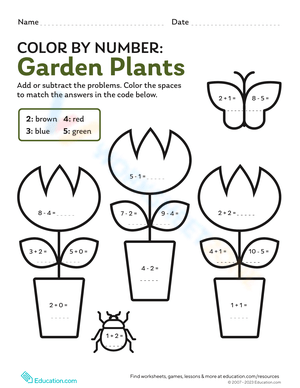
These kindergarten subtraction within 5 printable worksheets give teachers a focused set of tools for the moment when "taking away" stops being abstract and starts clicking. Each worksheet stays within the 0–5 range — not because subtraction within 5 is a simple skill, but because five-year-olds need a small, visualizable set of numbers before they can build any real automaticity. The resources use crossing out, five-frames, number lines, and brief story scenarios, giving students several different entry points into the same operation.
What Students Practice Across the Set
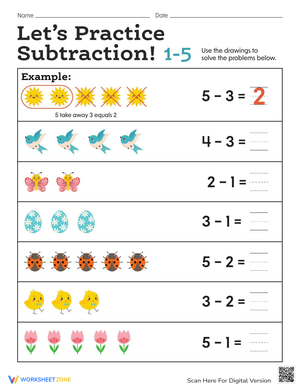
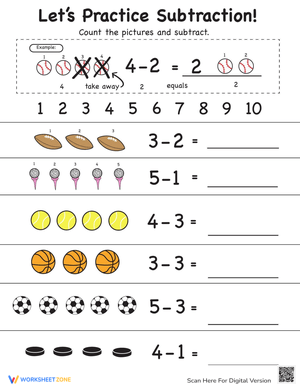
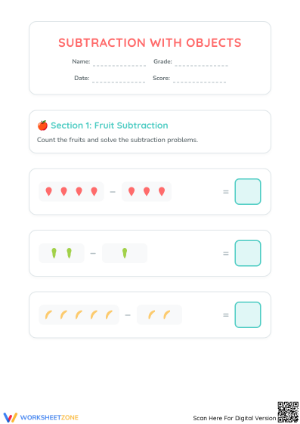
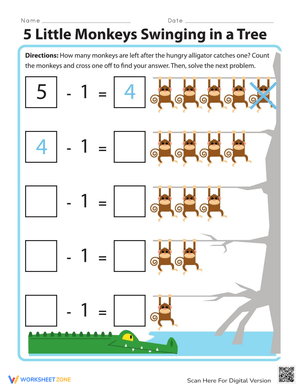
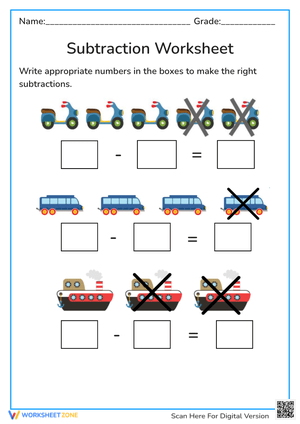
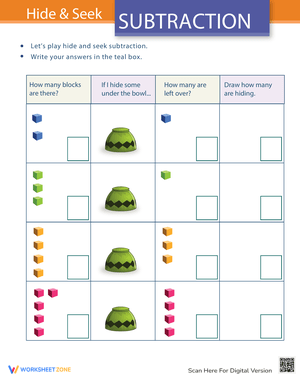
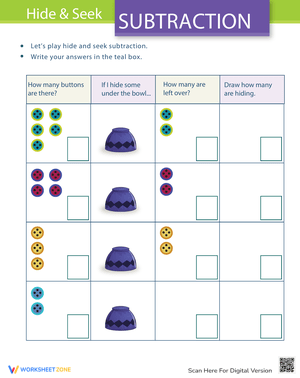
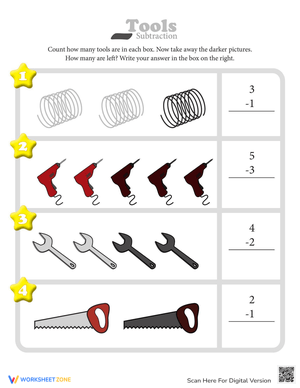
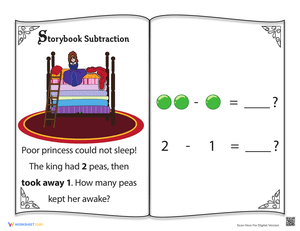
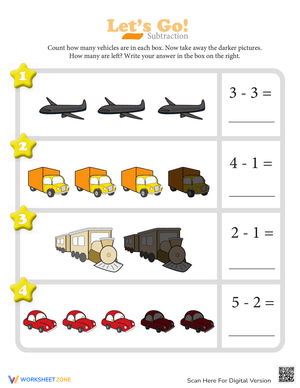
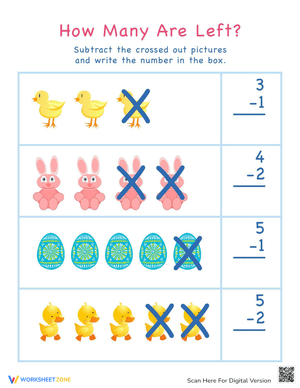
The worksheets cover several distinct formats rather than running the same drill repeatedly. Students cross out drawn objects — apples, stars, small animals — to find the difference, then write the equation that matches what they did. Other worksheets present a five-frame with some cells filled and ask students to determine what was removed; over time, reading a five-frame without counting each cell builds the visual number sense that makes subtraction faster and more intuitive. A third format pairs a short story sentence with a drawing space, so students construct the scene before they write the answer. Number line worksheets ask students to mark the starting number and hop backward, establishing a left-to-right sense of decreasing value that carries into first-grade work.
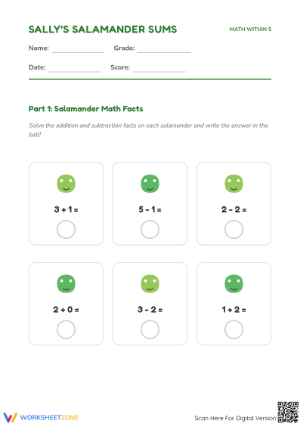
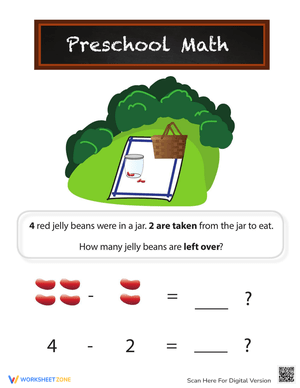
Each worksheet also requires writing the full equation — number, minus sign, number, equals sign, answer — rather than filling in a single blank at the end. That seems like a small decision, but children at this age often treat the equals sign as a "now write the answer" prompt rather than a symbol of balance. Writing the full equation every time is a quiet correction to that misconception before it calcifies.
The Subtraction Errors Five-Year-Olds Make Most Often
The most common error isn't a wrong number — it's the wrong operation. Children who have spent months putting sets together will look at a subtraction problem and count everything in the picture, including the crossed-out items. A worksheet showing 4 apples with 2 crossed out produces the answer "4" from students who haven't yet internalized that crossing out means those objects are gone. Catching this during small-group time tells you quickly who needs more work with physical manipulatives before moving to pictures on a page.
A second pattern shows up on number line worksheets: students counting up from the smaller number rather than back from the larger one. A child solving 5−3 will start at 3, count forward two more ("three, four, five — the answer is two"), and arrive at the right answer through an addition strategy. In the range below 5, this works. The problem surfaces when numbers grow, and the only reliable way to catch it now is to ask students to explain their thinking aloud while they work. If a student's finger is moving left to right on a subtraction number line, that's worth addressing before first grade.
Where These Worksheets Fit in the School Day
The most reliable placement is as a Monday warm-up after morning meeting — three to five minutes before the formal math block begins. Used this way, each worksheet functions as a low-stakes retrieval moment rather than new instruction, which produces more durable retention than treating these as introduction activities. By Thursday, pulling out the same format used on Monday gives students a direct look at their own improvement, which matters for five-year-old motivation in a concrete, immediate way.
Math centers are another natural home. Print on cardstock, laminate, and pair with counting bears or linking cubes stored in a small bin nearby. Students build the starting number with manipulatives, physically remove the subtracted amount, count what remains, and then record the answer. That sequence — build, remove, count, record — mirrors the concrete-to-abstract progression that makes subtraction meaningful rather than procedural. These kindergarten subtraction within 5 printable worksheets also work as the independent station task in a small-group rotation: while the teacher works with four or five students at a table, the rest of the class has a focused, manageable worksheet in front of them rather than an open-ended activity that drifts.
Standard Alignment
These worksheets address K.OA.A.1 and K.OA.A.5 from the Common Core State Standards for Mathematics. K.OA.A.1 calls for students to represent subtraction using objects, drawings, equations, and verbal descriptions — the exact sequence built into the formats here. K.OA.A.5 targets fluency: students should add and subtract within 5 by the end of kindergarten, meaning answers come without extended counting strategies. The set addresses both standards in order: picture-based worksheets build the conceptual grounding K.OA.A.1 requires, while repeated equation-format practice pushes toward the automaticity K.OA.A.5 expects. In most kindergarten pacing guides, subtraction within 5 lands in the second or third unit, after number recognition and addition within 5 are underway — meaning most teachers reach this material in the fall, well before winter break.
Meeting Different Starting Points Within the Set
Students who still need to count every object benefit most from the picture-crossing worksheets, paired with actual manipulatives placed directly on top of the printed images before any crossing out happens. Setting counting cubes on the drawn apples, then physically removing the right number, gives students a tactile rehearsal of the operation before pencil meets paper. That physical step is worth keeping even after a student seems comfortable with pictures alone — it keeps the concept grounded in real quantity rather than a paper procedure.
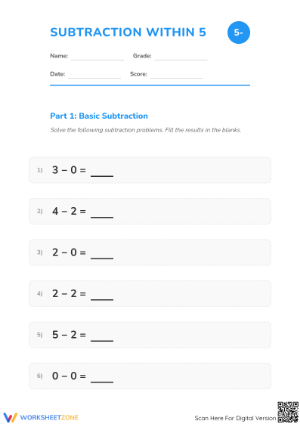
For students who have the concept but need a push toward fluency, a two-minute timing on the equation-format worksheets serves a diagnostic purpose as much as a practice one. The goal isn't speed — it's noticing whether any facts are starting to feel automatic rather than calculated. When a student looks at 3−1 and says "two" without any counting behavior, they've crossed a meaningful threshold. For students at the earliest stage, working through these kindergarten subtraction within 5 printable worksheets with quantities limited to 3 and below first — before opening up to the full range — keeps the numbers small enough to process without overload.
Frequently Asked Questions
Should students use manipulatives every time, or is the goal to phase them out?
At the start of a subtraction unit, manipulatives belong in the process — on the desk, available for every worksheet. The shift away from physical objects should come from the student, not a set timeline. When a child reaches for a counter and then solves the problem before actually using it, that's the signal that abstraction is taking hold. Pulling manipulatives away because a student is getting right answers often masks how fragile the understanding still is.
How do these worksheets work alongside a digital math program?
These kindergarten subtraction within 5 printable worksheets complement digital programs rather than compete with them. Digital tools give immediate feedback and adjust difficulty automatically. Printed worksheets give teachers something to examine — actual written work, visible erasures, numbers formed with uncertain pencil pressure — that reveals how a student is thinking in ways a screen score does not. Using both means you have information from two different modes, which is more useful than either alone when you're planning the next lesson.
What does real fluency within 5 look like in a kindergartener?
A fluent kindergartener looks at 4−2 and says "two" without visibly counting. No finger movement, no lip-counting, no pause — the answer arrives quickly and with confidence. That level of automaticity typically develops in the final third of kindergarten for most students, built through short, repeated practice over weeks rather than a concentrated unit. Five minutes daily with these resources produces more lasting results than a single longer math block each week.













 Interactive Worksheet Maker
 Quiz Maker
 Word Search Maker
 Crossword Puzzle Maker
 Word Scramble Generator
 Sentence Scramble Generator
 Handwriting Worksheet Generator
 Name Tracing Generator
 Fill In The Blank Generator