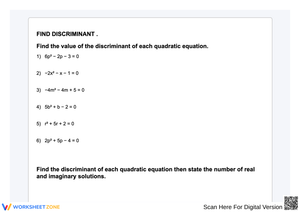
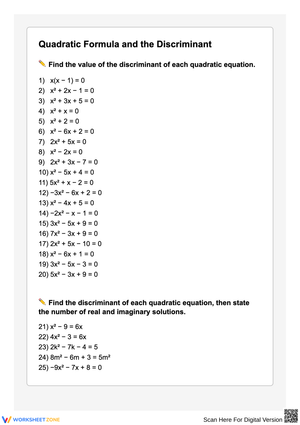
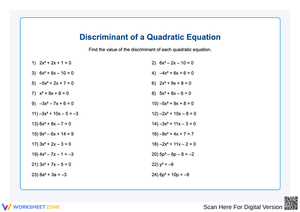
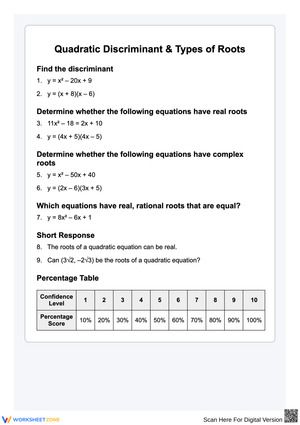
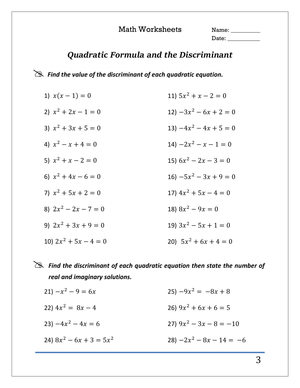
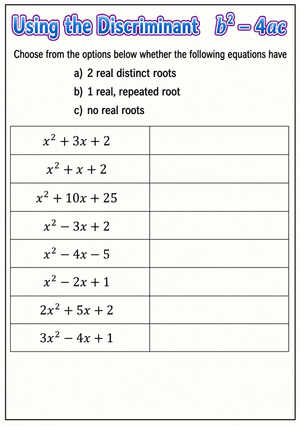
These discriminant printable worksheets for 9th grade give algebra teachers a targeted way to address one of the most conceptually dense steps inside the quadratic formula — the expression b² - 4ac — without requiring students to execute the full formula at once. Each worksheet isolates that single calculation and asks students to interpret the result: two distinct real roots, one repeated root, or no real solutions. That deliberate narrowing of scope is what makes the set valuable at the start of a quadratics unit, before the full formula arrives.
What Students Practice Across the Set
The worksheets move through a clear sequence of sub-skills. Early problems present equations already in standard form (ax² + bx + c = 0), so students can concentrate on reading off a, b, and c correctly — which is harder than it sounds when a coefficient is negative or terms appear out of the usual order. From there, students practice the arithmetic of b² - 4ac, which requires squaring signed numbers and then subtracting a product that may itself be negative. Later problems introduce equations not yet in standard form, asking students to rearrange before they identify any coefficients.
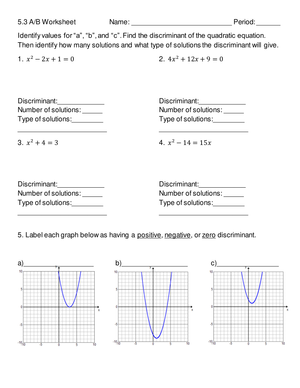
A number of worksheets also include a classification or matching component: students calculate the discriminant and then mark whether the corresponding parabola has two x-intercepts, one x-intercept at the vertex, or no x-intercepts at all. The three outcomes each worksheet builds toward are:
- Positive discriminant (greater than zero): two distinct real solutions; the parabola crosses the x-axis at two separate points.
- Discriminant equal to zero: exactly one real solution, a repeated root; the vertex sits directly on the x-axis.
- Negative discriminant (less than zero): no real solutions; the parabola sits entirely above or below the x-axis.
That algebraic-to-graphical connection is what makes the classification work more than routine calculation practice — students build a mental model of quadratic behavior, not just a rule to memorize.
Mistakes Students Make That These Worksheets Surface
Two errors appear in student work across every unit on the discriminant, and they are predictable enough to plan around. The first is a calculator parentheses problem: when b is negative — say, b equals -3 — students type -3² instead of (-3)², which the calculator reads as negative nine rather than positive nine. That one keystroke habit flips the discriminant and sends students to the wrong conclusion about their roots. Requiring students to write empty parentheses before substituting — literally writing ( )² - 4( )( ) on the paper first, then filling in values — catches this before it becomes a pattern. These discriminant printable worksheets for 9th grade build that notation habit by including formatted substitution spaces in early problems and removing them in later ones, so students internalize the structure rather than just following a printed prompt.
The second common error surfaces when a quadratic is missing its linear term. Given 3x² - 12 = 0, a surprising number of students assign -12 to b rather than c, because they are reading by position in the sequence rather than by the variable attached to each term. Worksheets that deliberately include equations with a missing middle term force students to slow down and match terms to their positions in standard form. Catching this misassignment in worksheet practice is far preferable to encountering it for the first time on a unit exam.
Fitting These Worksheets Into the Lesson Week
A five-problem discriminant worksheet works well as a Monday warm-up after students have seen the concept for the first time the previous Friday. Students come in, pick up the paper, and have something concrete to do during the first eight minutes while attendance runs. The low problem count keeps it from feeling like a full assignment, but the calculations are substantive enough to re-engage the skill after a weekend break — which matters more here than on topics students find intuitive, because the sign rules around b² - 4ac slip quickly if they go unvisited.
For a longer block, a sorting version of the worksheet — where students calculate and then categorize a set of equations by root type — generates productive mathematical conversation. Students argue over sign errors, check each other's arithmetic, and end up using the precise vocabulary the topic demands. Groups of three work better than pairs here; with three students, there is usually at least one who catches the negative-b parentheses error before it spreads through the group's work.
As a formative check, a brief exit ticket pulled from the set tells you exactly where the next lesson needs to go. Students who correctly classify equations with a positive discriminant but consistently miss the zero and negative cases need a focused ten-minute re-teach on those two outcomes — not a full re-lesson on the whole concept.
Adjusting the Worksheets for a Range of Learners
For students whose signed-number arithmetic is shaky, start with equations where a, b, and c are all positive integers. The three-way classification still holds; the arithmetic is simply cleaner, and students can encounter all three root-type outcomes without fighting negative coefficient errors at the same time. Once the classification logic is solid, introduce negative values in stages: negative c first, then negative b, then equations that require rearrangement before coefficient identification can even begin.
Students who have already internalized the three root cases benefit from extension problems that connect discriminant results to complex number notation. If b² - 4ac equals -16, what exactly are the two complex roots? That question sends them back into the full quadratic formula with a specific purpose, rather than repeating calculations they already handle correctly. The discriminant printable worksheets for 9th grade that include an extension column for follow-up questions give advanced students a genuine reason to stay engaged rather than waiting for peers to finish the core problems.
Standard Alignment
These worksheets directly address CCSS HSA-REI.B.4, which requires students to solve quadratic equations using multiple methods — including the quadratic formula — and to recognize when the formula yields complex solutions. Calculating b² - 4ac and interpreting whether the result is positive, zero, or negative is precisely the mechanism that standard asks students to use for that determination. In most Algebra 1 pacing guides, this standard lands in the fourth quarter, after factoring and before any formal introduction to complex numbers. The discriminant printable worksheets for 9th grade that align to this standard teach students to run a pre-check before committing to the full formula calculation — a habit that reduces errors and that Algebra 2 teachers consistently report students arriving without.
Frequently Asked Questions
What is the difference between a zero discriminant and a negative discriminant?
A zero discriminant — b² - 4ac equals zero — means the quadratic has exactly one real solution, a repeated root. The parabola's vertex sits precisely on the x-axis, touching but not crossing it. A negative discriminant — b² - 4ac is less than zero — means there are no real solutions; the roots are complex, and the parabola never reaches the x-axis. The two cases are easy to conflate because both involve fewer than two real roots, but they are meaningfully different: a repeated root is a real number students can calculate, while complex roots live outside the real number system entirely.
Does the equation have to be in standard form before I calculate the discriminant?
Yes. The a, b, and c values in b² - 4ac are defined by standard form (ax² + bx + c = 0). If an equation is written as x² = 5x - 4, students must first rewrite it as x² - 5x + 4 = 0 before identifying any coefficients. Applying the formula to an equation not yet set equal to zero produces incorrect values and wrong root-type conclusions. This rearrangement step is one of the most commonly skipped steps in student work — students see recognizable numbers and begin substituting before considering what form the equation needs to be in.
How does the discriminant predict the number of x-intercepts on a graph?
The discriminant value maps directly to x-intercept count: a positive value means two x-intercepts, a value of zero means the vertex touches the axis at exactly one point, and a negative value means the parabola clears the x-axis entirely with zero intercepts. Students who build the three-case table in their notes can sketch the general shape of a quadratic's graph from a discriminant calculation alone, without plotting a single coordinate.
Why calculate the discriminant before applying the full quadratic formula?
It functions as a pre-check that saves time and prevents unnecessary work. If the result is negative, there are no real solutions — useful information in an applied problem, where it may signal a setup error or indicate the problem involves complex roots. If the result is a perfect square greater than zero, the roots are rational, and factoring will likely be faster than the full formula. Breaking the process into two stages — discriminant first, full calculation second — gives students a checkpoint and reduces arithmetic errors in the longer expression.














 Interactive Worksheet Maker
 Quiz Maker
 Word Search Maker
 Crossword Puzzle Maker
 Word Scramble Generator
 Sentence Scramble Generator
 Handwriting Worksheet Generator
 Name Tracing Generator
 Fill In The Blank Generator




 BACK TOSCHOOL