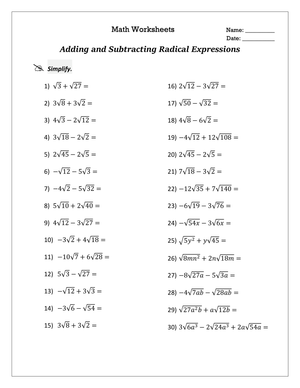
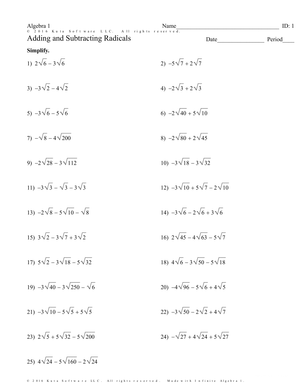
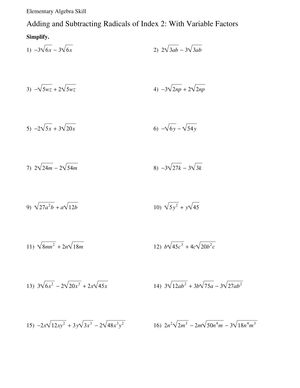
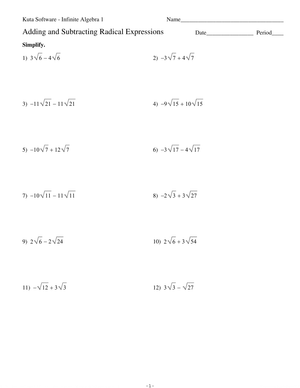
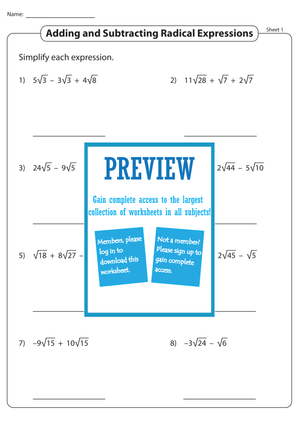
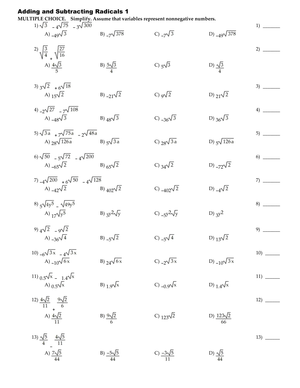
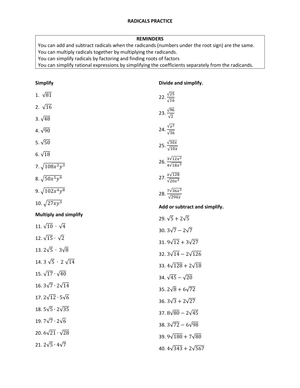
These 9th grade adding and subtracting radicals printable worksheets resources give algebra teachers a sequence of standalone practice materials that moves students from recognizing like radicals through simplifying and combining multi-step expressions — all without assuming they arrive already fluent in perfect square factoring. Each worksheet targets a specific layer of the skill, so teachers can assign them selectively based on where students are in the unit rather than working through the set in fixed order.
What Students Practice Across the Set
The core task — adding or subtracting radical expressions — rests on the same logic as combining like terms in algebra, but students don't always arrive at that connection on their own. The worksheets address three distinct skill layers:
- Identifying whether two radical expressions share the same radicand and index before attempting any operation
- Simplifying radicals by factoring out perfect square factors — a prerequisite step that determines whether unlike-looking radicals can actually be combined
- Performing coefficient arithmetic while leaving the radical part unchanged
The middle layer carries the most instructional weight. Students who handle 5√3 + 2√3 without hesitation still stumble when asked to add √50 + √8 because the like-radical structure isn't visible at first glance. Several worksheets in the set use a two-column format: students simplify each radical on the left side, then carry those simplified forms into the addition or subtraction on the right. That physical separation reduces working-memory load and keeps the error trail visible when students go back to check their work.
Student Errors Worth Anticipating Before You Assign These Worksheets
The most predictable mistake: students write √3 + √5 = √8. This isn't random. It mirrors the multiplication property they encountered just before this unit (√3 · √5 = √15), and students misfire the same "operate on the numbers inside" instinct onto addition. A single well-chosen counterexample breaks this faster than repeated warnings — √9 + √16 = 3 + 4 = 7, and √25 = 5, not 7. Walking through that arithmetic out loud once tends to land in a way that abstract reminders don't.
The second error pattern shows up mid-simplification. A student working on √72 will often reach 2√18 and stop, not recognizing that √18 reduces further to 3√2, making the final simplified form 6√2. Students who stall here usually haven't internalized perfect squares past 9. A reference list through 144 — printed at the top of the worksheet for students who need it — addresses the recall bottleneck without removing the conceptual task.
There's also a quieter mistake that surfaces when one term carries no visible coefficient. In an expression like √7 + 3√7, some students write 3√7 as the answer because they read the first term as having "nothing" to add. A brief reminder that √7 is shorthand for 1√7 usually resolves this, but it's worth flagging before the first worksheet rather than after the first round of incorrect answers comes back.
How These Worksheets Fit Into Your Lesson Planning
Most teachers introduce this topic immediately after a unit on simplifying radicals, and the like-radicals worksheets from this set serve as the bridge. The first two or three worksheets work well as daily warm-ups during that transition week — four to five problems at the start of class take roughly eight minutes and surface exactly which students didn't consolidate the simplification skill well enough to move forward. That diagnostic information shapes the day's instruction before it has cost thirty minutes of class time.
For independent practice during a block period, one worksheet with mixed problem types — some already in like-radical form, others requiring simplification first — gives enough material for 15 to 20 minutes without becoming repetitive. Teachers who run station rotations can assign two different worksheets across groups, which keeps the activity moving without requiring a full new set of materials. The 9th grade adding and subtracting radicals printable worksheets set is also well-suited to end-of-unit retrieval practice: assigning one worksheet a full week after the initial lesson, rather than the day after instruction, produces more durable retention than massed practice does.
Standard Alignment
These worksheets address HSN.RN.A.2, which asks students to rewrite expressions involving radicals and rational exponents using properties of exponents. In classroom terms, that standard appears in two distinct instructional moments: first when students learn to simplify radicals using the product property, and again when they apply that simplification as the entry step for combining radical expressions. The worksheets sit at both of those points, making the set usable at either moment in an HSN.RN.A.2 instructional sequence rather than only at the end.
Adjusting the Worksheets for a Range of Learners
Students who are still shaky on perfect square factoring benefit from working through the earlier worksheets alongside a printed reference list of perfect squares from 1 to 144. Pulling that list away once a student demonstrates consistent recall is a simple way to raise the demand without changing anything else about the task — no modified version needed.
For students who are ready to push beyond whole-number radicands, problems involving variable expressions under the radical (such as √(12x²)) extend the same combining-like-terms logic without introducing an entirely new operation. A few of those items added alongside a standard worksheet give early finishers something substantive to work on rather than waiting. Students who consistently set up multi-step problems correctly but lose their work midway through often do better when they fold the paper to cover the right column during the simplification step, then unfold it to complete the addition — a simple physical constraint that enforces one step at a time without requiring a different worksheet entirely.
Frequently Asked Questions
Do students need to know rational exponents before working through these worksheets?
Not for the core adding and subtracting tasks. The skill depends on recognizing perfect square factors and understanding the product property of radicals — not on converting between radical and exponential notation. If a class has already covered rational exponents, noting that √x = x^(1/2) deepens the underlying reasoning, but it isn't a prerequisite for successfully completing any worksheet in the set.
Are these worksheets better assigned in class or as homework?
The multi-step worksheets — where students must simplify before combining — are better handled in class, where errors in the simplification step can be caught before they become entrenched. The like-radicals worksheets travel home well since students can verify their coefficient arithmetic by working backward. For the 9th grade adding and subtracting radicals printable worksheets resources that involve the most steps, having students work in pairs during class tends to produce sharper error correction than independent homework does, because students catch each other's incomplete simplifications in real time.
How many problems does each worksheet include?
The count varies by type. Like-terms and identification worksheets typically include 15 to 20 problems because each item is relatively quick to execute. Multi-step simplification worksheets run shorter — usually 10 to 14 problems — because each problem carries more cognitive weight. The set is built so that any single worksheet fills a focused warm-up or a 15-minute practice block without overrunning available time.
Can these worksheets support targeted review rather than whole-class reteaching?
That's exactly where the standalone format earns its keep. Teachers who use formative checks during the unit can identify the specific layer — identifying like radicals, simplifying correctly, or managing the full multi-step process — where a student broke down, then assign the one worksheet that addresses that layer. The 9th grade adding and subtracting radicals printable worksheets format makes that kind of precision straightforward; teachers aren't sorting through a full packet to find the right problems, because each worksheet already isolates a specific skill.














 Interactive Worksheet Maker
 Quiz Maker
 Word Search Maker
 Crossword Puzzle Maker
 Word Scramble Generator
 Sentence Scramble Generator
 Handwriting Worksheet Generator
 Name Tracing Generator
 Fill In The Blank Generator




 BACK TOSCHOOL