


























Views
Downloads

Discriminant Worksheet | Essential Algebra Practice
Paste this activity's link or code into your existing LMS (Google Classroom, Canvas, Teams, Schoology, Moodle, etc.).
Students can open and work on the activity right away, with no student login required.
You'll still be able to track student progress and results from your teacher account.
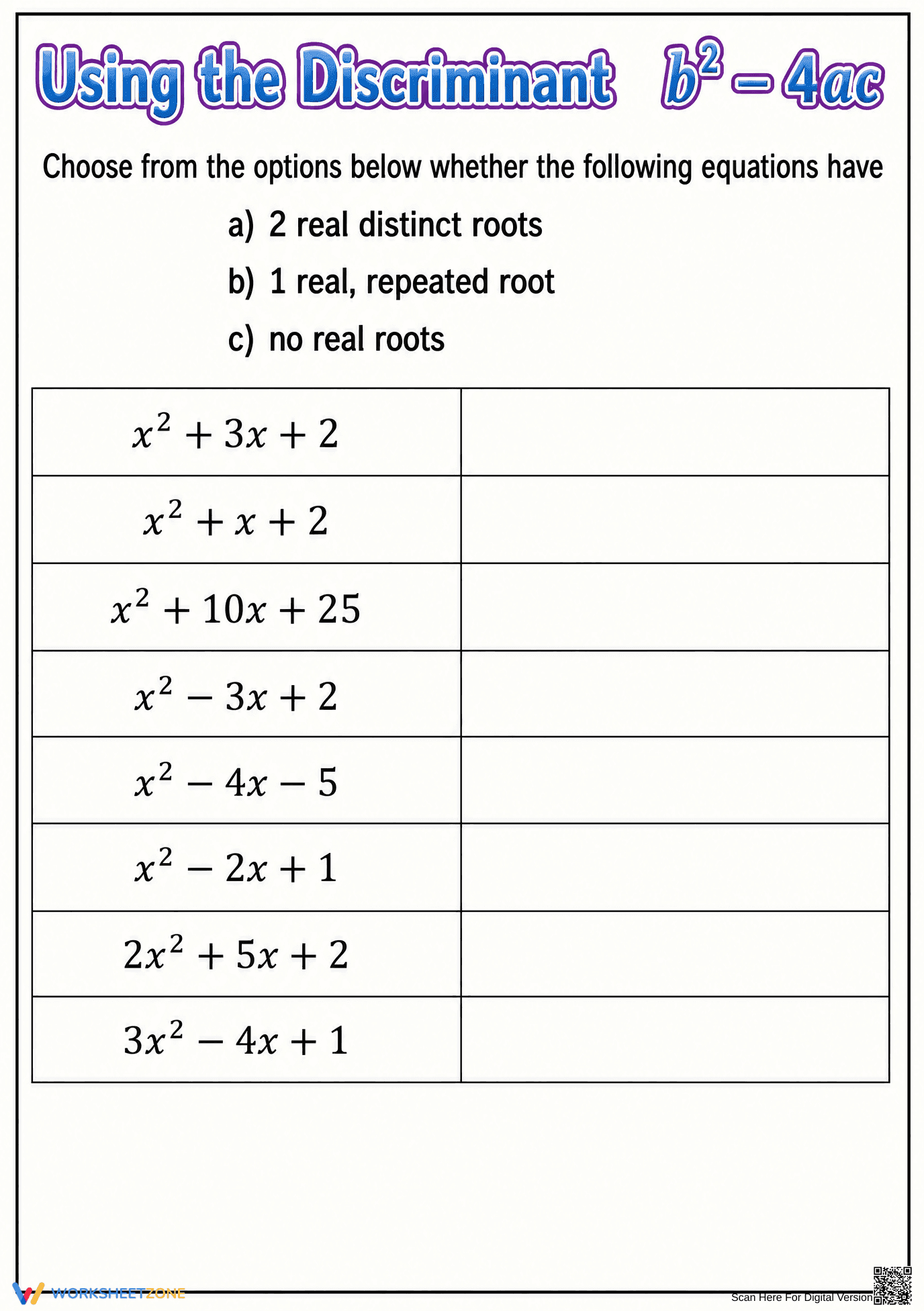
This Algebra worksheet focuses on calculating the discriminant to identify the nature of roots for quadratic equations. Students analyze eight distinct equations to determine if they possess two real distinct roots, one repeated root, or no real roots. It provides immediate application of the discriminant formula to build algebraic fluency and conceptual understanding.
At a Glance
- Grade: 9-12 · Subject: Algebra
- Standard:
HSA.REI.B.4.B— Use the discriminant to determine the number and nature of roots- Skill Focus: Quadratic Discriminant Analysis
- Format: 1 page · 8 problems · Answer key included · PDF
- Best For: Independent practice and formative assessment
- Time: 15–20 minutes
The worksheet features a clean, tabular layout containing 8 quadratic equations ranging from simple monic trinomials to equations with coefficients greater than one. It includes a clear reference to the discriminant formula at the top and provides three specific classification options for students to select. A full answer key is provided for rapid grading and student self-correction.
- Guided practice: The worksheet starts with the formula b² - 4ac clearly displayed at the top of the page to anchor student work.
- Supported practice: Students work through 8 structured table rows, applying the formula to equations like x² + 3x + 2 with clear classification options.
- Independent practice: The final problems require students to handle larger coefficients and negative values without additional scaffolding or hints.
This sequence follows a gradual-release model to ensure students move from formula recognition to independent root classification with high accuracy.
Standards Alignment
This resource is aligned with `CCSS.MATH.CONTENT.HSA.REI.B.4.B`, which requires students to solve quadratic equations and use the discriminant to determine the number and nature of roots. It also supports HSA.SSE.B.3 by requiring students to choose and produce equivalent forms of an expression. Both standard codes can be copied directly into lesson plans, IEP goals, or district curriculum mapping tools.
How to Use It
Use this worksheet as a check for understanding immediately following a direct instruction lesson on the quadratic formula. It is also effective as a warm-up activity for the following day to reinforce the relationship between the discriminant's value and the graph's x-intercepts. Teachers can observe students as they calculate the b² term to identify common errors with negative numbers. Expected completion time is 15 to 20 minutes.
Who It's For
This practice sheet is designed for high school Algebra 1 or Algebra 2 students. It is particularly helpful for learners who need repetitive practice to internalize the three possible outcomes of the discriminant. Pair this with a graphing calculator activity to visualize how the calculated roots correspond to the parabola's position on the coordinate plane.
According to the RAND AIRS 2024 report, targeted practice on discrete algebraic sub-skills like the discriminant significantly improves student performance on high-stakes summative assessments. This worksheet aligns with the CCSS.MATH.CONTENT.HSA.REI.B.4.B standard, focusing on the plain-English skill of using the discriminant to determine the number and nature of roots in quadratic equations. By isolating the calculation of b² - 4ac from the full quadratic formula, students can develop a deeper conceptual understanding of equation behavior before tackling complex multi-step problems. Research from Fisher & Frey (2014) suggests that this type of focused, scaffolded practice is essential for moving students toward mathematical mastery. The inclusion of 8 varied problems ensures that students encounter positive, negative, and zero results, providing a comprehensive review of all possible root scenarios in a single, print-ready page.


