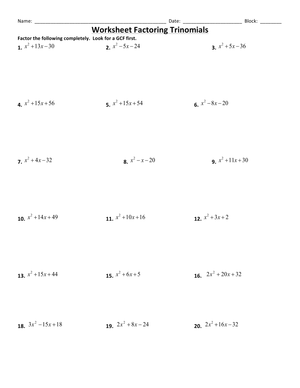
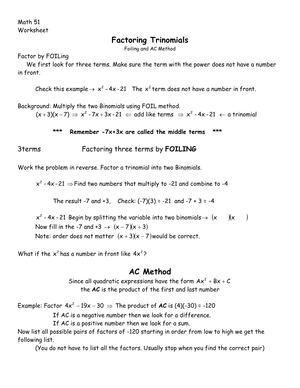
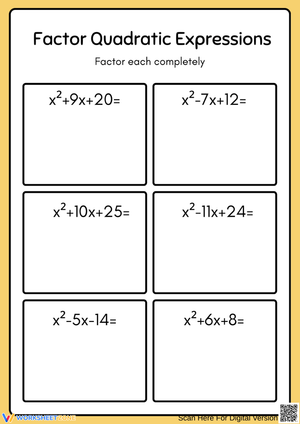
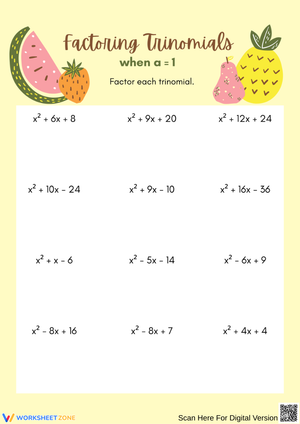
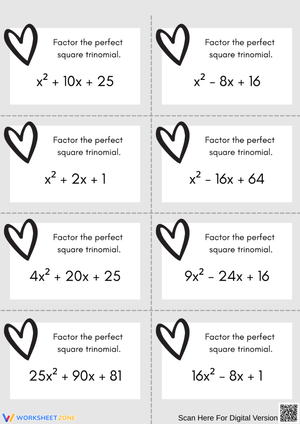
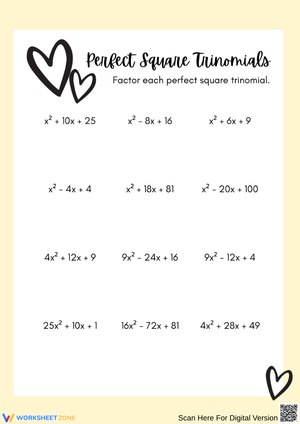
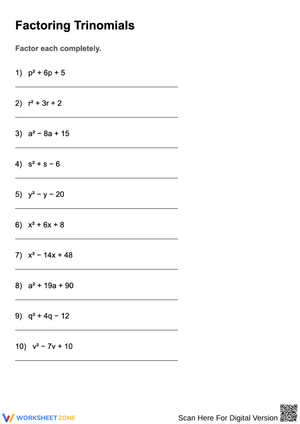
Factoring trinomials printable worksheets for 9th grade give Algebra 1 teachers a dependable way to move students through one of the trickiest procedural skills of the year — without building materials from scratch for each stage of the progression. The set addresses two distinct problem types: monic trinomials where the leading coefficient equals 1, and those where it is greater than 1, which call for a fundamentally different process.
The Skills These Worksheets Target
Practice opens with trinomials in the form x² + bx + c, where students look for two integers that multiply to the constant term and add to the middle coefficient. That product-sum relationship is the conceptual foundation of the entire unit, and the early worksheets keep it visible before any additional complexity enters. Problems then shift to mixed-sign cases — positive and negative constants — where factor pair selection becomes less automatic and sign tracking matters more. A well-built set of factoring trinomials printable worksheets for 9th grade covers both the monic and non-monic structures explicitly, treating the second not as bonus material but as the logical destination of the progression. Later worksheets take up ax² + bx + c when a is greater than 1, which requires factoring by grouping: splitting the middle term, forming a four-term expression, and pulling out common factors in two stages. Each worksheet includes space for students to expand the resulting binomials back out and verify the answer, which builds the checking habit while the work is still new.
The final worksheets in the set are mixed review. Students encounter various trinomial structures without any label identifying which method applies. Making that call correctly — deciding whether to factor directly or split the middle term first — is where readiness for solving quadratic equations actually shows.
Frequent Student Errors Worth Watching For in This Unit
Sign errors are the most predictable problem. A student will correctly recognize that they need factor pairs of negative twelve, then write (x + 4)(x + 3) for x² - x - 12 — the numbers are right, but both signs are positive, producing a middle term of positive seven instead of negative one. That error is extremely common in the first week, and it appears consistently in written work in a way that mental math practice would not expose.
A second pattern: students who lock onto the first factor pair they find without checking the sum. On x² + 2x - 24, a student might try 6 and 4 immediately because those numbers multiply to 24, write the binomials, and submit before verifying the middle term. Worksheets that include several problems built from the same constant but with different middle coefficients — three or four trinomials all involving 24 — slow that habit down by making the comparison unavoidable.
The shift to non-monic trinomials introduces a third error: students apply the direct factor-pair method to 2x² + 7x + 3 the same way they would to a monic trinomial, produce wrong binomials, and have no mechanism for catching the mistake. A mixed worksheet that places monic and non-monic problems in the same column, without labeling which is which, surfaces that method-selection gap quickly.
How to Work These Worksheets Into Your Lesson Planning
Most Algebra 1 teachers spend two weeks on factoring between introducing quadratic expressions and solving equations by factoring. The first week covers monic trinomials — positive constants first, then mixed signs. The second handles non-monic trinomials and mixed review. The worksheets in the set map onto that calendar without requiring reorganization.
- Bell ringers: four or five problems from an introductory worksheet give students a low-stakes warm-up that also reads as a formative checkpoint.
- Station work: sort by structure type — monic positive at one station, mixed-sign monic at a second, grouping problems at a third — so each rotation has a clear mathematical focus.
- Pre-quiz review: a focused sign-pattern worksheet in the final ten minutes before a test refreshes the procedure more efficiently than a full review worksheet would.
- Reteach groups: pull a targeted worksheet and work through two or three problems together before releasing students to try the rest independently.
- Homework: a short monic or mixed-sign worksheet sent home with the answer key included supports self-checking without requiring teacher follow-up for every item.
Substitute days are another reliable use case. Factoring trinomials printable worksheets for 9th grade require no setup, no device access, and no explanation beyond what is already printed on each worksheet — which makes them a clean option for any sub day that falls during the unit.
Standard Alignment
The primary standard addressed is CCSS.MATH.CONTENT.HSA-SSE.A.2: "Use the structure of an expression to identify ways to rewrite it." Factoring a trinomial is exactly that — recognizing that x² + 5x + 6 can be rewritten as (x + 2)(x + 3) by reading the polynomial's internal structure rather than applying a formula. In classroom terms, this standard lands at the beginning of the quadratics unit, directly before students use factored form to solve quadratic equations under CCSS.MATH.CONTENT.HSA-REI.B.4b. The fluency these worksheets build is what makes that transition workable rather than halting.
Adapting the Set for a Range of Learners
For students still uncertain with integer operations — especially multiplying and adding negatives — the monic positive-only worksheet is the right starting point, and spending an extra class period there before introducing mixed signs prevents sign errors from becoming entrenched. Presenting those eight to ten problems on their own, without the rest of the set in view, reduces the amount of new information students hold at once, which matters when the product-sum relationship itself is still unfamiliar.
Students who move through monic trinomials quickly are ready for the grouping worksheets earlier than the rest of the class. Those worksheets work well as independent extension during the second week — those students work through splitting the middle term and factoring four-term expressions while the rest of the class consolidates mixed-sign monic practice. Mixed review worksheets bring both groups to the same task during the final two days of the unit, since every student works through the same decision-making problem regardless of where they entered the progression.
Frequently Asked Questions
Which worksheet should I assign first if my students have never factored trinomials before?
Start with a monic worksheet where all constants are positive — problems like x² + 7x + 12. Students only need to find two positive integers satisfying the product-sum condition, so sign logic stays out of the picture until the basic search routine is solid. Introduce negative constants once that pattern runs automatically.
How many problems per worksheet is realistic for one class session?
Ten to fifteen is a practical range when accuracy matters more than volume. Longer sets push students to rush through factor pairs without verifying each result. If a worksheet runs to twenty or more items, split it across two sittings or pull a targeted subset for a specific error pattern rather than assigning the entire set at once.
Do students need prior experience with factoring by grouping before using the non-monic worksheets?
It helps, but it is not a hard requirement. The grouping worksheets show the split-the-middle-term step explicitly, so students who understand pulling a common factor from two terms can follow the process even when grouping itself is new. That said, practicing factoring by grouping with a four-term polynomial first — before moving to trinomials where a is greater than 1 — gives students a cleaner entry point into the method.
Can these worksheets be reused across multiple class sections or in future years?
Factoring trinomials printable worksheets for 9th grade work exactly the way any printable resource does — store the original file, print as many copies as needed, and pull individual worksheets for reteach groups, absent students, or review days in later semesters. Answer keys remain useful indefinitely.














 Interactive Worksheet Maker
 Quiz Maker
 Word Search Maker
 Crossword Puzzle Maker
 Word Scramble Generator
 Sentence Scramble Generator
 Handwriting Worksheet Generator
 Name Tracing Generator
 Fill In The Blank Generator




 BACK TOSCHOOL