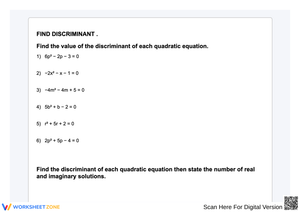
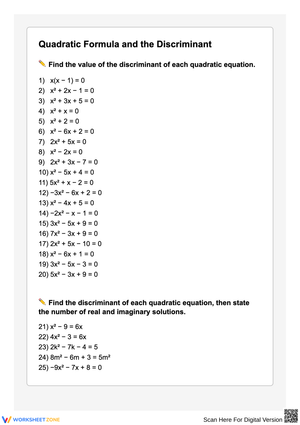
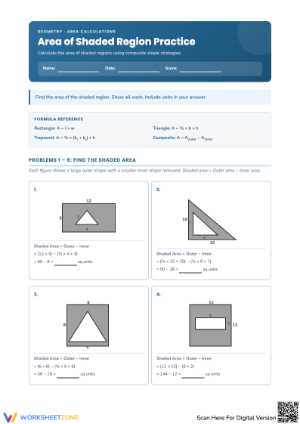
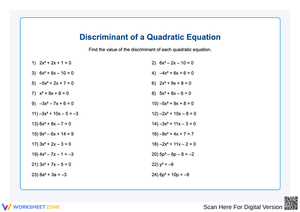
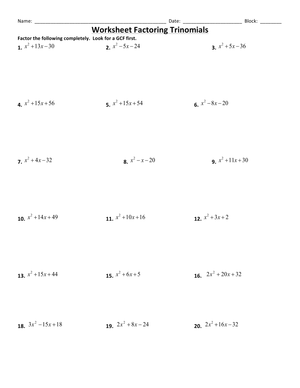
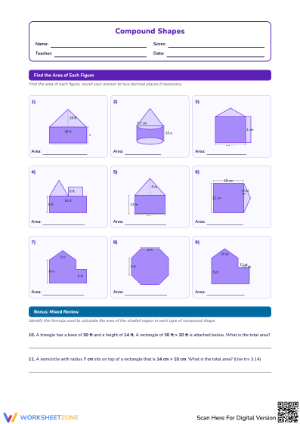
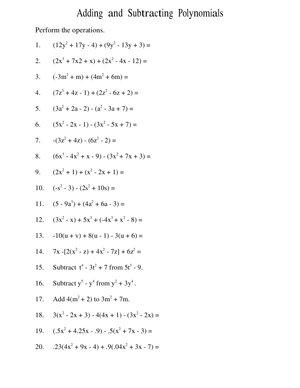
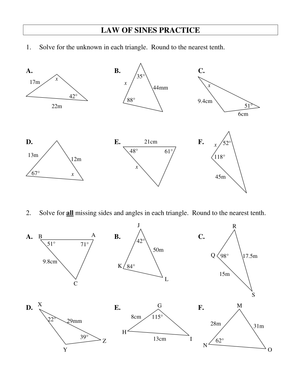
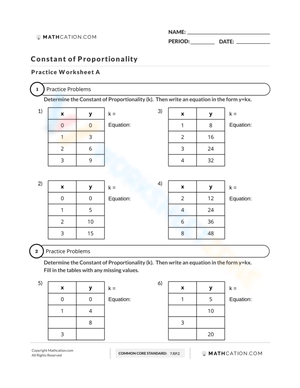
These 9th grade others math worksheets give teachers a set of standalone, printable resources for the math topics that fall outside the standard Algebra 1 or Geometry tracks — consumer math, introductory statistics, symbolic logic, and discrete mathematics. Each worksheet targets one concept and can be used independently, so there is no requirement to run a full unit to get value from the set. For freshmen who are not in the standard algebra pipeline, or for Algebra 1 students who need a different context for mathematical reasoning, these resources fill a gap that most textbooks leave unaddressed.
Concepts Each Worksheet Addresses
The set covers four content areas, and each worksheet stays within one topic so teachers can assign exactly what fits the lesson.
- Consumer math: budgeting, gross versus net income, sales tax, reading pay stubs, and simple and compound interest
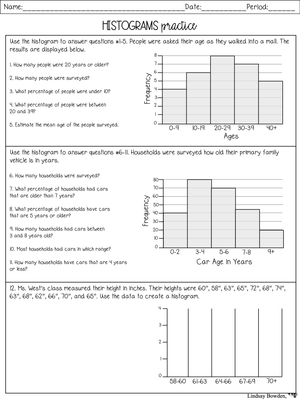
- Statistics: scatter plot construction, line-of-best-fit interpretation, and theoretical versus experimental probability
- Logic and set theory: truth tables, two- and three-set Venn diagrams, and conditional statements
- Discrete mathematics: counting principles, permutations, combinations, and introductory graph theory
The range matters beyond variety. A student who freezes on a linear equation will often work productively through a budgeting problem or a logic puzzle — the underlying reasoning habits are the same, but the unfamiliar notation is not blocking the way. Having all four areas available lets teachers make that connection explicit rather than treating "others math" as a miscellaneous holding category.
Financial Literacy as a Teaching Priority
Consumer math is the highest-demand category in this set. The worksheets go beyond calculating a percentage: students read simplified pay stubs and determine take-home pay after federal withholding and FICA deductions, calculate the total repayment cost of an auto loan given a fixed APR, and — in one particularly productive worksheet — compare three savings accounts with different compounding periods to determine which earns the most over five years. That last task reliably produces classroom discussion because students initially assume the account with the highest stated rate always wins, without accounting for compounding frequency. The error only surfaces when a worksheet forces a direct comparison.
Many states have moved toward requiring financial literacy instruction before graduation, and freshman year is the logical entry point. The Jump$tart National Standards in K-12 Personal Finance Education benchmark income and financial responsibility skills specifically at the high school level. These worksheets address those benchmarks through contexts students recognize: part-time earnings, savings goals, and the real cost of borrowing.
Frequent Errors Worth Watching For and Correcting
In consumer math, the most consistent confusion is between simple and compound interest. Students apply I = Prt correctly to a simple interest problem and then use the exact same formula for compound interest, treating the principal as fixed across all periods. They produce one calculation where they should iterate across compounding periods. Worksheets that put both problem types side by side surface that confusion faster than a lecture does — students can see the difference in their own work rather than in a teacher's example on the board.
In probability, students routinely swap P(A and B) with P(A or B), particularly in two-stage problems. They add where they should multiply, or they double-count overlapping outcomes instead of subtracting them. This is not a careless mistake — it reflects a genuine confusion between the mathematical and everyday meanings of "and" and "or." In logic, the most common structural error is affirming the consequent: a student reads "If it is raining, then the ground is wet" and concludes that a wet sidewalk confirms rain. At 14, that inference feels correct, which is exactly what makes it a productive teaching target rather than a mistake to simply mark wrong.
How to Fit These Worksheets Into Your Instructional Week
The most natural placement for 9th grade others math worksheets is during unit transitions. When students have wrapped up linear equations but the quadratics unit has not launched, the gap is real — two to four days where mathematical momentum typically drops. A consumer math worksheet on loan costs or a logic worksheet on conditional statements keeps reasoning active without requiring a formal unit introduction.
They also work well as Monday warm-ups after morning attendance. Cold-open algebra drills can feel punishing at the start of a week; a Venn diagram or a budgeting problem asks for careful thinking without triggering the anxiety that equation-solving under time pressure sometimes produces in 9th graders. For teachers running a small-group intervention block alongside regular instruction, these worksheets let a subset of students work on self-contained, practical problems while the larger group continues on the Algebra 1 pacing guide. Because each worksheet stands alone, there is no continuity requirement between sessions — a student can work on a statistics worksheet one day and a budgeting worksheet the next without missing a thread.
Standard Alignment
The statistics and probability worksheets in the 9th grade others math worksheets collection align with CCSS.MATH.CONTENT.HSS.ID.B.6 (representing data on two quantitative variables and assessing model fit) and CCSS.MATH.CONTENT.HSS.CP.A.1 through A.5 (conditional probability and independence). In practice, these work well as formative check-ins within those standards clusters — not as summative assessments. Teachers in states that have departed from the Common Core framework should verify specific code alignment against their own state standards before citing them in formal lesson plans.
Consumer math content corresponds to the Jump$tart National Standards in K-12 Personal Finance Education, specifically the Financial Responsibility and Income benchmarks. These carry no CCSS code, so alignment depends on whether a state has adopted standalone financial literacy standards. Logic and discrete math topics do not have a single 9th grade CCSS anchor, but they directly support Mathematical Practice Standards MP.3 (construct viable arguments and critique the reasoning of others) and MP.6 (attend to precision) — the two practice standards most active when students work through conditional logic and systematic counting problems.
Adjusting the Set for Different Student Levels
For students who are not yet fluent in algebraic notation, the consumer math and basic probability worksheets offer the lowest barrier to entry. A budgeting worksheet that provides a fixed monthly income and a list of expense categories requires arithmetic and decision-making, but not variable manipulation. Students who typically disengage during Algebra 1 often work through these problems with more persistence, and that persistence — built in a context that feels manageable — sometimes carries over to the core curriculum once a student has a few wins behind them.
For students who move quickly through standard assignments, the combinatorics and logic worksheets push in the opposite direction. A problem asking how many distinct four-digit codes can be formed from digits 1 through 9 without repetition feels approachable and regularly produces wrong answers on the first attempt. That gap between initial confidence and actual accuracy is useful: it prompts students to slow down and examine their reasoning rather than pattern-match their way through. A truth table with four variables produces the same effect — the work is rule-governed, but the volume of cases demands organized thinking that challenges students across the ability range, not just those who are behind.
Frequently Asked Questions
Are these worksheets suitable for a standard Algebra 1 class, or only for a separate others-math course?
Both. In a dedicated consumer math or others-math course, each worksheet functions as core instructional material. In an Algebra 1 class, the set works best during transitions, as enrichment for early finishers, or as a change-of-context warm-up. A compound interest worksheet connects naturally to exponential growth, which many Algebra 1 sequences address later in the year — using 9th grade others math worksheets in that context bridges practical financial reasoning and algebraic thinking without pulling teachers off their pacing guides.
Do the logic worksheets require any math prerequisites?
No prerequisites beyond basic reading comprehension. Truth tables and set theory use precise rules that students apply step by step — no prior algebra is needed. Combinatorics worksheets introduce factorial notation, which most students handle after a brief teacher explanation of what a factorial means. The difficulty in logic is not computational; it is attentional. Students who rush make the most errors, and that is worth stating clearly before students begin.
Can these be sent home as homework without prior in-class introduction?
Consumer math and basic probability worksheets work as homework with minimal setup — the contexts are familiar enough that students can read the instructions and begin without much guidance. Logic and set theory worksheets are different. Sending home a truth table worksheet before any in-class exposure tends to produce blank submissions or systematic guessing. A five-minute in-class walkthrough of the notation — not a full lesson, just enough to establish what the symbols mean — makes a significant difference in whether students actually work through the problems at home or leave them for the morning.
How long does a typical worksheet take to complete?
Most worksheets run 20 to 35 minutes for an average-paced student working independently. The longer truth table worksheets can take closer to 40 minutes, which makes them less suitable for tight warm-up slots. Consumer math and statistics worksheets fit a 20-minute window more reliably. If instructional time is limited, pulling from those two categories for warm-ups and reserving logic and discrete math worksheets for longer work periods makes the set easier to manage across a week.














 Interactive Worksheet Maker
 Quiz Maker
 Word Search Maker
 Crossword Puzzle Maker
 Word Scramble Generator
 Sentence Scramble Generator
 Handwriting Worksheet Generator
 Name Tracing Generator
 Fill In The Blank Generator




 BACK TOSCHOOL