9th Grade Are We Similar PDF Worksheets
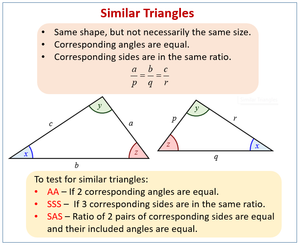
These 9th grade are we similar pdf worksheets give geometry teachers a focused set of exercises for a unit where students shift from visual recognition to written justification — specifically, identifying and proving triangle similarity using AA, SSS, and SAS. Each worksheet targets one concept cluster rather than mixing criteria together, so placing them in a lesson sequence requires very little planning overhead.
The Specific Skills These Worksheets Target
Students work through five skill areas across the set:
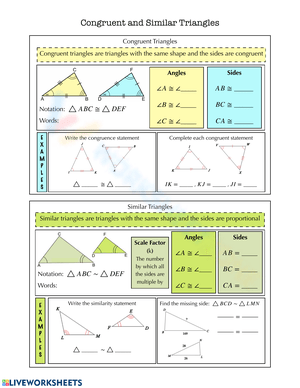
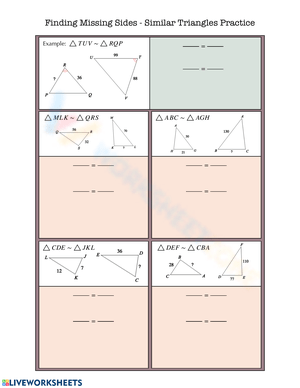
- Writing similarity statements with vertices in the correct correspondence order — the structural move that organizes every proportion that follows
- Identifying AA evidence by locating two pairs of congruent angles in separated, overlapping, and nested triangle figures
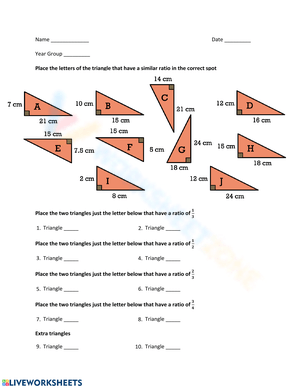
- Verifying SSS similarity by computing and comparing ratios for all three pairs of corresponding sides, not just the most obvious pair
- Checking SAS similarity by confirming one congruent angle and proportional sides that form that angle
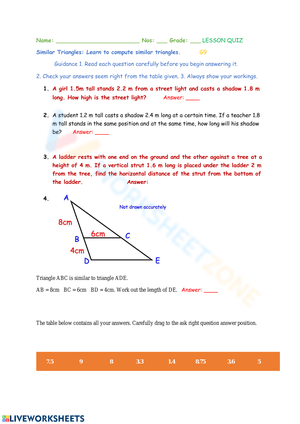
- Applying similarity reasoning to indirect measurement problems — shadow lengths, flagpole heights — where students construct the similarity argument without being guided toward a specific criterion
The similarity statement receives consistent attention across these 9th grade are we similar pdf worksheets because skipping that step is where proportion errors start. Writing "Triangle ABC ~ Triangle DEF" in the correct vertex order encodes all the correspondence information students need before they set up a single ratio. Students who go straight to numbers without writing the statement are the ones who misplace sides in proportions and cannot locate the error afterward.
Error Patterns to Anticipate and Address Before the Unit Assessment
The most damaging error in this unit is proportion mismatch. A student who correctly identifies two similar triangles will write AB/EF = BC/DE when the correct setup is AB/DE = BC/EF — one triangle's measurements belong in the numerator position consistently, the other triangle's in the denominator, across both ratios. The wrong equation looks structurally plausible, which is why students rarely flag it themselves. The similarity statement convention exists to prevent this, but it only works if students are taught to write and read the statement before setting up any proportion.
Scale factor direction is the second common pattern. When a dilation reduces a figure, students frequently report a scale factor greater than 1 because they invert the division instinctively rather than dividing image by pre-image. Asking students to record whether the image is larger or smaller than the pre-image before computing the scale factor slows this error down. It takes five seconds and catches the mistake before it becomes a final answer.
Third: students memorize AA, SSS, and SAS as labels without fully anchoring each label to its evidentiary requirements. A student marks a problem "SSS" after checking only two side ratios, or labels a proof "AA" after confirming just one angle pair. Worksheets that ask students to list the specific evidence they used — not just name the theorem — surface this confusion at a point in the unit where it can still be corrected before a test.
Where These Worksheets Fit in the Teaching Week
The most reliable structure is same-day application: introduce one similarity criterion, work two or three class examples together, and assign the corresponding worksheet before students leave. The ten to twelve minutes before a period ends is enough time for four or five focused problems — sufficient to create an initial foothold with that criterion. Students who leave without applying a new theorem tend to re-enter the next day uncertain about which criterion does what, and that confusion compounds quickly as the unit moves forward.
Once all three criteria are introduced, station work uses these 9th grade are we similar pdf worksheets efficiently. One station presents AA diagrams with marked angle pairs, a second gives three side-length pairs to check for proportionality, and a third uses indirect measurement problems where students decide which theorem applies and then solve. That third station generates the most questions — not because the algebra is harder, but because students have to construct the similarity argument from scratch rather than execute a given procedure. For three-day review cycles before a unit assessment, assigning one criterion per day and using error patterns on student work to determine which criterion needs whole-class reteaching is a more precise intervention than re-teaching the full unit from the beginning.
Standard Alignment
These worksheets address CCSS HSG-SRT.A.2, which requires students to determine whether two figures are similar and describe the transformation sequence that produces the relationship, and HSG-SRT.A.3, which focuses on using AA, SSS, and SAS to prove triangles similar. In classroom sequence, HSG-SRT.A.2 typically comes first — it frames similarity as a transformation result rather than a visual judgment — and HSG-SRT.A.3 follows as students move into theorem-based proof. The worksheets reflect this progression, moving from identification tasks toward full written justifications as the set advances.
Adjusting the Practice for Different Student Needs
Students who stall on proportion arithmetic often do so not because they misread the geometry but because the algebraic manipulation interrupts their thinking. For those students, providing a calculator and a pre-labeled diagram with the vertex correspondence already marked removes two obstacles at once, letting them focus on the actual geometric reasoning — selecting the right criterion and setting up the proportion — without breaking down on computation.
Students who have the three criteria solid benefit from problems where the theorem label is absent, requiring them to determine which criterion applies before solving. A stronger extension: present two triangles with all three side-length pairs listed, only two of which form equal ratios, and ask students to identify the non-corresponding pair and explain why it doesn't fit. That task requires proportional reasoning at a different level than routine solving problems do.
English language learners manage the vocabulary load better with a two-column reference card listing each theorem name, its requirements in plain language, and a labeled diagram. The term density in a similarity unit is real — corresponding, proportional, dilation, pre-image, congruent all appear in the same problems — and a written reference keeps students focused on geometric reasoning rather than vocabulary retrieval. The 9th grade are we similar pdf worksheets in this set use clear, consistent problem language that pairs well with that kind of reference support.
Frequently Asked Questions
What is the difference between SSS congruence and SSS similarity?
SSS congruence requires all three pairs of corresponding sides to be exactly equal in length. SSS similarity requires only that the three pairs are proportional — the ratios must be equal, but the actual side lengths do not need to match. A triangle with sides 3, 4, 5 is similar to a triangle with sides 6, 8, 10 (scale factor of 2), but the two triangles are not congruent.
Is one pair of congruent angles enough to prove triangle similarity?
No. One congruent angle pair satisfies no similarity criterion on its own. AA requires two pairs of congruent angles. SAS requires one congruent angle plus proportional sides forming that angle. Without the second piece of evidence, similarity cannot be established — finding one angle match tells you nothing definitive about the full relationship between the triangles.
How do students know which sides correspond when setting up a proportion?
The similarity statement encodes the correspondence. If Triangle ABC ~ Triangle DEF, then AB corresponds to DE, BC corresponds to EF, and AC corresponds to DF. Teaching students to write and read the similarity statement before touching any ratio eliminates the most common proportion mismatch errors, which typically stem from students pairing sides that look proportional in the diagram rather than following the vertex order.
Do the worksheets include indirect measurement problems?
Yes. Several worksheets include shadow problems and flagpole-height problems where students first establish which triangles are similar and why, identify the scale factor from a known pair of corresponding sides, and then solve for the unknown measurement. These problems are a reliable check of whether students understand similarity as a concept or are simply executing a memorized procedure — students who rely on memorization stall at the point where they need to construct the similarity argument without being prompted.
Clear All