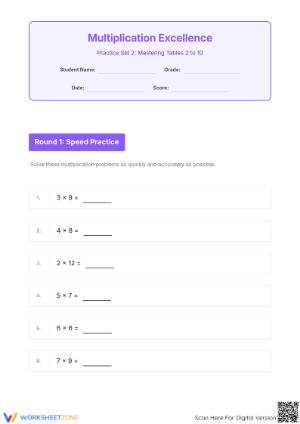
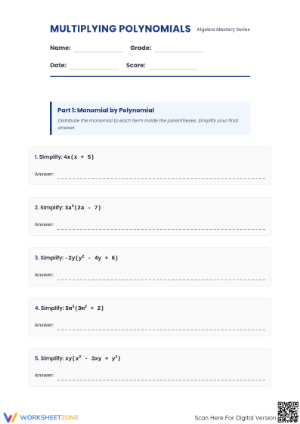
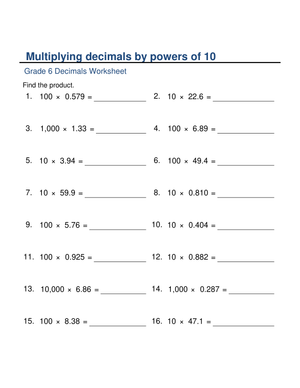
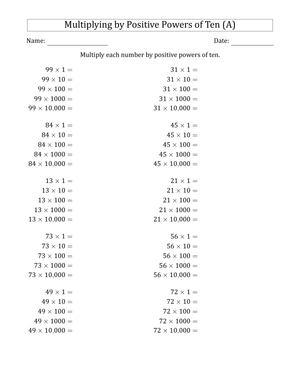
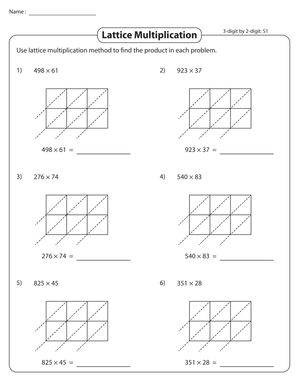
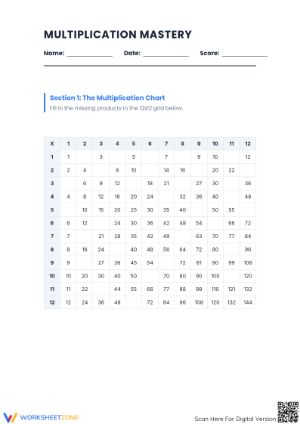
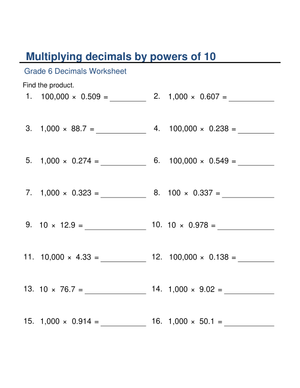
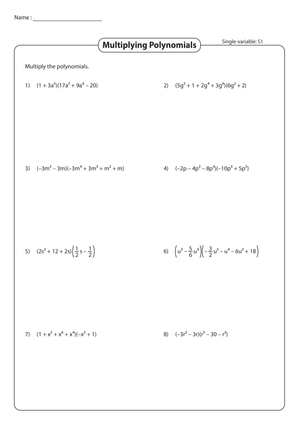
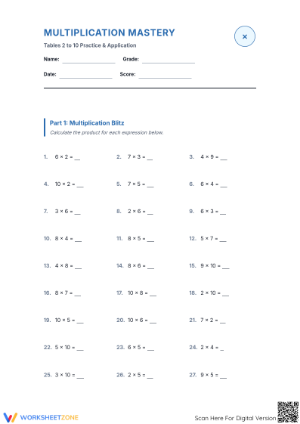
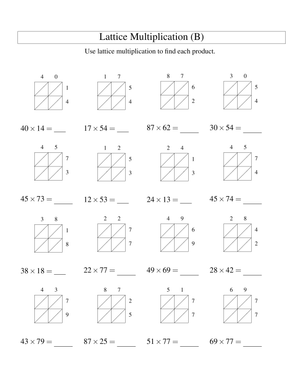
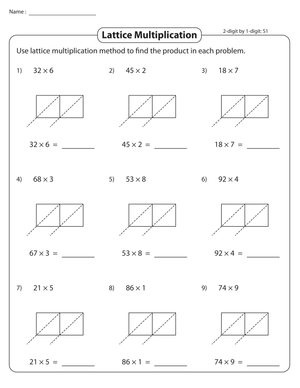
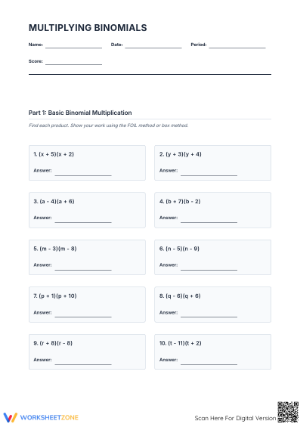
These multiplication worksheets for 9th grade address the version of multiplication that matters in Algebra 1: distributing across polynomial expressions, applying the laws of exponents, and handling scientific notation. The arithmetic fluency students built in middle school is the assumed entry point here — what these resources build is algebraic procedural fluency, which is a meaningfully different skill.
What the Set Covers
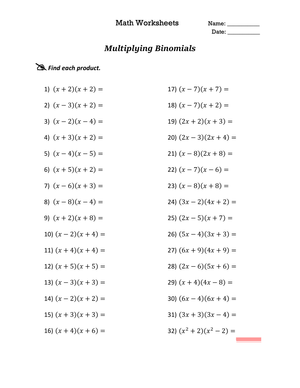
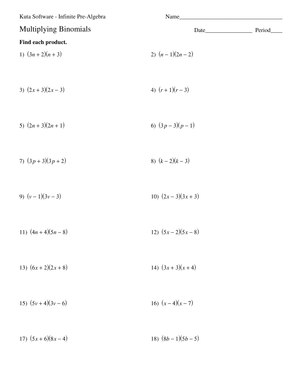
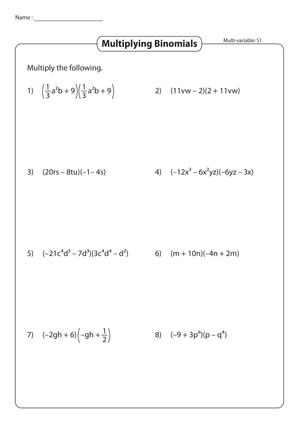
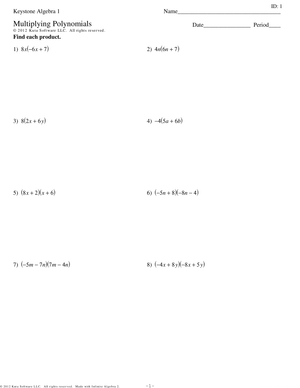
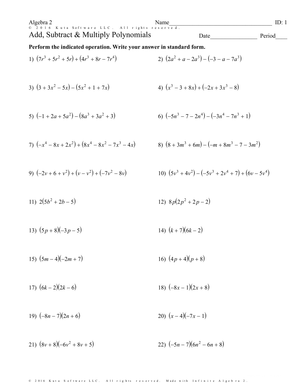
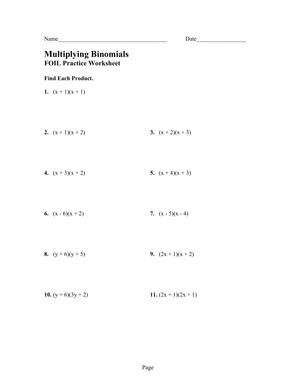
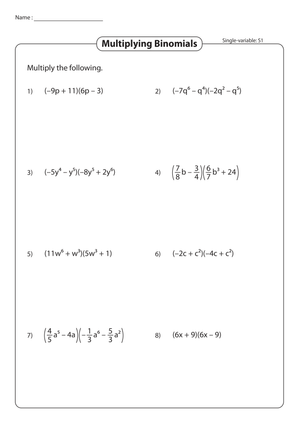
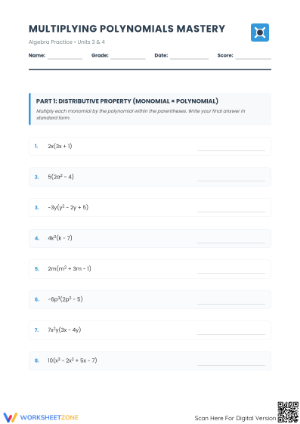
The core territory spans three areas. Monomial-by-polynomial multiplication gives students their first real reps with the distributive property in abstract form. Binomial-by-binomial multiplication — the domain where FOIL and the box method both apply — occupies the largest portion of the work. Exponent rule practice, particularly the product rule (x to the power a times x to the power b equals x to the power a plus b), threads through nearly every worksheet because students cannot accurately multiply polynomial terms without it.
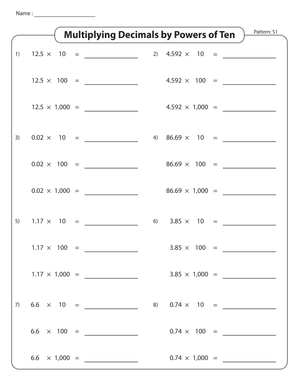
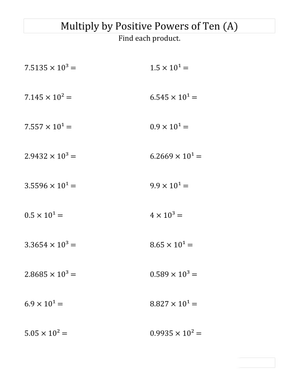
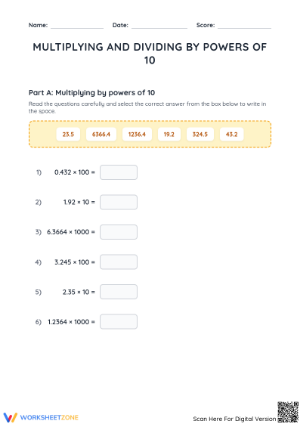
Scientific notation rounds out the set. That content often arrives in 9th-grade physical science at the same time, so teachers in both departments find use for it. Multiplying expressions in scientific notation requires students to handle the decimal components and the powers of ten separately — a two-step structure that reinforces place-value reasoning while building algebraic fluency.
Where Student Work Consistently Goes Wrong
The most reliable error at this level is a sign error — not a conceptual breakdown. Students who can explain polynomial multiplication accurately will still write (x minus 3)(x plus 5) as x² plus 2x minus 15 without catching the mistake, because they dropped the negative when distributing the inner terms. Making it a classroom habit to circle the sign attached to each term before beginning the multiplication is worth the extra thirty seconds. These worksheets present enough negative-term problems that the habit gets reinforced through volume rather than a single reminder.
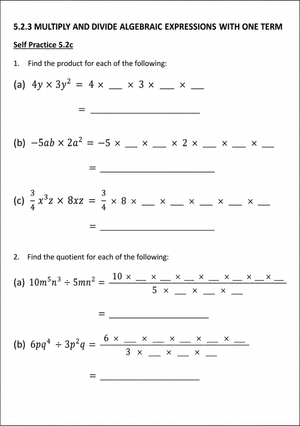
Exponent errors are the second category worth watching. Students who understand the add-the-exponents rule in isolation will still multiply 3x² by 4x³ and write 12x⁶ instead of 12x⁵. The move of multiplying coefficients while simultaneously adding exponents requires holding two separate operations in mind, and the interference is real — especially as expressions grow more complex. Several worksheets isolate this operation so students build clean repetition before encountering it embedded inside longer polynomial problems.
Working These Worksheets Into Your Lesson Planning
Station rotations fit this material well. Three stations — one for monomial distribution, one for binomial multiplication, one for exponent rules — give students structured variety within a single period, and the teacher can position themselves at whichever station the class currently struggles with most. Exit tickets drawn directly from these worksheets provide same-day data on where to open the following lesson.
These multiplication worksheets for 9th grade also work as Monday warm-ups during a polynomial unit. Five minutes of box-method practice before launching into new content keeps prior learning active without eating into instruction time. For students who enter 9th grade with shaky basic multiplication facts, the fluency-building worksheets work best framed as algebra preparation — the reframe genuinely matters, because high schoolers who feel handed something from 4th grade often disengage before they start.
Adapting the Work for Different Learners in the Room
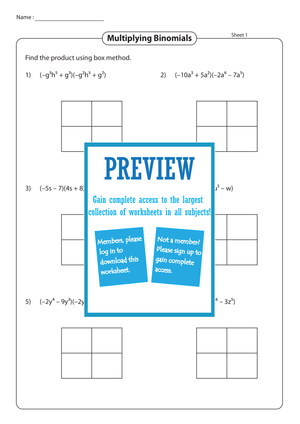
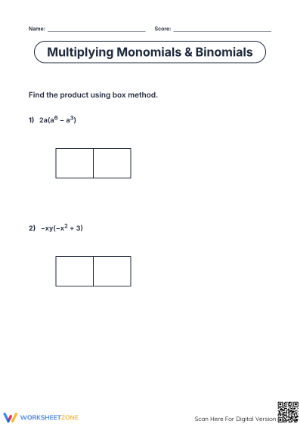
The multiplication worksheets for 9th grade in this set include options at different entry points, so differentiation is largely a sequencing decision rather than a search for separate resources. For students who freeze when variables appear without a concrete anchor, start with box-method worksheets where the grid is pre-drawn. The visual structure keeps attention on the multiplication itself rather than on organizing the setup — students fill in the cells rather than build the framework from scratch. Once a student completes pre-drawn grids reliably, move to blank worksheets where they construct the grid themselves. That transition is the actual skill progression.
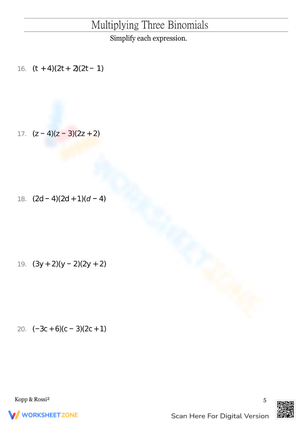
Students who have already mastered binomial multiplication benefit from worksheets that extend to trinomial-by-binomial problems, where FOIL no longer applies and the full distributive property takes over. Positioning the box method early — even for students who can use FOIL — prevents the ceiling problem that shows up when a student needs to multiply a trinomial and has no tool that scales to it.
Standard Alignment
The polynomial multiplication worksheets align with HSA-APR.A.1, which requires students to understand that polynomials form a system closed under addition, subtraction, and multiplication, and to carry out those operations fluently. In classroom terms, this standard sits at the hinge between procedural work — distribution, the box method, combining like terms — and conceptual work, meaning understanding why multiplying two polynomials always produces another polynomial. Strong performance on HSA-APR.A.1 tasks is also the clearest early-year predictor of readiness when factoring arrives later in the course. The scientific notation worksheets connect to 8.EE.A.4, which many 9th-grade classes revisit as foundational material before students enter the Algebra 1 sequence proper.
Frequently Asked Questions
Do students need solid basic multiplication facts before using these worksheets?
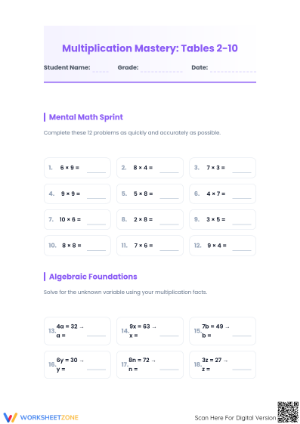
For the polynomial and exponent worksheets, yes. When a student stops mid-problem to work out 7 times 9, the interruption spills into the algebraic work and errors accumulate fast. For students with fluency gaps, the remediation worksheets in the set address arithmetic multiplication through an algebraic framing — coefficients rather than bare numbers — and are worth assigning before the polynomial work begins.
Is FOIL introduced, or does the set rely on the box method instead?
Both. FOIL is introduced for binomial-by-binomial multiplication because it is the language students encounter in most textbooks and from other teachers. The box method is introduced alongside it as the approach that extends cleanly to trinomials and larger polynomials. Students who understand that FOIL is a limited case of distribution — not a separate rule — are better prepared for the moment FOIL stops fitting the problem in front of them.
Can these worksheets serve students who need multiplication remediation rather than algebra instruction?
Yes. These multiplication worksheets for 9th grade are written with a high-school student in mind — no elementary framing, no cartoon anchors — so the content stays age-appropriate while targeting the arithmetic gaps that slow algebraic work. They fit well during small-group intervention blocks or advisory periods when students need targeted fluency practice without being pulled from core instruction.
Do the worksheets include worked solutions or just final answers?
Each worksheet comes with a full answer key. For polynomial multiplication especially, having a key that shows intermediate steps — not just the final simplified expression — helps students and teachers identify exactly where a calculation broke down, whether that was a sign error, a skipped term, or an exponent mistake.














 Interactive Worksheet Maker
 Quiz Maker
 Word Search Maker
 Crossword Puzzle Maker
 Word Scramble Generator
 Sentence Scramble Generator
 Handwriting Worksheet Generator
 Name Tracing Generator
 Fill In The Blank Generator




 BACK TOSCHOOL