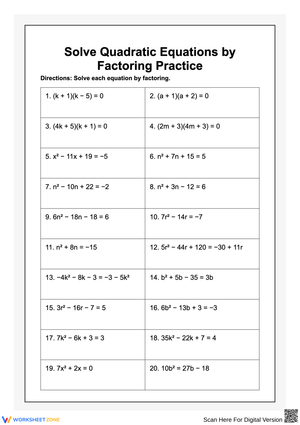
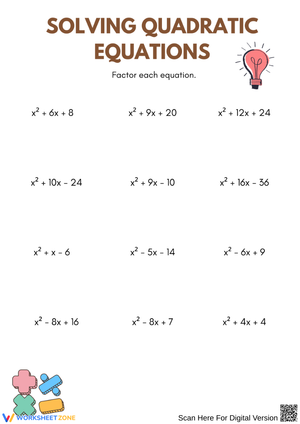
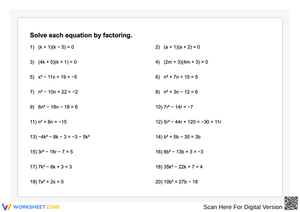
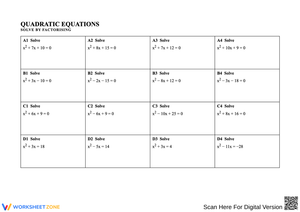
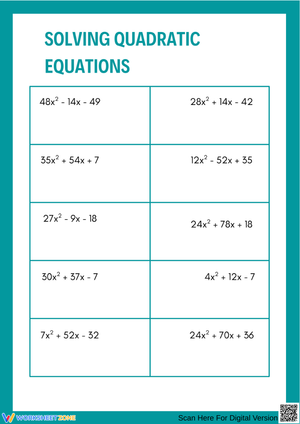
These solving quadratic equations by factoring worksheets for 9th grade give algebra teachers a focused set of resources for building the procedural fluency students need before they can apply factoring with any real confidence. The set covers the full range of factorable forms — from simple monic trinomials to equations that require rearranging before a student can begin — and includes answer keys that make it practical to check student work during class circulation.
The Specific Skills These Worksheets Build
Every item in the set uses equations students can solve by factoring over the integers. That constraint matters: when a worksheet mixes solving methods, students spend mental energy figuring out which technique applies rather than getting sharper at the one you just taught. These worksheets keep the target narrow and the practice purposeful.
- Monic trinomials in standard form: Students find two integers that multiply to the constant term and add to the middle coefficient, then apply the zero-product property to reach two solutions.
- Equations requiring rearrangement first: Terms are not already arranged as ax² + bx + c = 0, so students must rewrite before factoring — the step where a large share of sign errors begin.
- Leading coefficient greater than 1: Students must account for the leading term when testing factor pairs, which rewards systematic checking over guessing.
- GCF extraction before factoring: Some equations carry a common factor that, once pulled out, reduces the remaining expression to a simpler form students can handle more quickly.
- Difference of squares: Students recognize the a² − b² structure and apply the shortcut without running the full trinomial check.
The progression within each worksheet runs from simpler to more demanding problem types. The student who works through three rows of monic trinomials on Monday is not sitting through the same problems on Tuesday — the next worksheet introduces leading-coefficient complications that demand meaningfully more attention.
Student Error Patterns Worth Knowing Before You Assign These
The most consistent error in student work on this topic is not wrong factor pairs — it is the missed first step. Students see a quadratic and go straight into factoring without checking that one side equals zero. A student who sees 3x² + 5x = 2 will often attempt to factor the left side as written and then have no valid reason to apply the zero-product property. Rewriting as 3x² + 5x − 2 = 0 is not optional, and students need enough encounters with mixed-format equations to internalize that condition before they do anything else.
The second pattern appears once students do reach the zero-product property. A student who correctly factors (x − 5)(x + 3) = 0 will sometimes read the solutions directly from the binomials — writing x = 5 and x = 3 — rather than solving x + 3 = 0 to arrive at x = −3. The most direct correction is to have students substitute each proposed answer back into the original equation, written out in the workspace below the problem. That check step catches the error without requiring a reteach from the front of the room.
A third error is more about pattern recognition than procedure: students treat 4x² − 9 as a standard trinomial because they do not see the absent middle term. Writing the equation as 4x² + 0x − 9 = 0 helps — students can then ask why the middle coefficient is zero, which leads directly to recognizing the difference of squares structure rather than running the trinomial method into a dead end. These worksheets include enough difference-of-squares items to give students the repetition needed to recognize the form on sight.
How to Build These Worksheets Into Your Algebra Lessons
These resources fit multiple points in a standard class period. Shorter sets of six to eight problems work well as the first independent practice after a mini-lesson — enough to surface whether students followed the modeling but not so many that errors pile up before you can circulate. Longer sets hold up for a full work period, particularly on days when the expectation is that every step is written out: rewrite in standard form, factor, set each factor equal to zero, solve.
One classroom routine that reduces rushed errors is to have students annotate each problem before solving — marking a brief note such as already standard form, move terms first, pull GCF, or difference of squares. That pause costs about fifteen seconds per problem and noticeably cuts the number of students who run the wrong procedure. It also makes student work faster to scan during circulation: you can see in three seconds whether a student misread the structure, before you even check the algebra.
Exit tickets drawn from solving quadratic equations by factoring worksheets for 9th grade work best when they pair at least one equation not yet in standard form with one that is ready to factor directly. That combination tells you, before the period ends, whether a student has internalized the full process or only the factoring step itself.
Standard Alignment
These worksheets align most directly to CCSS.MATH.CONTENT.HSA.REI.B.4b, which expects students to solve quadratic equations by factoring, completing the square, the quadratic formula, and inspection, as appropriate to the initial form of the equation. In a typical 9th-grade course, this standard appears after students have worked with polynomial expressions under HSA.SSE.A.2 and HSA.SSE.B.3a, so factoring skill is expected to carry forward from expression work into equation solving. That transfer does not happen automatically. A student who can factor x² − 3x − 10 as an expression will often not think to apply the zero-product property when that same expression appears on the left side of an equation — and explicit practice at the equation level is what closes that gap.
Texas teachers will find the skill sequence maps to TEKS A.8A, which expects students to solve quadratic equations with real solutions by factoring, taking square roots, completing the square, and applying the quadratic formula.
Adapting the Set for a Mixed-Ability Classroom
The range of problem types across solving quadratic equations by factoring worksheets for 9th grade makes differentiation practical without requiring separate materials for each student group. Students still building fluency with integer factoring stay with monic trinomials already in standard form — ten to twelve items is enough to establish the pattern before moving on. Students ready for more do not need a different worksheet; they move to problems with a leading coefficient greater than 1 or to those that require rearranging first.
For students who stall on non-monic trinomials, a useful intermediate step is to have them build a factor-pair table before guessing — listing factor pairs of the leading coefficient in one column and factor pairs of the constant term in another, then testing combinations systematically. Written out on the worksheet, that step slows the impulsive guessing responsible for most leading-coefficient errors and gives you something concrete to review with a small group.
Students who move quickly through standard problems benefit from a short extension task: a small group of equations that do not factor cleanly over the integers, with the instruction to identify — without solving — why factoring would not work and which method would be appropriate instead. That judgment task pushes algebraic reasoning further without introducing the quadratic formula mid-unit.
Frequently Asked Questions
Should every equation in the set already be in standard form?
No — and the mix is intentional. A student can be fully fluent at factoring monic trinomials and still stall when a problem needs rearranging first, because they treat the two steps as unrelated. Including equations in non-standard form within the same worksheet makes that connection explicit and gives teachers a simultaneous check on both skills.
How many problems per session is actually productive?
Ten to fifteen well-chosen problems give enough repetition to build accuracy without pushing students into mechanical completion. Past roughly eighteen same-type items, most 9th graders stop checking their work and start rushing toward the end. Shorter, more focused sets used frequently outperform long exercises in retained accuracy — which is why these resources are separate worksheets rather than one extended drill.
Where in a quadratics unit do these worksheets belong?
After students have practiced factoring polynomial expressions but before the quadratic formula is introduced. Using solving quadratic equations by factoring worksheets for 9th grade at that transition point gives students the structured practice they need to arrive at formula lessons with a grounded sense of what solutions actually mean — not just a procedure to follow.
What if a student factors correctly but writes the wrong roots?
Have the student substitute each proposed answer back into the original equation — not the factored form. A student who correctly factors (x − 4)(x + 1) = 0 but then writes x = 4 and x = 1 will see the error the moment they test x = 1 in x² − 3x − 4 = 0: 1 − 3 − 4 = −6, not zero. Building that verification step into student routines early makes error detection something students do themselves rather than waiting for teacher feedback.














 Interactive Worksheet Maker
 Quiz Maker
 Word Search Maker
 Crossword Puzzle Maker
 Word Scramble Generator
 Sentence Scramble Generator
 Handwriting Worksheet Generator
 Name Tracing Generator
 Fill In The Blank Generator




 BACK TOSCHOOL