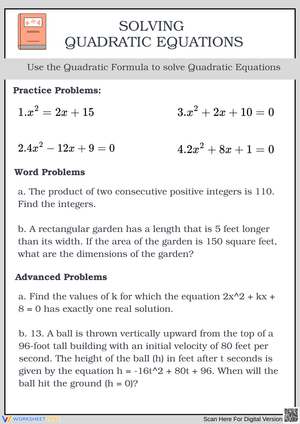
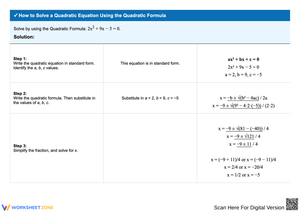
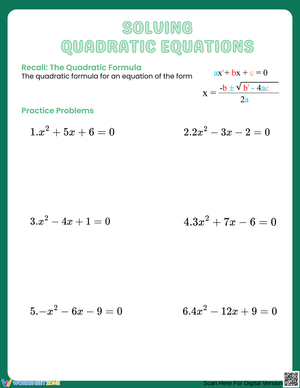
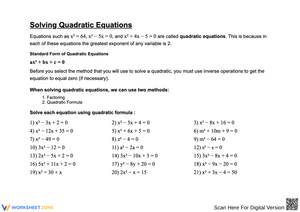
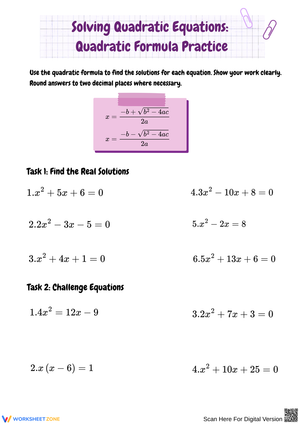
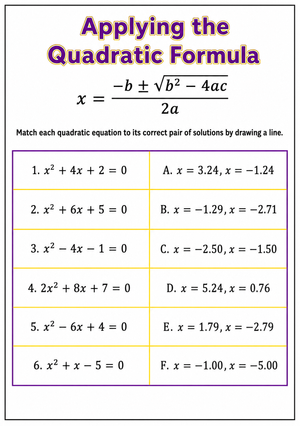
These solving quadratic equations using quadratic formula worksheets for 9th grade give teachers focused, printable practice for a skill that tests students' arithmetic, sign handling, and radical work simultaneously — all within a single formula application. Each worksheet targets a distinct layer of that process, making the set useful from initial instruction through unit review.
What Students Work Through
The core sequence students must internalize is the same on every problem: rewrite the equation in standard form, identify a, b, and c, substitute into the formula, compute the discriminant, and simplify. That sequence looks manageable until you watch a class of ninth graders actually do it. The worksheets break the process into distinct problem types rather than mixing every complexity together at once.
Across the set, students practice:
- Identifying a, b, and c from equations already written in standard form ax² + bx + c = 0
- Rearranging non-standard equations — including cases where terms appear on both sides — into standard form before any substitution
- Computing the discriminant and using its sign to predict the number of real roots before finishing the calculation
- Applying the formula when b = 0 or c = 0 and recognizing what the missing term means structurally
- Simplifying radical expressions in the numerator, including locating the largest perfect square factor
- Reducing the final fraction when the numerator terms and 2a share a common factor
- Writing both solutions when the discriminant is positive, and identifying no real solution when it is negative
Student Errors Worth Anticipating Before the Lesson
The most persistent problem involves sign handling on b. When b is negative — say, b = -7 — students must compute -b, which equals 7. What actually appears on student work is -(-7) rewritten as -7, because students interpret substitution as "write down the number I identified" rather than "evaluate the expression." The formula's leading negative and the negative coefficient collapse into one and the student doesn't catch it. Having students write the formula skeleton with empty parentheses before entering any values — x = (-( ) ± √(( )² - 4( )( ))) / 2( ) — catches this consistently.
Squaring a negative b produces the same category of error. A student who correctly identifies b = -5 then computes b² = -25 instead of 25, which drags the discriminant down and makes some equations appear to have no real solutions when they do. The underlying gap isn't carelessness — it's a persistent misunderstanding about how squaring interacts with signed numbers, one that resurfaces here after being partly addressed in earlier units.
A third breakdown occurs at the division step. Students treat the numerator visually as two separate pieces and divide only the radical portion by 2a, leaving the -b term undivided. Reminding students that the entire numerator rides over a single denominator — and having them draw a long fraction bar before substituting — is a more direct fix than repeating the rule verbally.
Standard Alignment
HSA-REI.B.4b is the standard these worksheets address most directly. It requires students to solve quadratic equations by inspection, factoring, completing the square, and the quadratic formula, and to recognize when each method is appropriate. In classroom terms, this standard typically arrives mid-unit, after students have already worked with factoring trinomials and graphing parabolas, so they carry some conceptual understanding of what a root means when they encounter the formula for the first time. The solving quadratic equations using quadratic formula worksheets for 9th grade in this set fit that instructional window — they presuppose familiarity with what a root represents and put the focus squarely on procedural accuracy.
Fitting These Worksheets Into Your Weekly Plan
Most teachers use these during the direct instruction phase — working the first two or three problems as a class, then releasing students to attempt the next cluster independently. Solving quadratic equations using quadratic formula worksheets for 9th grade also work well as Monday warm-ups after a long weekend, when procedural memory for multi-step formulas degrades quickly. A five-problem focused worksheet reactivates the substitution sequence without taking more than eight minutes of instructional time.
For homework, assign worksheets where the leading coefficient a is not 1. Those are the problems students are most likely to underestimate — the trinomial doesn't factor obviously, and the formula becomes necessary rather than optional. When students return with completed work the next day, a five-minute class reconstruction of how to handle a = 3 is far more efficient than re-teaching the formula from scratch.
The spot-the-error format — one worksheet pre-worked with three or four intentional mistakes — makes a strong mid-unit activity. Students mark the errors, identify which step went wrong, and rewrite the correct solution. That analytical shift moves students from passive execution to active monitoring of their own process, and it transfers directly to self-checking on assessments.
Adjusting the Set for Different Learners
For students still working through the substitution step, limit the initial work to equations already in standard form with positive integer coefficients and a discriminant that is a perfect square. Clean arithmetic keeps the focus on the procedure itself. Once substitution is reliable, introduce negative coefficients one at a time — negative b first, then negative c, then both — rather than presenting a worksheet where all three coefficients vary unpredictably.
Students who have the procedure down benefit from worksheets where the discriminant is not a perfect square. Simplifying √72 to 6√2 and then reducing the full fraction adds genuine cognitive demand without requiring new content. These students can also tackle equations that must first be rearranged from a non-standard form — something like 2x² = 5x - 3 — before coefficients can be identified. That rearrangement step is where errors tend to migrate once the formula itself is secured.
For students with high working memory load or processing differences, annotating the formula with color-coded labels — a, b, and c each in a distinct color, with matching coefficients circled in the original equation — provides a visual reference that reduces cognitive demand during substitution without bypassing the algebra itself.
Frequently Asked Questions
When does the quadratic formula make more sense than factoring?
Factoring is faster when the roots are small integers and the equation looks factorable by inspection — something like x² + 5x + 6 = 0. The formula becomes the better choice when the roots are irrational, when a is greater than 1 and the trinomial doesn't factor over the integers, or when students aren't certain factoring will work. Teaching students to use the discriminant as a decision tool — check whether b² - 4ac is a perfect square before committing to factoring — gives them a reliable strategy rather than a guess.
What happens when b or c is missing from the equation?
Students substitute zero for the missing coefficient and proceed normally. In 3x² - 27 = 0, b = 0 and the formula simplifies considerably. In 4x² + 8x = 0, c = 0. These cases are worth teaching explicitly because students who have only practiced equations with all three terms visible tend to freeze when one is absent. A missing term isn't a broken equation — it's a special case that the formula handles without adjustment.
How do we handle a negative discriminant at this grade level?
At 9th grade, the standard response is to report no real solutions and stop there. The graphical connection — this parabola doesn't cross the x-axis — gives students a concrete way to visualize the result and verify it makes sense. Whether to introduce complex numbers at that point depends on the specific curriculum. In most Algebra 1 courses, the negative discriminant is acknowledged and moved past rather than developed into a full treatment of imaginary numbers.
How many problems should students complete from each worksheet in a single session?
Eight to twelve problems is a realistic session range when students are still learning the procedure. Fewer than eight doesn't generate enough repetition for the sequence to settle; more than twelve and students start rushing through the arithmetic, which is precisely when sign errors stack up. The solving quadratic equations using quadratic formula worksheets for 9th grade that include space for students to show every substitution step work better for initial instruction than condensed versions where students are tempted to skip steps to save room.














 Interactive Worksheet Maker
 Quiz Maker
 Word Search Maker
 Crossword Puzzle Maker
 Word Scramble Generator
 Sentence Scramble Generator
 Handwriting Worksheet Generator
 Name Tracing Generator
 Fill In The Blank Generator




 BACK TOSCHOOL