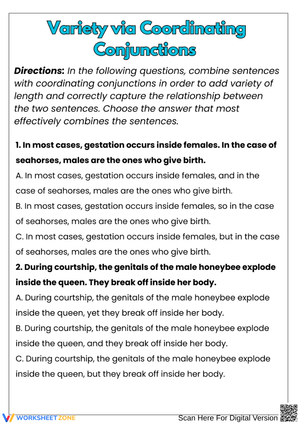
These sentence variety pdf worksheets for 9th grade address one of the most persistent problems in high school prose: paragraphs that are grammatically clean but monotonous because every sentence follows the same structural rhythm. The set includes sentence combining tasks, paragraph revision exercises, and targeted work on varying sentence openings—all formatted as printable resources teachers can slot into a mini-lesson, small-group session, or revision block without additional preparation.
The Work in Each Worksheet
Each worksheet focuses on one specific writing move rather than trying to cover all aspects of sentence variety at once. That narrow focus keeps students from feeling overwhelmed and makes class discussion sharper—when everyone worked on the same move, a five-minute share-out can actually change how students approach their next draft.
The skills across the set include:
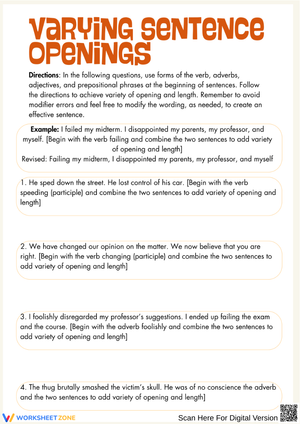
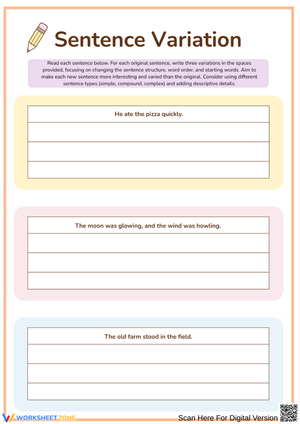
- Varying sentence openings so paragraphs don't rely on the same subject-verb pattern throughout
- Mixing short and longer sentences to control pacing and draw attention to key points
- Combining related short statements into a single, more controlled sentence without losing meaning
- Identifying and revising repetitive structural patterns inside a paragraph draft
- Imitating a model sentence as a way of learning a new structure before applying it independently
Each worksheet builds toward paragraph-level application rather than staying at the isolated sentence level, which is where transfer actually happens in student writing.
Student Error Patterns Worth Catching Before Drafting
The most recognizable error 9th graders make here isn't writing short sentences—it's that all sentences begin with the same two words. Literary analysis paragraphs are especially prone to the "The author..." cascade: "The author uses imagery. The imagery creates tension. The tension shows the theme." Each individual sentence parses fine. Together, they create a mechanical rhythm that flattens the argument. Students are often genuinely surprised when they count how many consecutive sentences start with "The" or with a subject pronoun.
A second, less obvious error surfaces during sentence combining tasks. Students who over-combine produce constructions that are harder to follow than the original short sentences were—a sprawling statement with three embedded clauses that loses the reader before the main point arrives. Including over-combined examples alongside effective revisions helps students calibrate: the goal is controlled variation, not longer sentences.
One more pattern worth watching: students who learn to vary openings sometimes shift to fronting every sentence with a transitional phrase ("In addition, ...", "Furthermore, ...", "However, ..."), which creates a different kind of monotony. Flagging this during class discussion prevents one fixed habit from replacing another.
Fitting These Worksheets Into Your Writing Unit
Sentence variety pdf worksheets for 9th grade land with more impact after students have a paragraph in hand—because they can immediately apply the skill to their own writing rather than to a generic exercise. The most reliable sequence: 3 minutes modeling one move, 8 minutes of worksheet practice, then 5 minutes where students open a current draft, highlight two sentences that follow the same pattern, and rewrite them using the technique just practiced. That final step is where the skill moves from exercise to writing behavior.
These worksheets also fit naturally into a reteach routine. After returning a set of drafts, a teacher can identify which students have the choppy-sentence problem and pull a small group for a focused 12-minute session—one combining worksheet, then direct revision in the draft itself. That targeted use is more efficient than re-teaching the whole class on an issue affecting only a portion of writers.
One logistical note: the answer keys that accompany these worksheets support discussion rather than just scoring. Because sentence variety often allows more than one strong revision, a key that shows two or three acceptable versions gives teachers material for a genuine conversation about why one choice reads better than another in a particular context.
Standard Alignment
CCSS.ELA-LITERACY.W.9-10.5 addresses developing and strengthening writing through revision and editing, with explicit attention to structure, style, and clarity—precisely where sentence variety work lives in a writing unit. CCSS.ELA-LITERACY.L.9-10.3 extends this to language choices that affect meaning and tone, including syntax decisions that shape how a reader moves through a paragraph. Together, these two standards position sentence variety not as a style bonus but as a measurable revision competency, which gives teachers a documented basis for including this practice in a formal writing unit plan.
Adapting These Worksheets for Different Writers
Students who need more support should start with the sentence combining worksheets before moving to paragraph revision. Combining gives writers a bounded task with a clear before-and-after, which removes the ambiguity that comes with open-ended revision prompts. Providing one completed example alongside the task so students can check their own attempt against a model version helps those writers stay on task without requiring constant one-on-one support.
Students already writing fluently can skip the combining tasks and work directly on the paragraph-revision exercises—or take the revision task in reverse: rewrite an effective, varied paragraph using only short, identical-length sentences, then describe what was lost. That reconstruction exercise makes the value of variety concrete rather than abstract.
Sentence variety pdf worksheets for 9th grade that include modeled examples with brief annotations—showing why a particular revision improves the original—give students at all levels a reference point during independent work, rather than relying solely on memory of a class explanation.
Frequently Asked Questions
What sentence structures do these worksheets cover?
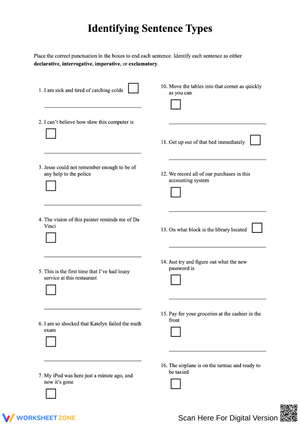
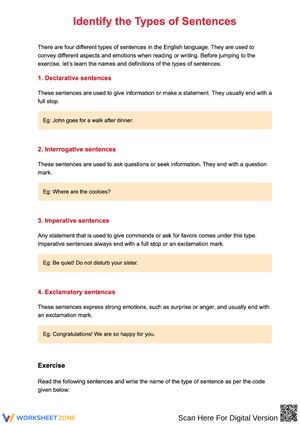
The worksheets address varying sentence openings (moving away from subject-first patterns), mixing sentence length for emphasis, combining short independent clauses into compound or complex structures, and revising repetitive paragraph-level patterns. The focus stays on functional control rather than naming and memorizing every grammatical form.
How long does a typical worksheet session take?
Most worksheets fit a 10–15 minute practice block when paired with a brief model. Teachers running a full revision cycle—model, practice, apply to draft—should budget 20–25 minutes, including the draft application step that produces the strongest retention.
Can these worksheets be used with students who have writing IEPs?
Yes. Each worksheet's narrow focus makes accommodation straightforward: reduce the number of items, provide a sentence frame for the transfer task, or limit the revision goal to one move such as varying only sentence openings. The modeled examples in each worksheet give struggling writers a reference point while they work independently.
Do students need a completed draft before using these worksheets?
Sentence variety pdf worksheets for 9th grade work as standalone practice early in a unit, but they produce the strongest transfer when students can immediately apply the skill to a paragraph they've already written. If drafts aren't ready, even a journal entry or free-write gives students text to revise during the application step.












 Interactive Worksheet Maker
 Quiz Maker
 Word Search Maker
 Crossword Puzzle Maker
 Word Scramble Generator
 Sentence Scramble Generator
 Handwriting Worksheet Generator
 Name Tracing Generator
 Fill In The Blank Generator