































Complete Syntax Revision Worksheet | Grade 9 English I

Paste this activity's link or code into your existing LMS (Google Classroom, Canvas, Teams, Schoology, Moodle, etc.).
Students can open and work on the activity right away, with no student login required.
You'll still be able to track student progress and results from your teacher account.
This Grade 9 English I worksheet guides students through the mechanics of revising complex sentence structures without distorting empirical facts or causal relationships. High school writers learn to manipulate syntax, clausal hierarchy, and grammatical voice while preserving critical data, precise measurements, and chronological integrity across technical and narrative contexts.
At a Glance
- Grade: 9 · Subject: English I
- Standard: High School Language & Composition — Apply syntactic revision techniques to refine style while preserving factual accuracy
- Skill Focus: Revise Syntax While Preserving Facts
- Format: 6 pages · 10 problems · Answer key included · PDF
- Best For: Advanced sentence combining and editorial revision
- Time: 45–60 minutes
What's Inside
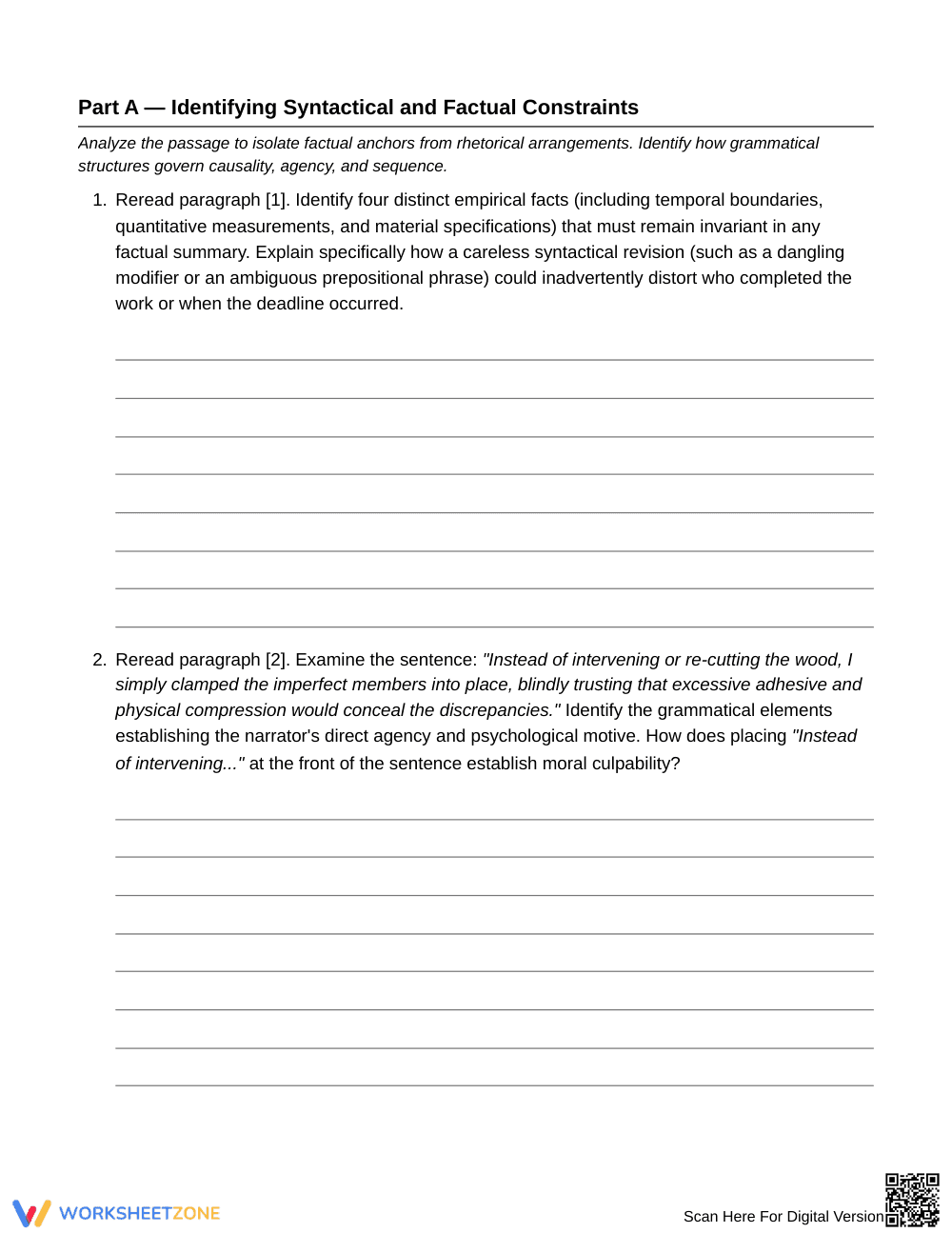
The 6-page worksheet features a rigorous theoretical overview of syntactic constraints followed by an authentic narrative passage describing an engineering structural failure. Across 10 structured tasks, students complete text-dependent analysis, targeted sentence combining using periodic, compound-complex, and cumulative structures, objective register translation, multiple-choice error analysis, and analytical justifications. A complete 5-page answer key provides exemplar sentence constructions and full rhetorical explanations.
Skill Progression
- Guided Practice (Tasks 1–2): Students analyze factual anchors and identify how misplaced modifiers or active-to-passive shifts affect causal agency and culpability in the source text.
- Supported Practice (Tasks 3–8): Writers construct constrained syntactic forms—including periodic sentences, subordinate concessive clauses, and cumulative structures—while maintaining absolute data fidelity.
- Independent Practice (Tasks 9–10): Learners compose multi-paragraph rhetorical defenses evaluating voice selection and syntactic evidence balancing in technical debriefs.
This sequence follows the gradual-release model, moving writers from structural identification to guided reconstruction and independent rhetorical evaluation.
Standards Alignment
This resource aligns directly with high school standards for language conventions, sentence composition, and writing revision. Students demonstrate command of English grammar when writing, editing, and varying clausal syntax to convey specific meanings while maintaining complete informational accuracy. This alignment can be copied directly into lesson plans, IEP goals, or district curriculum mapping tools.
How to Use It
Deploy this activity during a syntax and style unit after introducing subordination, voice, and sentence types. For whole-class instruction, complete Part A collaboratively before assigning Part B for paired sentence drafting. Formatively check Task 6 to identify whether students can spot subtle factual shifts in syntactic revisions. Expected completion time is 45 to 60 minutes.
Who It's For
This resource supports Grade 9 English I students, honors composition cohorts, and secondary writers preparing for technical or academic writing tasks. Pair this practice with an anchor chart on subordinating conjunctions and active-versus-passive voice to support developing writers.
According to Fisher & Frey (2014), explicit instruction in syntactic structures and deliberate clausal manipulation accelerates secondary students' reading comprehension, analytical precision, and expository writing proficiency. When students engage in structured sentence combining and intentional grammatical revision, they develop essential metacognitive control over tone, clausal subordination, and rhetorical emphasis. This Grade 9 English I worksheet operationalizes these evidence-based principles across 10 analytical tasks that require high school writers to restructure complex sentences without corrupting core factual data, quantitative measurements, or causal sequences. By evaluating how grammatical voice, clause placement, and modifier positioning alter reader perception, students successfully bridge formal mechanics with rigorous informational integrity. The comprehensive 6-page progression provides the explicit scaffolding necessary for students to analyze mentor prose, apply constrained syntactic transformations, and articulate multi-paragraph written justifications for their editorial choices.


