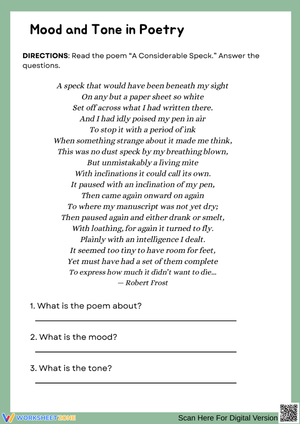
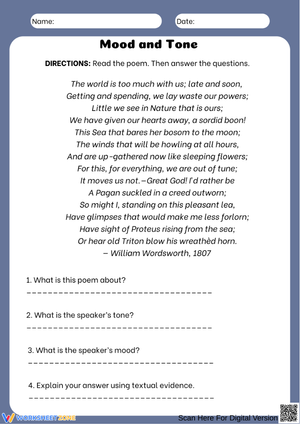
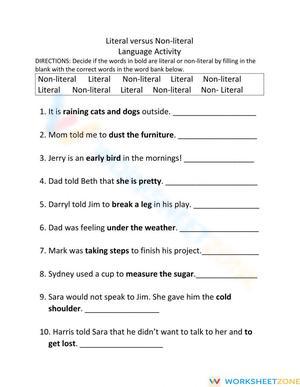
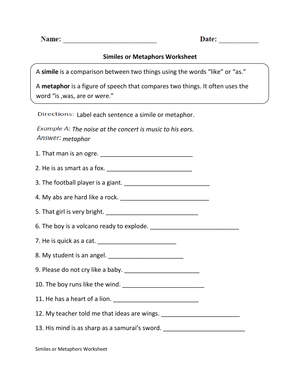
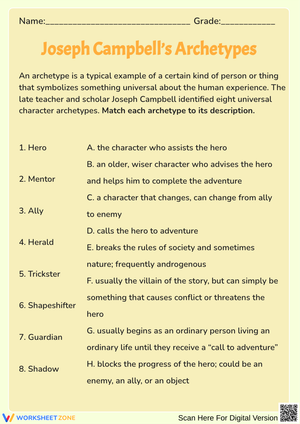
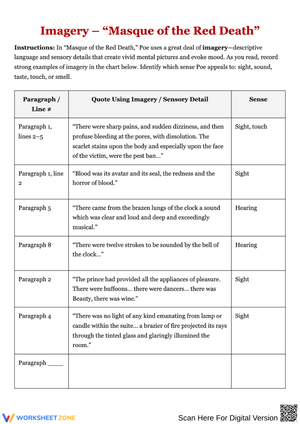
These 9th grade figurative language printable worksheets give teachers a direct route into one of the trickiest analytical shifts in high school ELA: moving students from spotting a device to explaining what it actually does to a text's meaning, tone, or emotional register.
The Specific Skills These Worksheets Target
Grade 9 is the point where the curriculum stops rewarding recognition and starts demanding interpretation. Students have labeled similes and metaphors since fifth grade; the question now is whether they can explain why a specific comparison lands harder than a literal statement would. Each worksheet in this set pushes that more demanding kind of thinking.
The devices covered include:
- Verbal, situational, and dramatic irony — treated separately, because students conflate all three until they work through enough distinct examples to feel the difference
- Allusion — with exercises that ask students to explain the connotation the reference imports, not just identify its source
- Paradox and oxymoron — paired so students can see the structural distinction between a contradictory statement and a contradictory phrase
- Extended metaphor — excerpts long enough that students must track how a comparison evolves rather than simply flag its first appearance
- Hyperbole and understatement — analyzed for rhetorical effect, not just tone
Several worksheets also target the connotation layer of figurative language — asking students to choose between near-synonyms and justify which word a skilled author would select. That task builds vocabulary precision at the same time it develops analytical thinking.
Mistakes Students Make That These Worksheets Help You Catch
The most persistent error at this level is what you might call the "makes it more interesting" response. A student identifies a metaphor and writes, "The author uses a metaphor to make the writing more interesting." The exercises specifically require students to name the specific effect — what the comparison reveals about character, what emotion it intensifies, what thematic thread it extends. Vague praise of authorial technique does not count as analysis, and the task structure makes that expectation visible from the first attempt.
Dramatic irony produces a reliable second category of confusion. Many students understand it as "something bad is about to happen," which is closer to foreshadowing. These worksheets present scenes where the reader holds information the character explicitly lacks, and ask students to mark that gap and explain how it changes the reader's experience of the moment — a task that clarifies the distinction faster than a definition alone ever does.
Allusion is where prior knowledge gaps show up most clearly. A student with no background in Greek mythology reads "It was his Achilles heel" and correctly identifies it as an allusion but writes a circular explanation: "It means he has a weakness." Worksheets that supply a two-sentence context note for each allusion let students practice the analytical move without getting stranded on background knowledge, and teachers can quickly see which students need more cultural context built into future lessons before the next unit.
How to Build These Worksheets Into Your Lesson Plans
The strongest slot for a single worksheet is the first eight or ten minutes of class — before the day's main text opens. A brief analysis of one complex excerpt sets an interpretive frame and activates the vocabulary students need during discussion. Teachers who use 9th grade figurative language printable worksheets this way report fewer "I don't know what to say" moments during Socratic seminars, because students have already rehearsed the analytical language once that morning.
When introducing paradox or dramatic irony for the first time, pair the worksheet with a whole-class read-aloud of the excerpt before students work independently. Students who skip the close reading and jump straight to the response prompt miss the contradiction or ironic gap entirely. A quick read-aloud takes two minutes and makes the subsequent independent work substantially more productive.
At the end of a literature unit, pulling two or three thematically connected worksheets and asking students to compare how different authors use the same device across texts creates a stronger synthesis activity than a standalone essay prompt. Students arrive at the writing task with examples already annotated in their own handwriting — a meaningful head start.
Standard Alignment
These resources directly support CCSS.ELA-Literacy.RL.9-10.4, which asks students to determine the meaning of words and phrases as they are used in a text — including figurative and connotative meanings — and to analyze the cumulative impact of specific word choices on meaning and tone. That standard appears in state reading assessments and sits inside nearly every 9th grade literature unit. The worksheets also reinforce CCSS.ELA-Literacy.L.9-10.5, covering figures of speech and their nuances — the standard most directly responsible for the irony and paradox work at this level. Because both standards appear in reading and writing rubrics, improvement on these exercises tends to carry over into essay quality, a connection worth making explicit with students when you return their work.
Adjusting the Set for a Range of Learners
Students who are still consolidating foundational reading fluency work best with worksheets that include a device glossary in the margin and use shorter, syntactically simpler excerpts. The analytical task stays the same — identify, explain effect, cite evidence — but the linguistic complexity of the passage is lower. That preserves the thinking process without letting the text itself become the primary obstacle.
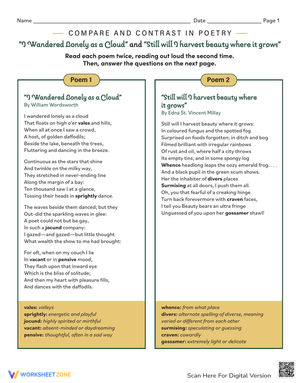
At the advanced end of the set, the 9th grade figurative language printable worksheets pull longer excerpts from texts like Hamlet, Langston Hughes's poetry, or Zora Neale Hurston's prose, where multiple devices layer inside a single sentence. Those worksheets ask students to annotate for three or four devices simultaneously and then write a short paragraph explaining how those devices work together — a task that mirrors the evidence-based writing expected on AP-level assessments, even for students who are only in grade 9.
For English Language Learners, the explicit unpacking of figurative meaning matters most. Phrases like "his blood ran cold" are not immediately legible as non-literal, and a worksheet that presents both the figurative sentence and a paraphrased literal version helps students build the habit of reading for connotative meaning rather than stopping at denotation.
Frequently Asked Questions
Can these worksheets replace close reading of a full text?
No — and they are not meant to. Each worksheet isolates a device in a short excerpt, giving students a lower-stakes context to practice the analytical move. That practice transfers to full-text analysis, but it does not substitute for working through a complete novel or play with sustained attention. Use these resources to build the skill, then release students to apply it in longer texts independently.
How do I know which worksheet to assign first if students have uneven backgrounds?
Start with the irony worksheets. Irony appears in almost every 9th grade core text, and student responses quickly reveal how much analytical vocabulary they already carry. The ones who write "the character should have known better" instead of naming the dramatic irony are the students who need the most structured practice before moving forward, and you will identify them on day one.
Do these worksheets include answer keys?
Yes. For open-ended response questions, the answer keys include model responses at different quality levels — not just a single correct answer. That makes them useful for showing students what strong literary analysis actually looks like compared to a surface-level response, and it reduces grading ambiguity considerably.
How do these worksheets connect to student writing?
Incorporating 9th grade figurative language printable worksheets into a writing workshop cycle produces visible improvement in essay quality. When students analyze how a professional author builds a metaphor or sustains dramatic irony across a scene, they internalize the technique in a way that generic "use figurative language in your writing" instruction rarely achieves. Many teachers assign one analytical worksheet before a narrative or analytical writing task and find students' drafts show more deliberate, specific language choices as a direct result.












 Interactive Worksheet Maker
 Quiz Maker
 Word Search Maker
 Crossword Puzzle Maker
 Word Scramble Generator
 Sentence Scramble Generator
 Handwriting Worksheet Generator
 Name Tracing Generator
 Fill In The Blank Generator