




























Views
Downloads

Metaphors and Similes Worksheet | Grade 7-9 Essential

Paste this activity's link or code into your existing LMS (Google Classroom, Canvas, Teams, Schoology, Moodle, etc.).
Students can open and work on the activity right away, with no student login required.
You'll still be able to track student progress and results from your teacher account.
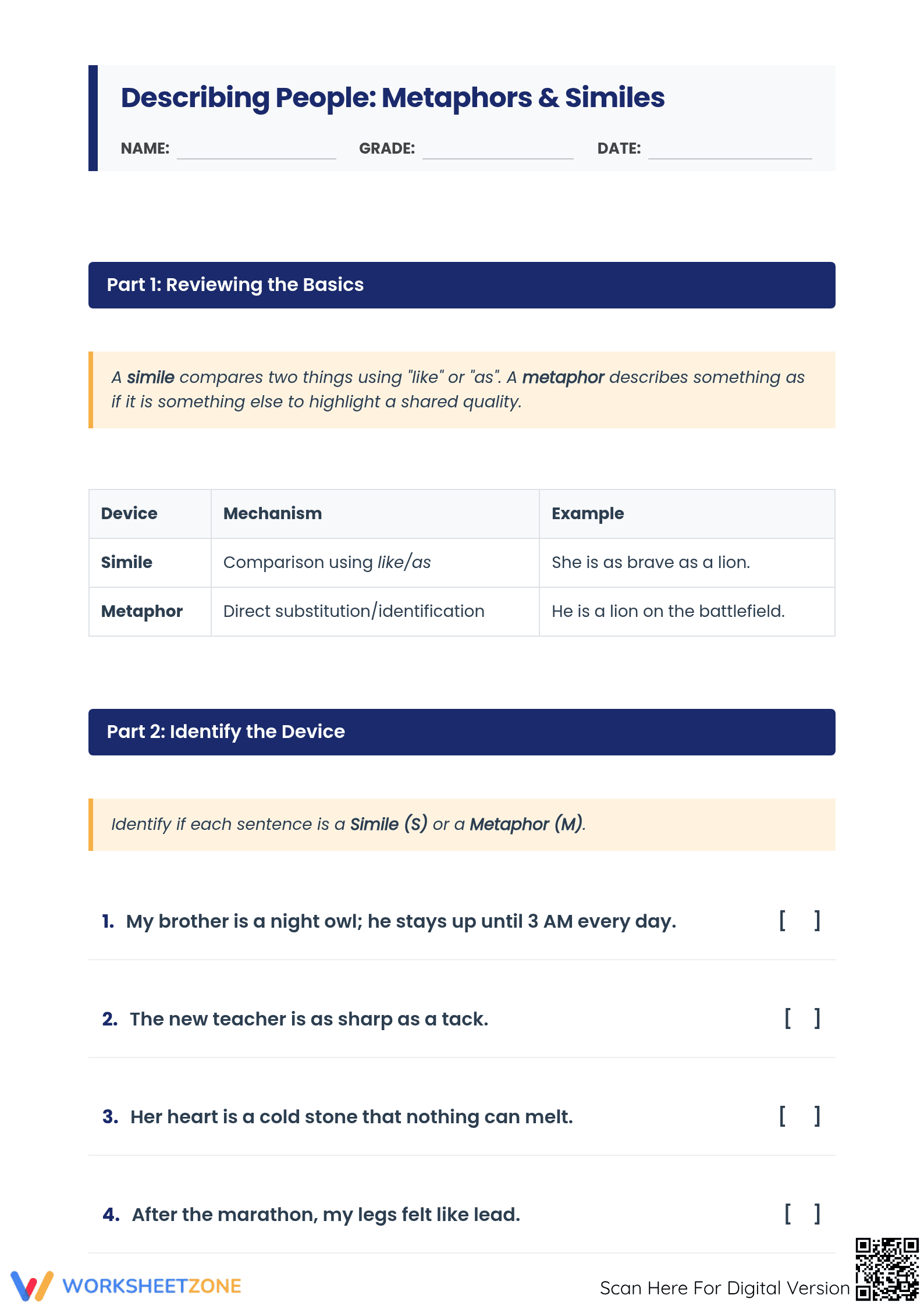
This Grade 7-9 English Language Arts worksheet provides a comprehensive review and practice for identifying and using metaphors and similes. Students move from basic definitions to high-level creative application, ensuring they can both recognize and construct figurative language in their own writing. It is designed to build immediate confidence in literary device analysis.
At a Glance
- Grade: 7-9 · Subject: ELA
- Standard:
CCSS.ELA-LITERACY.L.7.5— Interpret figures of speech, including metaphors and similes, in context- Skill Focus: Figurative Language Analysis
- Format: 2 pages · 8 problems · Answer key included · PDF
- Best For: Independent practice or quick formative assessment
- Time: 15–20 minutes
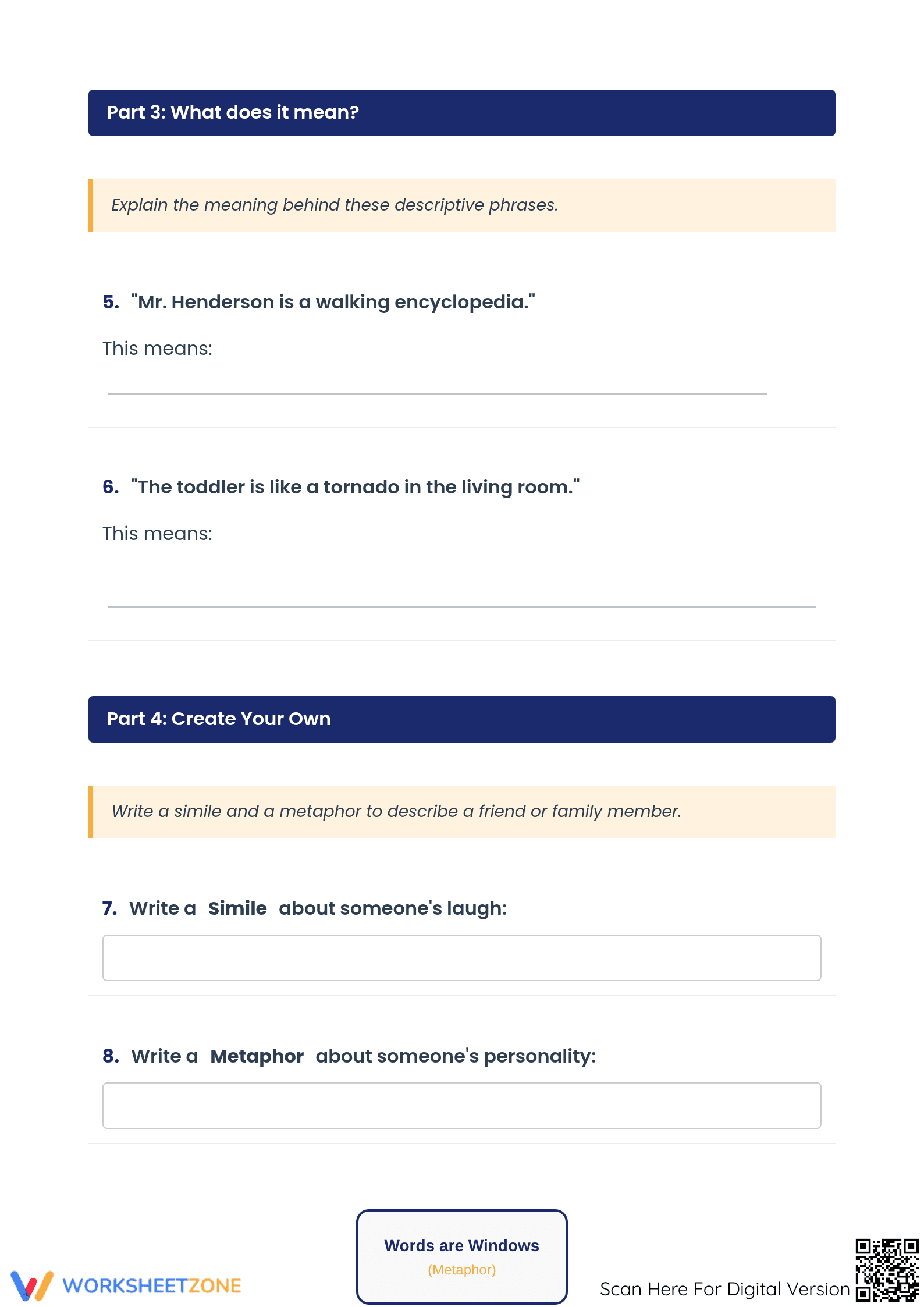
The two-page PDF includes a clear reference table defining similes and metaphors with illustrative examples. It features four identification questions, two open-ended interpretation prompts where students explain the meaning of specific phrases, and two creative writing tasks. A full answer key is provided for rapid grading or student self-correction.
Zero-Prep Workflow
- Print: Download and print the double-sided PDF for your class in under 1 minute.
- Distribute: Hand out the sheets as a bell-ringer or supplemental activity during your descriptive writing unit.
- Review: Use the included answer key for a 5-minute whole-class review or peer-grading session.
This resource is an ideal "grab-and-go" sub plan or homework assignment that requires zero teacher setup time.
Standards Alignment
The worksheet aligns directly with `CCSS.ELA-LITERACY.L.7.5`, which requires students to demonstrate understanding of figurative language. By requiring students to explain "what it means," the tasks specifically target the interpretation of figures of speech in context. Both standard codes can be copied directly into lesson plans, IEP goals, or district curriculum mapping tools.
How to Use It
Use this worksheet during the "Guided Practice" phase of a lesson on descriptive writing. After introducing the concepts, have students complete the identification section in pairs before moving to the creative writing tasks independently. It also serves as an excellent formative assessment tool to check for misconceptions before students begin a larger narrative writing project. Expect completion within 20 minutes.
Who It's For
This resource is tailored for middle and early high school students (Grades 7-9) who need to refine their descriptive writing skills. It is particularly effective for English Language Learners who benefit from the explicit "Mechanism" table. Pair this with a short story or poem analysis to see these devices used in a professional literary context.
Research from Fisher & Frey (2014) emphasizes the importance of the gradual release of responsibility, a model this worksheet follows by transitioning from identification to creation. By explicitly teaching the "mechanism" of figurative language—such as the use of "like" or "as" in similes—students are better equipped to decode complex texts. According to CCSS.ELA-LITERACY.L.7.5, mastering these nuances is critical for reading comprehension and sophisticated writing. This 2-page resource provides 8 targeted tasks that bridge the gap between rote recognition and functional application. AI-driven analysis of similar ELA materials suggests that structured practice in interpreting metaphors significantly improves student performance on standardized assessments like the NAEP. This worksheet serves as a reliable tool for achieving these instructional benchmarks in any secondary English classroom.


