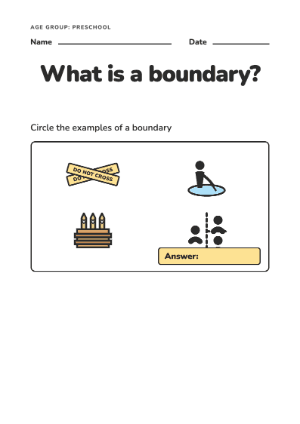
These boundaries worksheets for 9th grade give health teachers, counselors, and advisory staff a practical format for one of the harder SEL skills to teach directly — naming a limit, noticing when one has been crossed, and responding in language that holds up in the hallway, the group chat, or an early relationship. Ninth grade is when the social landscape shifts fast enough that students can often sense something feels wrong before they can say what it is or why.
What Students Practice Across the Set
Each worksheet targets a different layer of boundary work rather than cycling through the same definition-to-reflection loop. Students sort scenarios as healthy, unclear, or crossed. They rewrite vague statements — "that makes me feel bad" — into direct ones: "I'm not available to respond to texts after ten at night." They analyze digital situations, friendship dynamics, and early relationship patterns where the stakes are real but the available language is thin. One worksheet focuses specifically on telling the difference between caring behavior and controlling behavior, which is a distinction ninth graders can make when they have concrete examples in front of them rather than abstract definitions in a lecture.
The set also builds in sentence stem practice, and this is not just a support structure for students who struggle with writing — it is a deliberate practice move. Hearing "I need more time before I decide" said aloud, or writing it down in a guided activity, builds the automaticity students need to actually produce that sentence in a real moment. The gap between knowing a boundary exists and stating one calmly is where the practice matters most.
Student Mistakes Worth Addressing Before the Lesson Starts
The most consistent error in 9th grade boundary work is confusing a boundary with a rejection. When a scenario shows someone saying "I don't want to share my password," a significant number of students mark that response as unfriendly or mean rather than clear and reasonable. That misread usually reflects an absorbed peer norm — that saying no damages relationships. It is worth surfacing this assumption explicitly before any written activity begins, because students who hold it will default to passive or softened language even when a prompt is asking for directness.
A second pattern: students write feelings when prompts ask for responses. Asked what they would say in a given situation, many write "I would feel uncomfortable" instead of drafting actual words. The distinction between naming an internal state and producing usable language is not obvious at 14. A step-by-step structure built into each worksheet — notice the feeling, name the limit, choose the words — addresses this directly without requiring students to already understand the difference before they begin.
How to Work These Worksheets Into Your Lesson Plans
The strongest use sequence starts with scenario sorting before any reflective writing. When students evaluate fictional situations first, they build shared vocabulary and reduce the defensiveness that sometimes surfaces when the topic feels close to home. A 25-minute advisory block works well: three to four minutes of framing, ten minutes of scenario work, eight minutes of sentence stem practice, and a brief exit ticket. That leaves transition time without cutting the conversation mid-thought.
In health class, boundaries worksheets for 9th grade fit naturally inside a healthy relationships unit, a consent lesson, or a communication skills sequence. Teachers often use one worksheet as a warm-up before a role-play activity or as a formative check after a video or class discussion. In a counseling group, the same worksheet can be slowed down considerably — pausing after each scenario to talk through tone, word choice, and what body language might be communicating alongside the words.
For sub plans, these worksheets are reliable. The instructions read clearly without the teacher present, the scenarios don't require prior content knowledge to engage with, and the sentence stem activities give students enough structure to work independently. That is a practical advantage experienced teachers recognize quickly.
Adjusting These Worksheets Across Student Readiness Levels
Students who are still working on identifying emotions at all need the scenario-sorting worksheet as their starting point — not the open reflection prompts. For those students, labeling each situation as comfortable, uncomfortable, or unsure is a meaningful first step that builds the awareness more complex tasks require later. Moving too quickly to "what would you say" questions before students can name what they feel tends to produce one-word answers or quiet avoidance.
On the other end, students who move through scenarios quickly can push further with the sentence stems. Invite them to generate two or three alternatives for the same situation, then evaluate which is clearest, which is most direct without becoming aggressive, and which they would realistically use in the moment. That extension task develops analytical thinking without requiring a separate worksheet entirely.
For English language learners, the sentence frames in these worksheets do more than reduce writing demand — they keep the conceptual task intact while lowering the language production barrier. "I am not comfortable when..." or "I need you to stop..." as printed frames allow students to engage with the full thinking task. Pairing that with a brief partner conversation before writing extends access for most ELL students without requiring a different activity altogether.
Standard Alignment
These worksheets align with National Health Education Standard 4, which calls on students to use interpersonal communication skills to enhance health and avoid or reduce health risks. At the 9th- and 10th-grade performance level, that includes demonstrating refusal skills, conflict management, and negotiation — all of which these activities address through direct language practice. In most school contexts, NHES Standard 4 is the explicit rationale for teaching communication skills inside health or advisory instruction rather than assuming students develop them through informal social experience. The scenario work and sentence stem practice in each worksheet target that performance expectation directly.
These worksheets also reflect CASEL's Relationship Skills competency, which covers communicating clearly, listening actively, and resisting social pressure. For schools using a CASEL-aligned SEL framework, the content maps naturally to goals already embedded in advisory, homeroom, or school-wide programming.
Frequently Asked Questions
Are these worksheets appropriate for whole-class use, or only small counseling groups?
Both settings work. The scenario-based format keeps the activity at a comfortable distance for most students — they are analyzing situations rather than disclosing personal experiences — which makes whole-class use in health or advisory manageable. In a counseling group, the same activities support deeper conversation because the adult can pause after each scenario and coach students through tone, word choice, and response options. The worksheet functions as a shared reference point in either context.
Should friendship and dating scenarios be covered in the same worksheet, or kept separate?
Each worksheet in the set concentrates on one primary context rather than mixing them. When students work through a friendship scenario alongside a dating scenario, they often apply different standards to each without noticing the inconsistency — expecting far more accommodation from a friend, for example, than from someone they are dating. Keeping the contexts separate first, then discussing what the examples share, tends to produce more honest reflection than mixing them from the start.
How should I prepare for the possibility of a student disclosing a real situation?
Have a clear plan before distributing any boundaries worksheets for 9th grade. At the start of the activity, establish that the task focuses on analyzing fictional situations and practicing language — not sharing personal stories. Remind students where to find support if they need it. If a disclosure happens, follow your school's reporting protocol: pause the class, speak with the student privately, and involve the right staff member. The worksheet format does not generate disclosures on its own, but the topic can, and teachers who work with this content should be prepared before the lesson begins.
What if students resist engaging seriously with the scenarios?
Resistance at the start of a boundary lesson usually reflects discomfort with the topic rather than actual disagreement with the content. Starting with the sorting task — labeling situations rather than producing language — lowers the stakes and tends to draw more students in, because evaluating is less exposed than performing. Offering a third-person response option ("how might someone handle this") instead of a first-person one ("what would you do") also helps. The boundaries worksheets for 9th grade set includes enough variety in task format that teachers can choose the entry point that fits their class's comfort level, then move toward more direct practice as the group settles into the material.
















 Interactive Worksheet Maker
 Quiz Maker
 Word Search Maker
 Crossword Puzzle Maker
 Word Scramble Generator
 Sentence Scramble Generator
 Handwriting Worksheet Generator
 Name Tracing Generator
 Fill In The Blank Generator