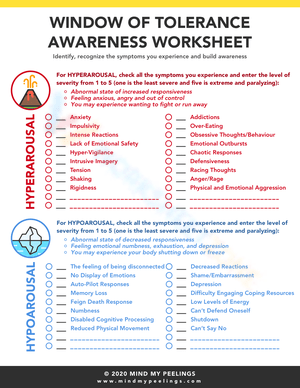
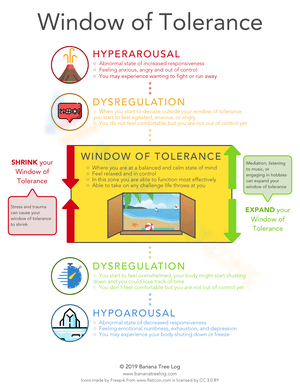
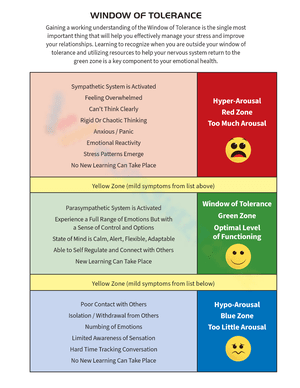
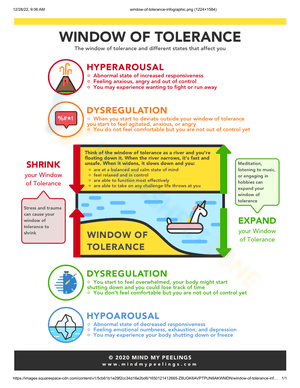
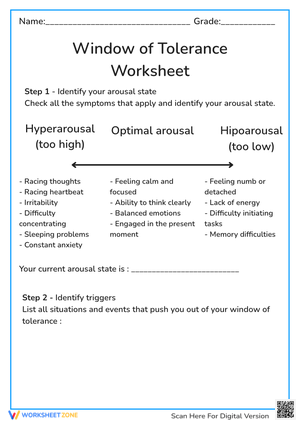
These window of tolerance worksheets printable for 9th grade give classroom teachers and school counselors a set of structured, self-directed activities for building emotional regulation skills at exactly the moment students need them — the first year of high school, when academic pressure and neurological development collide in predictable, disruptive ways. Each worksheet targets a specific layer of self-awareness: recognizing physical warning signals, mapping personal triggers, and building a coping-strategy repertoire students can actually use mid-class.
Why the Ninth Grade Year Is the Right Moment for This Work
The prefrontal cortex — responsible for impulse control, sequential planning, and slowing down before reacting — doesn't reach full maturity until the mid-twenties. At fourteen or fifteen, the amygdala runs fast while the braking system is still under construction. Ninth graders don't experience this as a developmental abstraction; they experience it as a test that suddenly feels catastrophic or a hallway conflict that escalates in a way that surprises even the student who started it. The window of tolerance framework externalizes that experience, giving students a concrete map of internal states so they can observe what's happening rather than be consumed by it.
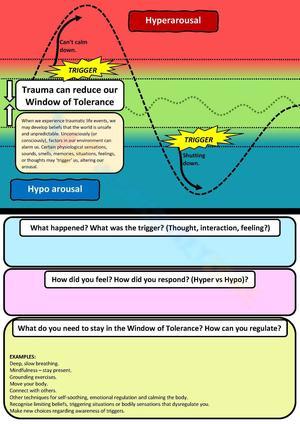
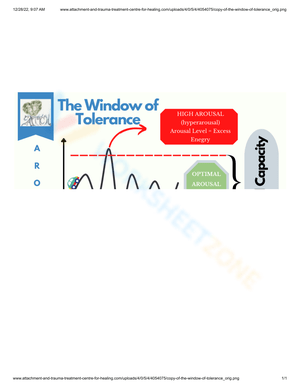
This also matters because ninth graders tend to interpret dysregulation as personal failure. A student who freezes during a presentation assumes something is wrong with them, not that their nervous system is responding to a perceived threat. Naming the states — hyper-arousal, hypo-arousal, optimal zone — reframes the experience as physiological and workable, which is a fundamentally different relationship to difficulty than most ninth graders walk into high school carrying.
The Specific Skills Each Worksheet Builds
The set covers four interconnected skill areas, and the order of introduction matters. Students need the conceptual vocabulary before the self-mapping activities produce anything useful. Introducing each skill area through a separate worksheet keeps the cognitive load manageable and lets teachers space the concepts across several sessions rather than compressing everything into one overstuffed lesson.
- Trigger identification: Students name specific situations that push them toward dysregulation — high-stakes exams, cold-calling in class, peer conflicts — and note whether each trigger tends to produce hyper-arousal or hypo-arousal. That distinction matters because the effective coping strategies for each state differ.
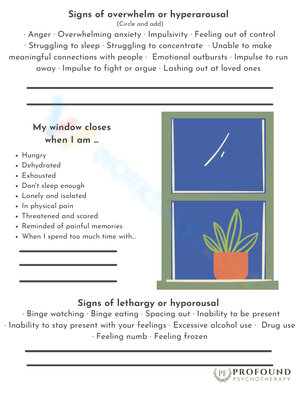
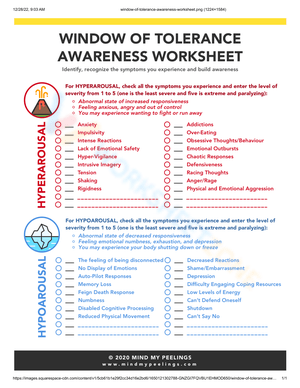
- Physical early-warning signals: One worksheet asks students to identify their personal pre-signals before full dysregulation sets in. Students often surface patterns they hadn't consciously registered: a tightening in the chest before a presentation, a sudden inability to track text on the page, an impulse to reach for their phone that feels impossible to override.
- Coping-strategy toolkit: Students select and practice grounding techniques — rhythmic breathing, the 5-4-3-2-1 sensory countdown, pressing both feet flat on the floor — and record which ones actually work for them. The completed worksheet becomes a personal reference, not a generic list copied from a slide.
- Environmental factors: A separate worksheet prompts students to examine how sleep, nutrition, and screen time affect their daily emotional bandwidth. Particularly productive before exam stretches, this activity makes the connection between lifestyle habits and stress capacity visible in concrete terms.
Student Errors Worth Anticipating Before You Begin
The most consistent problem is students — and sometimes teachers — conflating hypo-arousal with disengagement or laziness. A student in a freeze state looks like they've tuned out. They're quiet, not disruptive, so the classroom response is often to leave them alone or mark them absent for participation. The worksheet on hypo-arousal markers addresses this directly: it walks through the physical specifics — difficulty forming words, a feeling of heaviness, staring at a page without tracking the text. Once students can name the state, they stop treating it as a personal flaw, and teachers gain a more accurate read on what they're actually seeing.
The second persistent pattern is a retrieval-under-stress gap. Students can identify their triggers accurately in retrospect but miss them entirely in real time — which is exactly when recognition matters. The trigger-mapping worksheet helps, but the more useful extension is asking students to annotate their list with physical pre-signals, so that "presenting in English class" becomes "presenting in English class → shoulders lock up → breathing gets shallow → start losing the thread of what I was saying." That causal chain gives students something to catch before they're already fully dysregulated.
A third issue specific to ninth grade: students who encountered window of tolerance content in a middle school counseling group sometimes rush through these worksheets, treating them as review. Brief class discussion after independent work quickly surfaces whether students are applying the framework to their actual ninth-grade stressors or just writing answers they know are acceptable. Vague responses — "my trigger is stress" — are a reliable sign the transfer hasn't happened yet.
Fitting These Worksheets Into Your Teaching Week
The foundational rule: introduce the concept when students are regulated, not during a crisis. Advisory period, the first ten minutes of a health class, or a Monday morning check-in all work. When students are calm, the prefrontal cortex is available and can actually process the conceptual framework. Explaining hyper-arousal to a student who is already spiraling in the hallway is a categorically different task.
The window of tolerance worksheets printable for 9th grade work best as a sequence spread across two or three weeks rather than packed into a single class period. Introduce the zones-of-arousal vocabulary first, then have students complete the trigger-mapping worksheet as a take-home assignment so they're observing themselves across real situations, then debrief in small groups. That pacing allows students to return to the framework with actual data from their own lives rather than hypothetical answers written under time pressure.
The body-scan activity is the one most worth building into a recurring routine. Running a 90-second structured body check before a unit exam recovers instructional time rather than losing it — students who catch early tension signals before the test begins spend less of the assessment cycling through an anxiety response. A quiet reminder to check their completed coping-strategy worksheet before a presentation achieves the same effect without disrupting anyone around them.
Adapting These Resources for Different Student Starting Points
Students with prior SEL instruction — many will have encountered this framework in a middle school counseling group — can move through the zones-of-arousal overview quickly and spend more time on trigger mapping and the coping toolkit, applying everything to their more complex ninth-grade stressors. For students who are new to the vocabulary, the zones worksheet needs to precede any self-mapping work. Asking a student to identify what sends them into hypo-arousal before they understand what hypo-arousal actually feels like produces surface-level answers that don't transfer to real situations.
The window of tolerance worksheets printable for 9th grade work well for independent written completion in most classroom settings, but the core activities — identifying triggers, naming body signals, selecting coping strategies — translate directly to verbal and visual formats for students in inclusion settings or for those who need the work facilitated in a small group. For students currently managing acute trauma or significant ongoing stress, these resources work best alongside one-on-one counseling rather than as standalone independent activities.
Standard Alignment
These worksheets align with CASEL's Self-Awareness and Self-Management competency domains, which underpin state-level SEL standards in Illinois (ISBE), California, New York, and most states with adopted SEL benchmarks. Specifically, they address identifying emotions and their physical manifestations, recognizing personal triggers, and applying intentional regulation strategies — skills that appear in ninth-grade health curricula and advisory frameworks. Schools operating under trauma-informed practices models will find these activities support the core principle of teaching students to recognize and manage physiological stress responses before dysregulation escalates into behavior requiring a different intervention entirely.
Frequently Asked Questions
Can classroom teachers use these, or are they for school counselors?
Both can use them. Health teachers and advisory teachers are the most natural classroom fit because they typically have flexible time to introduce the vocabulary first — a necessary step before any self-mapping worksheet produces useful responses. English teachers who run regular journaling or reflection blocks can integrate the self-assessment worksheets without significant additional preparation. School counselors most often use the full set in small-group SEL sessions, where they can facilitate discussion and respond to anything serious that surfaces. The window of tolerance worksheets printable for 9th grade work in both settings, as long as the core vocabulary is established before students begin the self-reflection activities.
What should I do if a student discloses something serious on the trigger-mapping worksheet?
Review completed worksheets before returning them. The trigger-mapping activity asks students to name their stressors, and occasionally a student will write something indicating a mental health concern or safety issue — statements about self-harm, abuse, or severe ongoing distress. Any such disclosure follows the same mandatory reporting process as any other disclosure in your school. These are not clinical tools, and the classroom teacher is not the right person to process a crisis disclosure independently. Reading worksheets before returning them allows you to address concerns through appropriate channels before a public discussion surfaces them unexpectedly.
Should students complete these individually or in groups?
Individual completion first, then discussion — not the reverse. Students who work through a group conversation without writing first tend to anchor to what peers share rather than their own experience. The written work produces more honest, specific responses. Discussion after individual completion lets students recognize shared patterns, which is both normalizing and motivating — particularly for students who assumed their stress responses were unusual or excessive. A pair-share or small-group debrief after independent writing is the most effective structure across most of these activities.












 Interactive Worksheet Maker
 Quiz Maker
 Word Search Maker
 Crossword Puzzle Maker
 Word Scramble Generator
 Sentence Scramble Generator
 Handwriting Worksheet Generator
 Name Tracing Generator
 Fill In The Blank Generator