


























Views
Downloads

Zero Exponents Worksheet | Grade 9 Math Ready
Paste this activity's link or code into your existing LMS (Google Classroom, Canvas, Teams, Schoology, Moodle, etc.).
Students can open and work on the activity right away, with no student login required.
You'll still be able to track student progress and results from your teacher account.
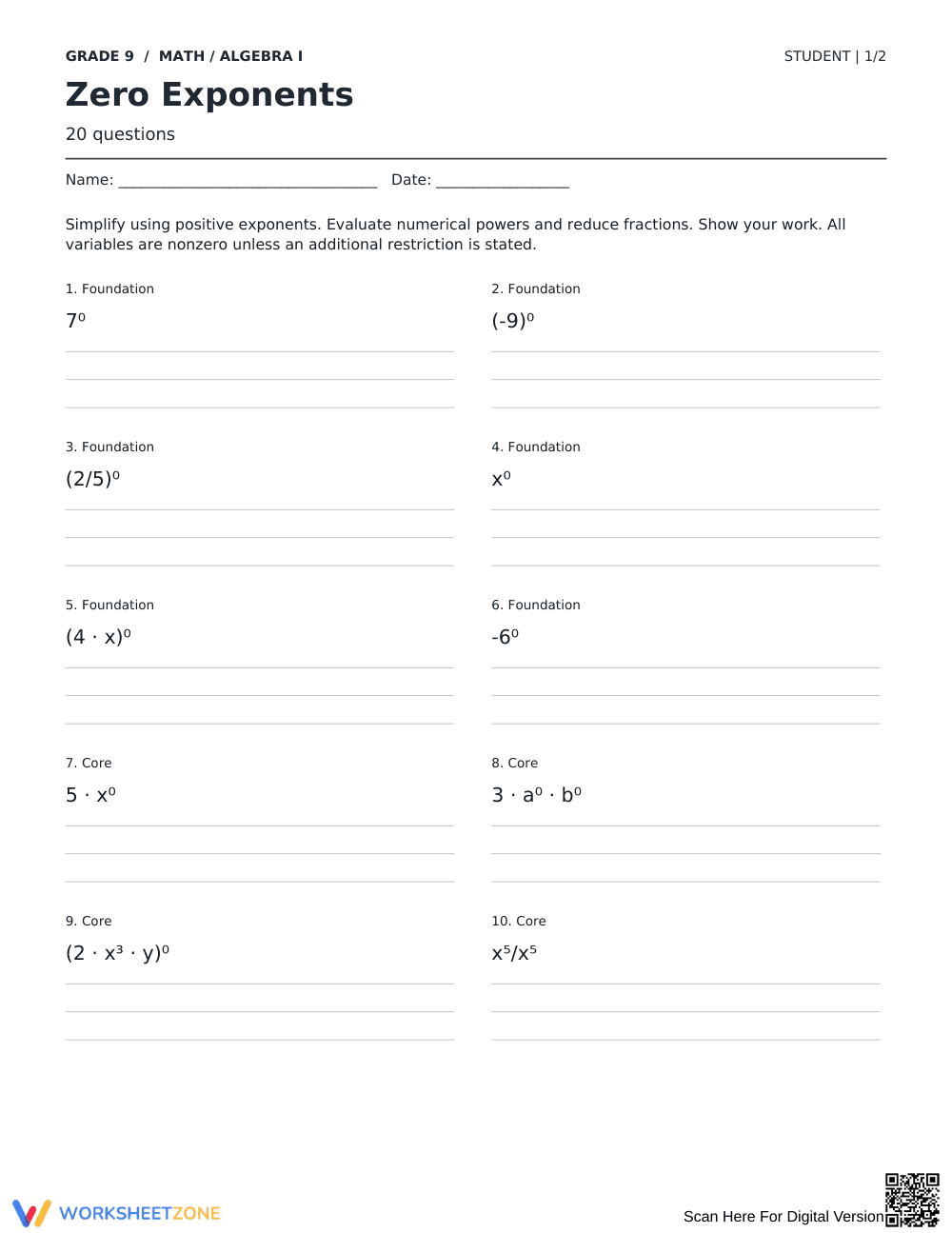
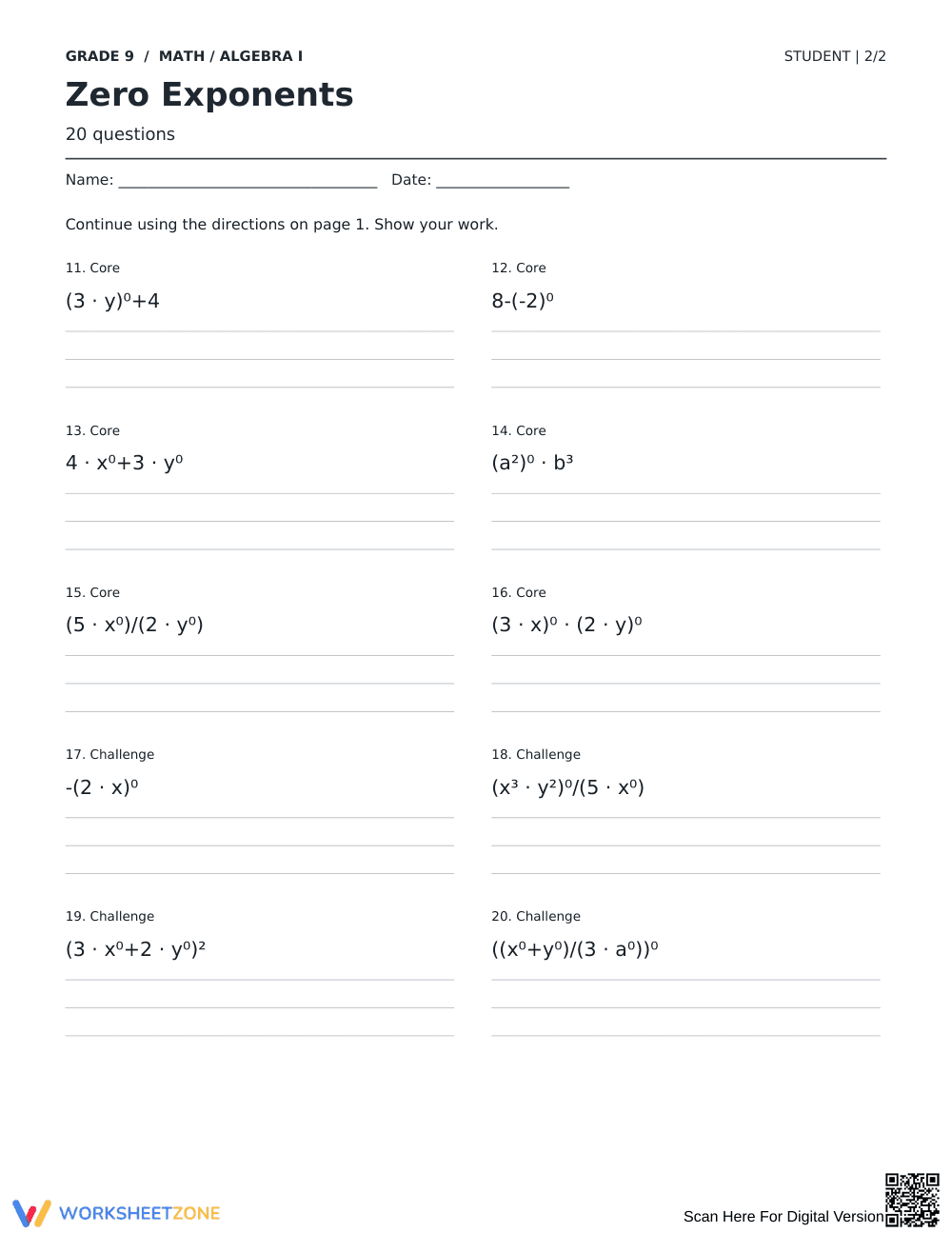
This zero exponents worksheet equips Grade 9 Algebra students to evaluate expressions with power zero and simplify complex variable terms. Learners master distinguishing between base-level zero powers and preceding coefficients or signs. Through 20 progressive tasks, students eliminate common algebraic misconceptions, developing computational fluency and structural confidence in foundational exponent rules.
At a Glance
- Grade: 9 · Subject: Algebra I
- Standard:
CCSS.MATH.CONTENT.8.EE.A.1— Apply integer exponent rules to evaluate numerical expressions and simplify algebraic terms.- Skill Focus: Zero exponent properties and order of operations
- Format: 2 pages · 20 problems · Answer key included · PDF
- Best For: Independent practice, homework, and prerequisite review
- Time: 25–40 minutes
What's Inside
This two-page PDF resource delivers 20 targeted algebraic items organized into three labeled tiers of difficulty: Foundation, Core, and Challenge. The worksheet includes dedicated multi-line workspaces for each question, prompting students to record intermediate operational steps. A two-page answer key provides step-by-step rationales, emphasizing negative signs outside parentheses and coefficient interactions.
Skill Progression
- Guided practice (Problems 1–6): Foundation exercises reinforce baseline definitions across single constants, parenthesized integers, fractions, variables, and standalone negated bases.
- Supported practice (Problems 7–16): Core items introduce mixed operations, combining zero powers with outside coefficients, quotients, sums, and multi-variable products.
- Independent practice (Problems 17–20): Challenge problems test advanced precision using negated groupings, layered parentheses, fractional power expressions, and compound powers of zero.
This structured progression reflects the gradual-release model, transitioning students smoothly from basic rule recall to multi-step expression evaluation.
Standards Alignment
The primary standard is `CCSS.MATH.CONTENT.8.EE.A.1`, requiring students to apply properties of integer exponents to generate equivalent expressions. In high school Algebra I, this review standard supports `CCSS.MATH.CONTENT.HSA-SSE.A.1` by helping students interpret parts of expressions, including terms and coefficients. Both standard codes can be copied directly into lesson plans, IEP goals, or district curriculum mapping tools.
How to Use It
Deploy this worksheet after direct instruction on zero powers to solidify rules before introducing negative exponents, or assign it for homework. During practice, check whether students distinguish -60 from (-9)0 to catch grouping errors early. Expected completion time is 25 to 40 minutes.
Who It's For
This resource supports Grade 9 Algebra I students and advanced Grade 8 classes reviewing exponent rules. It offers clear scaffolding for students who confuse base groupings. Pair this worksheet with an anchor chart demonstrating why non-zero bases to the power of zero equal one.
Mastery of integer exponent properties, as framed in CCSS.MATH.CONTENT.8.EE.A.1, requires learners to evaluate numerical bases and simplify variable terms using zero power rules. Understanding that any non-zero quantity raised to the power of zero equals one represents a critical conceptual milestone in algebraic reasoning. According to Fisher & Frey (2014), structured practice that transitions purposefully from guided foundation tasks to complex independent applications enables students to consolidate procedural fluency while reducing cognitive load. This worksheet organizes 20 tiered problems to address pervasive algebraic stumbling blocks, specifically the distinction between negative coefficients and bases enclosed in parentheses. By systematically working through single terms, combined sums, and multi-variable quotients, Grade 9 algebra students build the internal schema needed for high school polynomial operations. The included explanations ensure teachers can rapidly pinpoint procedural gaps, reinforcing enduring mathematical literacy across secondary learning environments.


