




























Views
Downloads


Printable Exponent Rules Worksheet: Negative & Zero Powers

Paste this activity's link or code into your existing LMS (Google Classroom, Canvas, Teams, Schoology, Moodle, etc.).
Students can open and work on the activity right away, with no student login required.
You'll still be able to track student progress and results from your teacher account.
This math worksheet helps students master negative and zero exponents through structured numerical and algebraic practice. Students will move from evaluating basic powers to simplifying complex expressions with multiple variables, ensuring a complete grasp of integer exponent properties. It is an ideal resource for Grade 7 and 8 learners building foundational skills for high school algebra.
At a Glance
- Grade: 8 · Subject: Math
- Standard:
CCSS.MATH.CONTENT.8.EE.A.1— Apply integer exponent properties to generate equivalent numerical expressions- Skill Focus: Negative and Zero Exponents
- Format: 2 pages · 22 problems · Answer key included · PDF
- Best For: Independent practice or homework assignments
- Time: 25–35 minutes
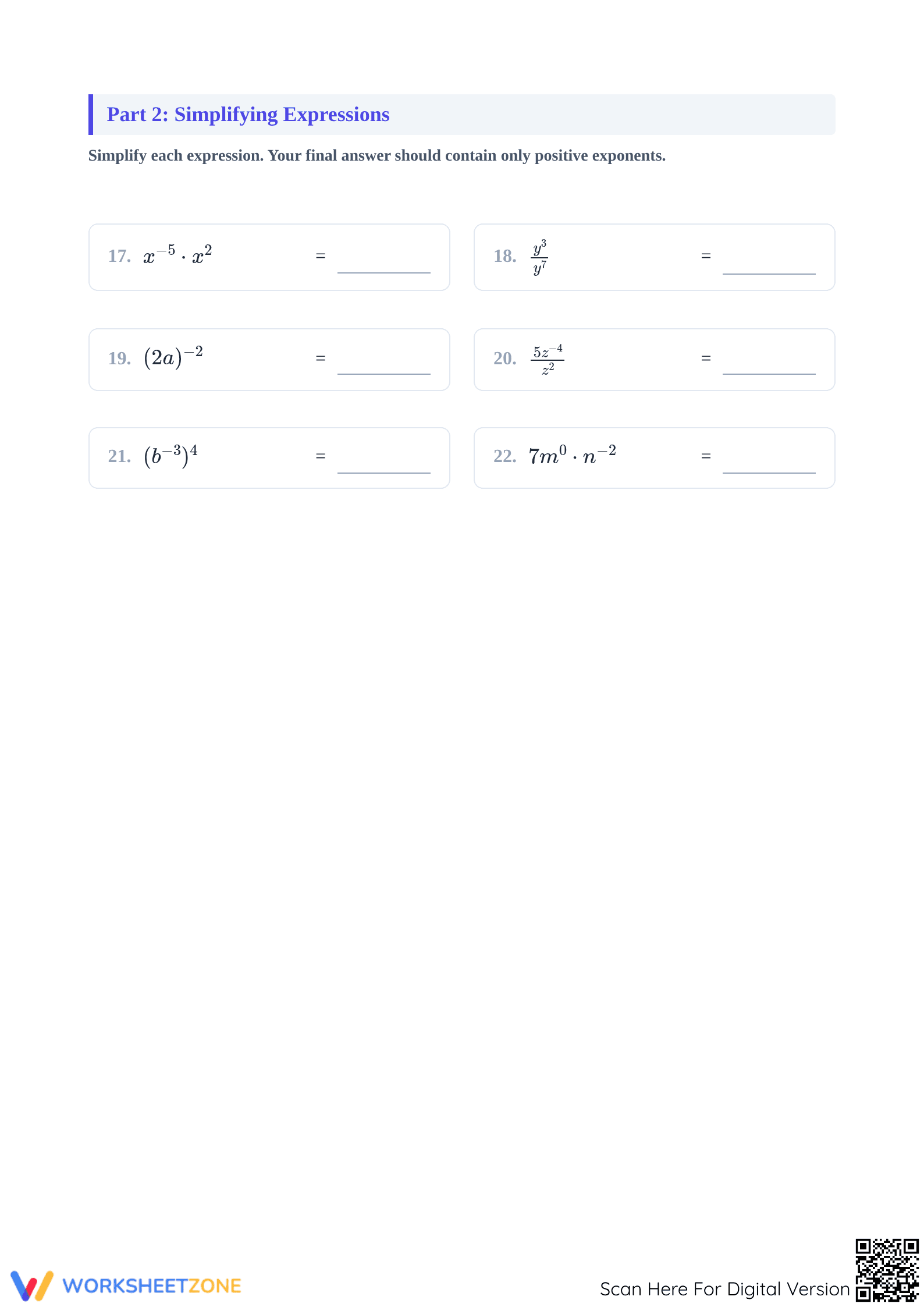
This 2-page PDF features 22 targeted problems designed for middle school mastery. Page one focuses on basic evaluation, requiring students to convert negative exponents into fractions or whole numbers. Page two advances to algebraic simplification, challenging students to apply exponent laws to variables. The document includes a full answer key for rapid grading and immediate student feedback.
Teachers can implement this resource in under two minutes. Simply print the two-page set (1 minute), distribute to the class for independent or partner work (30 seconds), and use the provided answer key for a whole-class review or individual grading (30 seconds). Its self-contained instructions make it an excellent choice for substitute plans or emergency math filler.
Aligned to CCSS.MATH.CONTENT.8.EE.A.1, this worksheet focuses on knowing and applying the properties of integer exponents to generate equivalent numerical expressions. It bridges the gap between basic arithmetic and algebraic fluency by introducing the reciprocal nature of negative powers. Both standard codes can be copied directly into lesson plans, IEP goals, or district curriculum mapping tools.
Use this worksheet as a formative assessment after introducing the rules of negative and zero exponents. During the activity, observe if students correctly identify zero exponents as one versus misapplying the rule as zero. Expected completion time ranges from 25 to 35 minutes, making it suitable for a standard class period transition or a rigorous homework task.
This resource is designed for Grade 7 and Grade 8 math students, particularly those struggling with the conceptual transition to integer powers. It serves as an effective scaffold for students in remedial algebra or as a review tool for higher-level students before moving into scientific notation. Pairs perfectly with interactive notebooks or exponent rule anchor charts.
According to the NAEP framework, proficiency in integer exponent properties is a critical gatekeeper for success in secondary mathematics and higher-order algebraic reasoning. This worksheet directly addresses the common misconception that negative exponents produce negative results, a frequent error cited in the Fisher & Frey (2014) research on gradual release of responsibility. By providing 22 structured opportunities to apply the CCSS.MATH.CONTENT.8.EE.A.1 standard, the resource ensures students internalize the relationship between base, power, and reciprocal. Systematic practice with both numerical and algebraic bases, as seen in this two-part layout, aligns with the ScienceDirect TpT Analysis regarding high-quality educational materials that promote mastery through varied task complexity. The inclusion of zero exponents further reinforces the identity property of multiplication, a foundational concept for all future coursework in functions and exponential growth models.


