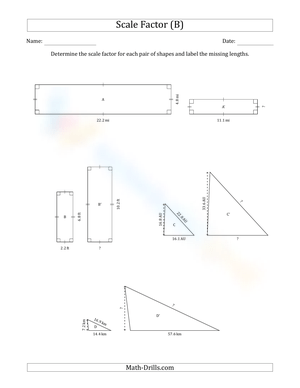
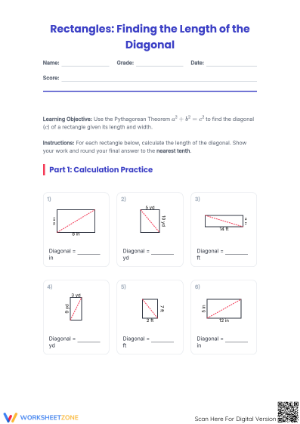
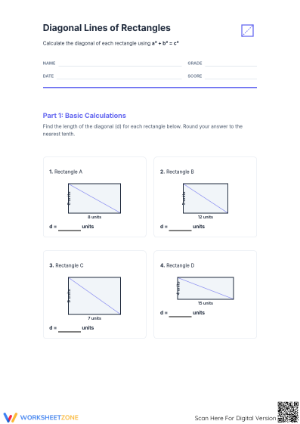
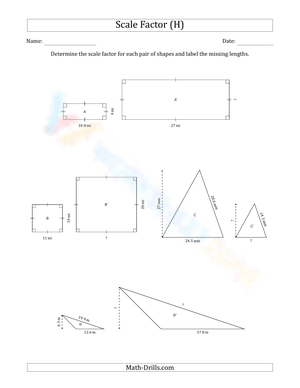
These 8th grade pythagorean theorem worksheets resources give teachers a printable set that moves through the full sequence of right-triangle skills Grade 8 students need — from first identifying which side is the hypotenuse to solving applied problems where the right angle isn't labeled and students must locate it on their own. Each worksheet carries an answer key, making the set workable for independent practice, stations, homework, and sub plans without extra preparation.
The Errors Worth Catching Before They Become Habits
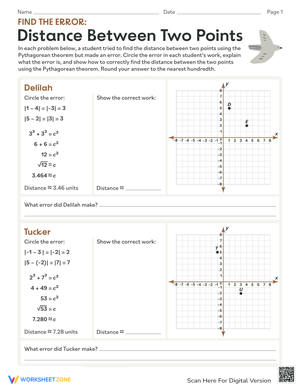
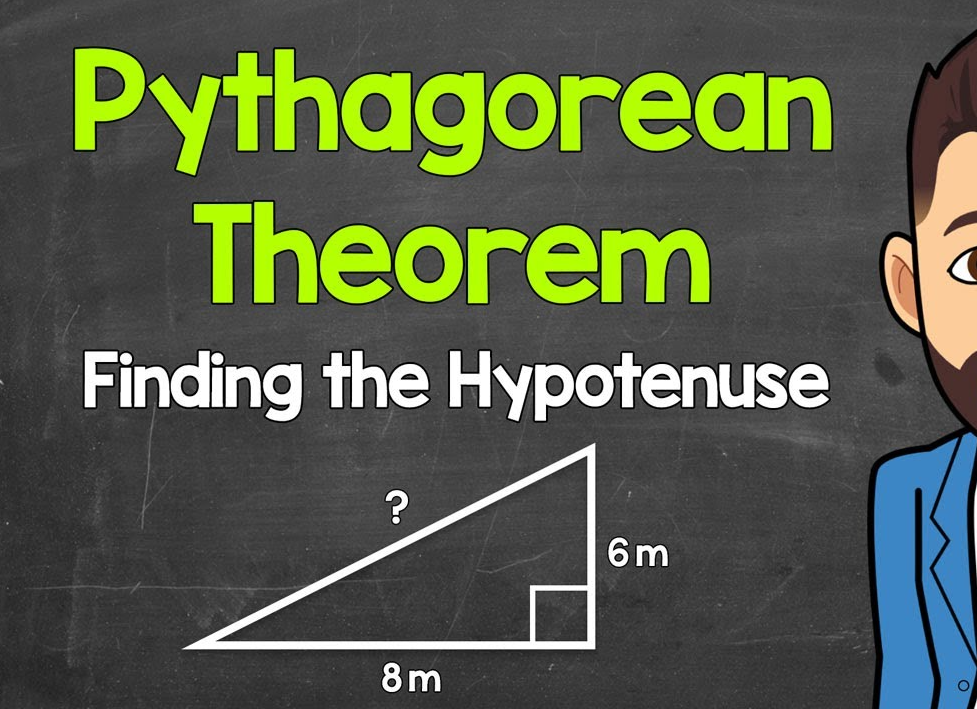
The Pythagorean theorem produces a small set of very predictable mistakes, and knowing them in advance makes it easier to watch for them during practice. The most common error isn't in the squaring step — it's what happens after. A student who correctly writes 6² + 8² = c² will often compute 36 + 64 = 100 and report c = 100. The arithmetic is right; the student just stopped one step too early, forgetting that c² = 100 still requires taking the square root to reach c = 10. This pattern appears often enough across classrooms that it's worth pausing mid-lesson to name the final step explicitly before students continue independently.
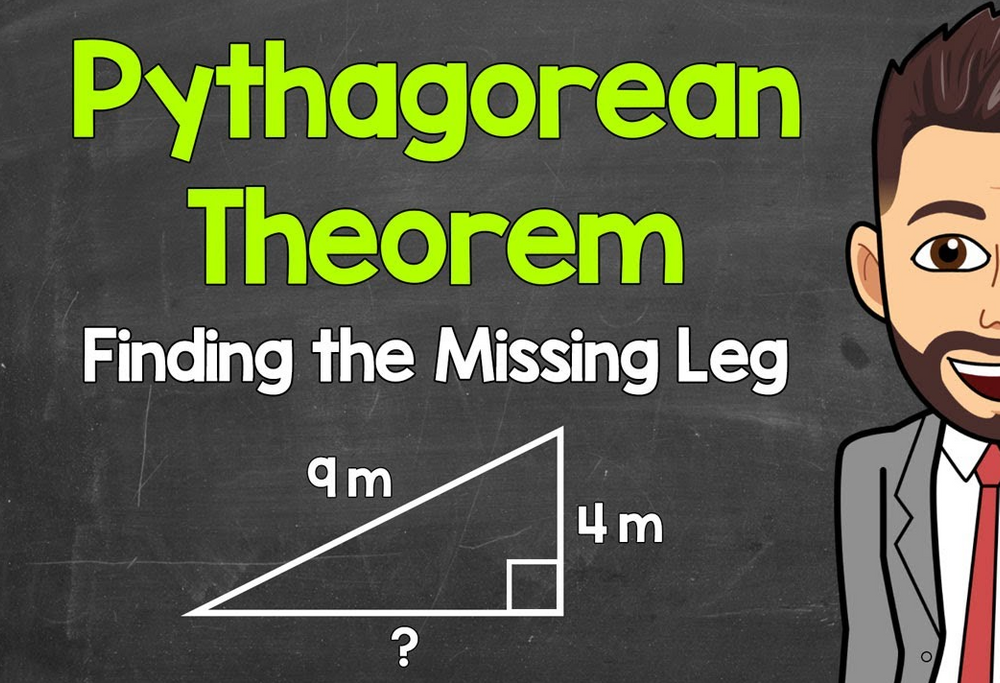
When the unknown is a leg rather than the hypotenuse, a different error surfaces. If a = 5 and c = 13 and students need to find b, many will set up 25 + b² = 169 correctly and then subtract 5 — not 25 — from 169, arriving at b² = 164 instead of 144. They substitute the squared value into the equation but revert to the original number when subtracting. These worksheets group leg-solving problems together early so teachers can spot this pattern across a whole class's papers at once, rather than discovering it one student at a time during grading.
A few other misconceptions appear reliably:
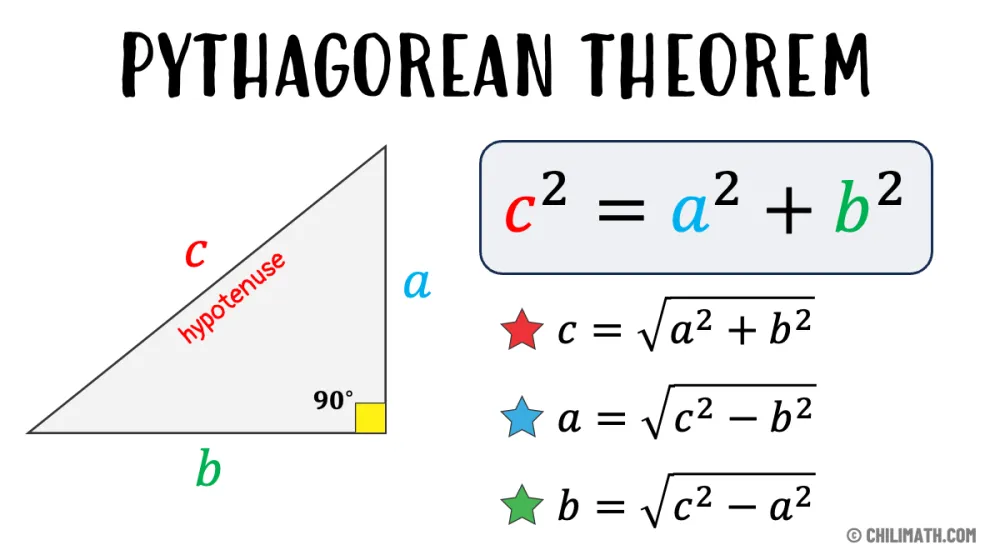
- Writing a + b = c from memory instead of the squared version
- Applying the theorem to any triangle, not just right triangles — especially when problem wording says "triangle" without specifying the angle
- Labeling the longest visible side as the hypotenuse without confirming the right angle first
- Omitting units in word problems, or rounding a decimal mid-calculation in a multi-step problem
What Each Worksheet Targets
Finding a complete set of 8th grade pythagorean theorem worksheets practice that covers all three phases — identification, computation, and application — in one collection saves teachers from pulling resources from multiple sources. The progression here starts with right-triangle identification and hypotenuse labeling, moves to solving for the hypotenuse with integer inputs, then shifts to the algebraically trickier task of isolating and solving for a missing leg. Each phase gets enough problems to build real fluency before the next begins.
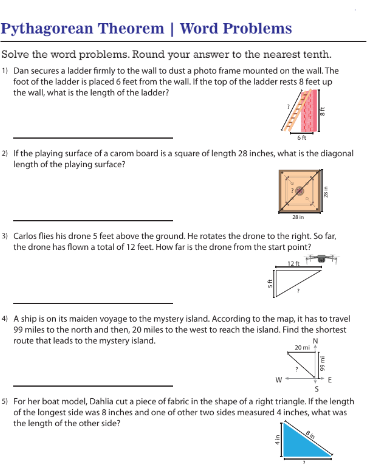
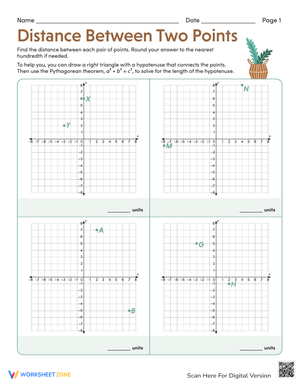
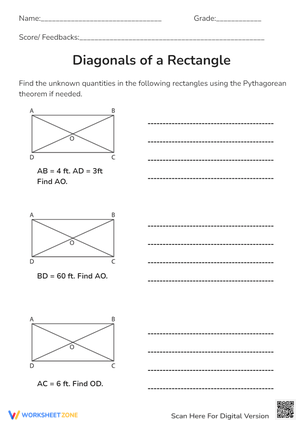
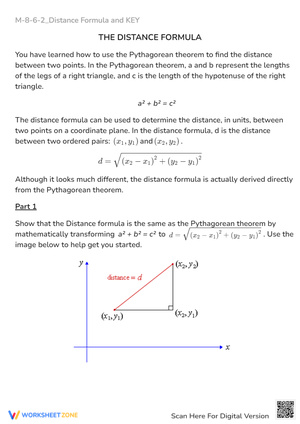
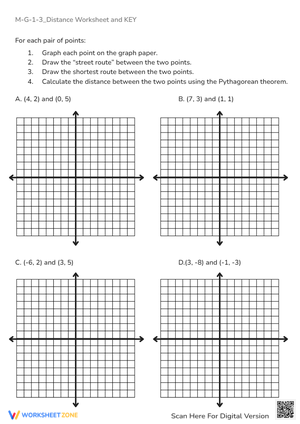
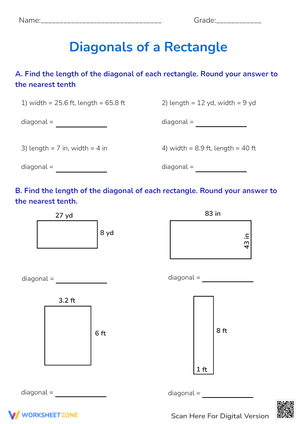
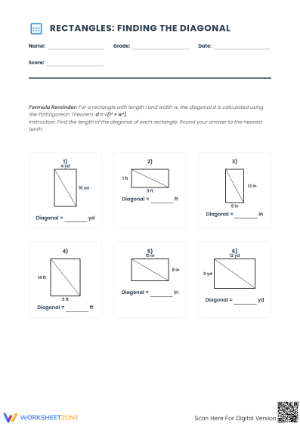
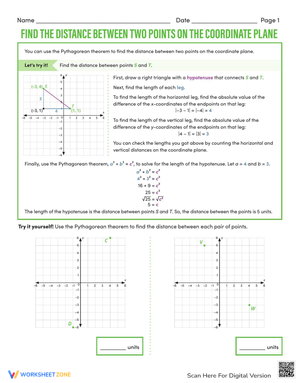
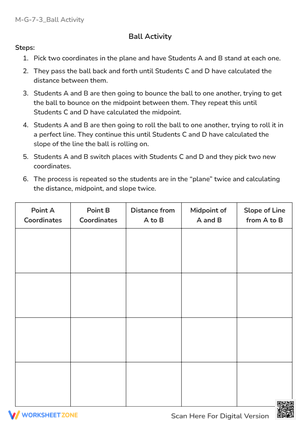
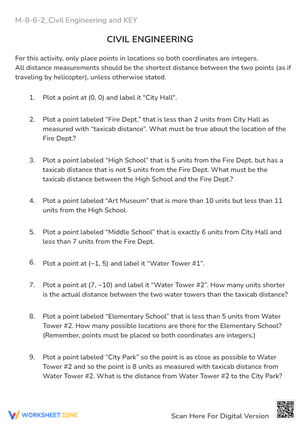
The application worksheets push students into contexts where the triangle isn't handed to them pre-labeled: finding the diagonal of a rectangle, calculating the straight-line distance between two coordinate points, or determining the length of a ladder reaching a specific height. These are still right-triangle problems at their core, but students have to identify the geometric structure before the calculation begins. That transfer step — recognizing a right triangle embedded in a real-world situation — is where Grade 8 students need the most deliberate practice, and where the class discussion around a well-constructed word problem matters as much as the written work beside it.
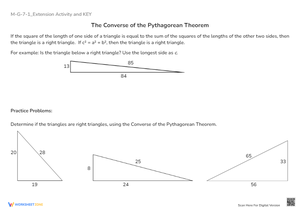
- Right-triangle identification — confirming the right angle before applying any formula
- Hypotenuse and leg labeling — distinguishing sides by position relative to the right angle, not just by length
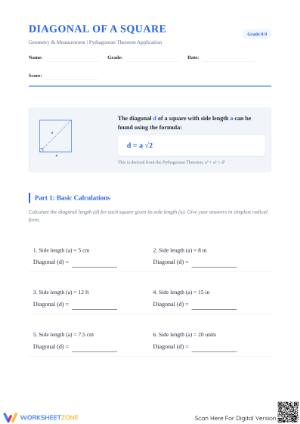
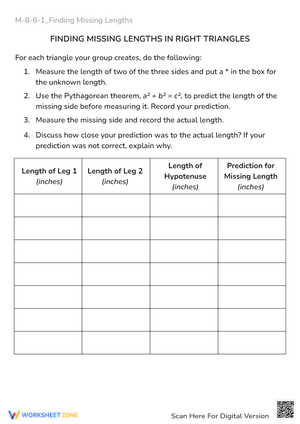
- Solving for the hypotenuse — setting up and evaluating a² + b² = c² with integer and decimal inputs
- Solving for a missing leg — rearranging the equation correctly before computing the square root
- Mixed problem types — problems where students choose the equation setup without a prompt
- Application and word problems — diagonals, coordinate distances, and real-world scenarios
How to Build These Worksheets Into Your Lesson Arc
On the first day introducing the theorem, use a worksheet with clearly drawn right triangles, integer side lengths from familiar triples (3-4-5, 5-12-13), and enough vertical space for students to write squaring, addition, and square root on separate lines. That layout slows the work down intentionally — making each step visible before speed matters. A common early mistake is releasing students to a mixed worksheet too quickly, before the procedure has any real structure behind it.
By day three or four, a short bell ringer with two or three mixed missing-side problems — one where students solve for the hypotenuse, one for a leg, one where they have to decide which — takes about eight minutes at the start of class. In a 50-minute middle school period, that leaves the rest of the lesson for deeper application work while giving the teacher a fast read on where students are still uncertain. That brief check reveals more than a longer warm-up would, because it separates students who understand the structure from students who have been pattern-matching the previous day's lesson type.
For sub plans, the self-contained format — directions printed on each worksheet, diagrams or contexts provided, answer key included — holds up without teacher explanation. Students can self-check or peer-check at the end of the period. During a geometry unit where instructional continuity matters, that independence is practical and worth planning for.
Tailoring Each Worksheet for Different Learner Readiness
Students who are shaky on perfect squares — confident on 5² = 25 but uncertain on 12² or 13² — work more accurately when a reference list of squares through 225 is clipped to the top of their worksheet. That removes a working-memory bottleneck so attention stays on the theorem's structure rather than arithmetic retrieval. Once the squares are automatic, the list comes off.
For students ready for more, the application worksheets offer the most natural extension. Ask those students to sketch the right triangle from the word problem before writing any equation — a step many advanced learners skip because it feels unnecessary, but one that catches diagram-extraction errors before calculation begins. A second useful challenge: after solving, substitute all three values back into a² + b² = c² to confirm the equation holds. That verification habit shows up repeatedly in algebra, and students benefit from practicing it during geometry before it becomes a formal expectation.
Organizing 8th grade pythagorean theorem worksheets sets by task type — one focused on hypotenuse problems, one on leg-solving problems, one on mixed application — lets students identify their current set at a glance and lets teachers pull a small group for targeted work without restructuring the whole lesson around it.
Standard Alignment
These worksheets align to CCSS.MATH.CONTENT.8.G.B.7, which requires students to apply the Pythagorean theorem to determine unknown side lengths in right triangles in both mathematical and real-world problems. In a typical 8th grade geometry sequence, this standard arrives after students have worked with angle relationships and transformations — placing it in the second half of the geometry domain and toward the later portion of the school year. Worksheets that include coordinate-grid problems also address CCSS.MATH.CONTENT.8.G.B.8, which extends the theorem to finding distances between points in a coordinate plane and serves as a natural bridge toward the distance formula students encounter in high school algebra.
Frequently Asked Questions
How many problems per worksheet is enough for meaningful practice without overloading students?
Eight to twelve problems is a useful range for skill-focused work. Fewer than eight gives students too little repetition to internalize a multi-step procedure. More than twelve risks pushing a class period into time pressure — and when students rush through the final problems, the error patterns teachers most need to identify get masked by speed. For homework or review, six to eight mixed problems are more useful than a long worksheet of identical setups, because variety requires students to choose the correct approach each time rather than repeating one procedure.
When should word problems replace pure equation practice?
Most students need two or three class sessions working from problems where the triangle is drawn and labeled before word problems feel approachable. Introducing applied tasks earlier layers reading-comprehension and diagram-extraction demands on top of a procedure students haven't yet made automatic. Once students can reliably set up and solve both missing-hypotenuse and missing-leg problems from diagrams, word problems become the logical next step rather than a source of avoidance.
Can these worksheets hold up at an independent station without the teacher present?
The self-contained structure — directions, diagrams, and an answer key on each worksheet — makes independent station use workable. In a rotation model, a teacher-led table can handle the algebraically demanding leg-solving problems while students at an independent station work through hypotenuse practice or application tasks. Between rotations, resetting the station means replacing the worksheets, nothing more.
Are these appropriate for test review, or are they better suited to initial instruction?
The most effective way to use 8th grade pythagorean theorem worksheets materials in a review context is to select a set where problem types appear in unpredictable order — students shouldn't be able to tell from context whether they're solving for a leg or a hypotenuse before reading the full problem. That randomization mirrors actual test conditions and surfaces students who can execute one procedure in isolation but haven't yet generalized across problem types. The mixed-review worksheets in this set are built for exactly that purpose.













 Interactive Worksheet Maker
 Quiz Maker
 Word Search Maker
 Crossword Puzzle Maker
 Word Scramble Generator
 Sentence Scramble Generator
 Handwriting Worksheet Generator
 Name Tracing Generator
 Fill In The Blank Generator