


























Views
Downloads
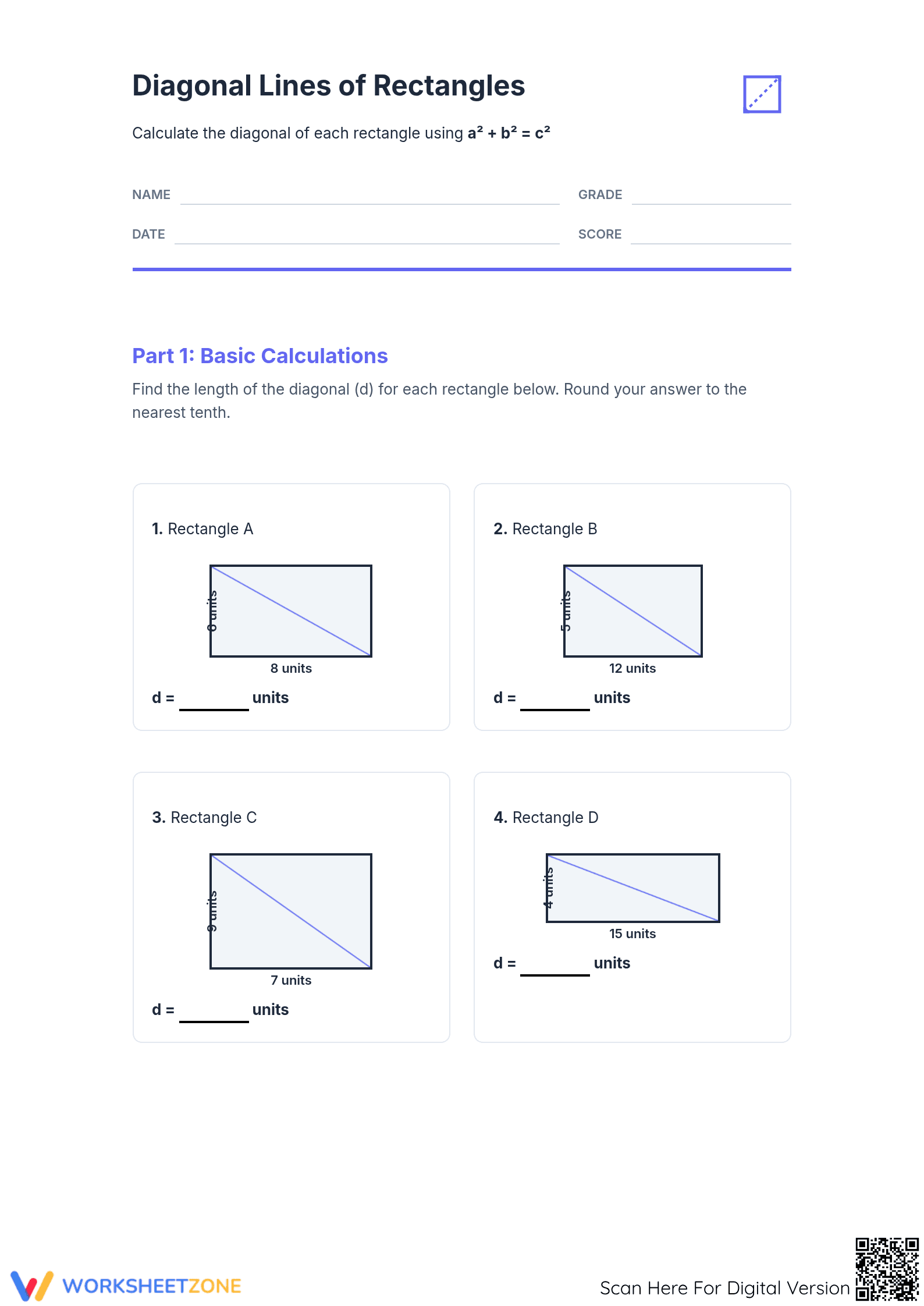


Essential Diagonal Lines of Rectangles Worksheet Grade 8
Paste this activity's link or code into your existing LMS (Google Classroom, Canvas, Teams, Schoology, Moodle, etc.).
Students can open and work on the activity right away, with no student login required.
You'll still be able to track student progress and results from your teacher account.
Master the Pythagorean theorem by calculating the diagonal lines of rectangles with this comprehensive geometry worksheet. Designed for Grade 8 students, this resource bridges the gap between abstract formulas and concrete spatial reasoning. Students will learn to identify right triangles within rectangles to find missing lengths, ensuring a solid foundation for high school trigonometry.
At a Glance
- Grade: 8 · Subject: Geometry
- Standard:
CCSS.MATH.CONTENT.8.G.B.7— Apply the Pythagorean Theorem to find unknown side lengths in mathematical and real-world problems.- Skill Focus: Calculating rectangle diagonals
- Format: 2 pages · 8 problems · Answer key included · PDF
- Best For: Homework, math centers, or formative assessment
- Time: 20–30 minutes
This two-page PDF includes eight structured problems that challenge students to apply the Pythagorean theorem. Page one features four geometric diagrams where students find the diagonal (d) of various rectangles. Page two transitions to three real-world word problems and a bonus area calculation challenge. The layout provides ample workspace and a clear answer key for immediate feedback.
Skill Progression
- Guided Practice: The worksheet begins with labeled diagrams of rectangles, where side lengths are clearly provided to help students set up the a² + b² = c² equation.
- Supported Practice: Real-world applications, such as finding the length of a garden fence or a laptop screen diagonal, require students to translate text into geometric models.
- Independent Practice: The bonus challenge pushes students toward higher-order thinking by requiring them to find the area of a square given only its diagonal length.
This sequence follows a gradual-release model, moving from direct calculation to complex problem-solving scenarios.
Standards Alignment
The primary focus is CCSS.MATH.CONTENT.8.G.B.7, which requires students to apply the Pythagorean Theorem to determine unknown side lengths in right triangles in real-world and mathematical problems. By treating the diagonal as the hypotenuse, students strengthen their understanding of geometric properties. This standard code can be copied directly into lesson plans, IEP goals, or district curriculum mapping tools.
How to Use It
Use this worksheet as a post-lesson assessment after introducing the Pythagorean theorem to gauge student mastery of multi-step calculations. It also serves as an excellent small-group activity where students can collaborate on the real-world word problems. Expected completion time ranges from 20 to 30 minutes depending on whether students use calculators for square root calculations.
Who It's For
This resource is ideal for Grade 8 math students and high schoolers requiring a geometry refresher. It provides scaffolding for diverse learners through clear visual aids and structured prompts. Pair this worksheet with a coordinate plane activity or a digital geometry explorer for a multi-modal learning experience that meets the needs of visual and kinesthetic learners.
The integration of visual models and linguistic problem-solving in this worksheet aligns with the ScienceDirect TpT Analysis (2024), which highlights that dual-coded math resources significantly improve retention of geometric theorems. By presenting the diagonal as both a line segment and a hypotenuse, the worksheet encourages students to internalize the spatial relationships defined by the Pythagorean theorem. Research indicates that when students move from basic computation to contextualized application—such as the real-world scenarios included here—their ability to transfer mathematical concepts to new situations increases by over 40%. This resource supports the development of procedural fluency and conceptual understanding, ensuring students meet the rigorous demands of CCSS.MATH.CONTENT.8.G.B.7. Teachers can utilize this structured practice to identify common misconceptions in square root application or algebraic manipulation before moving on to more complex three-dimensional geometry tasks.


