


























Views
Downloads

Essential Rectangle Diagonal Worksheet | Grade 8 Math
Paste this activity's link or code into your existing LMS (Google Classroom, Canvas, Teams, Schoology, Moodle, etc.).
Students can open and work on the activity right away, with no student login required.
You'll still be able to track student progress and results from your teacher account.
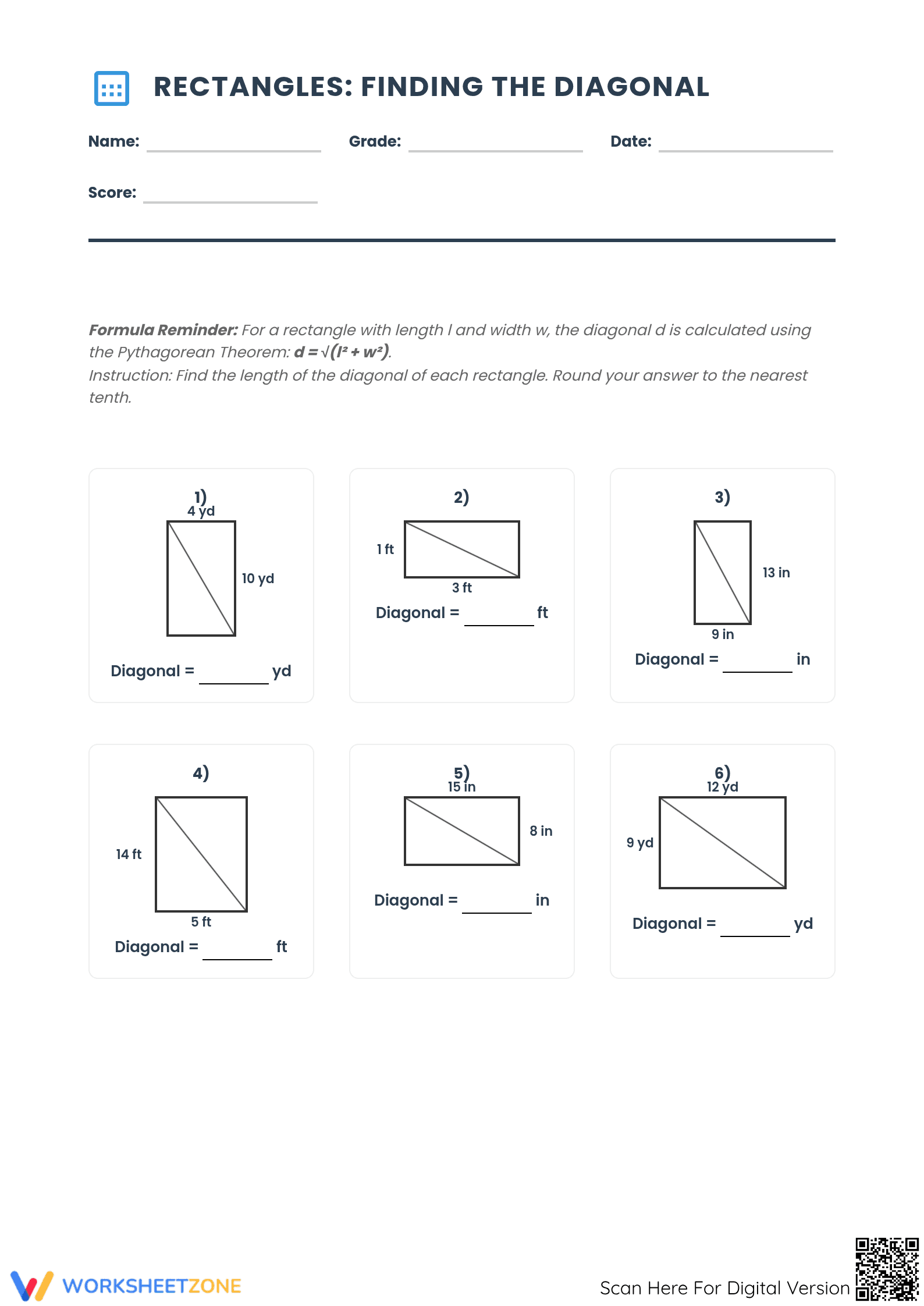
This comprehensive Grade 8 geometry worksheet helps students master the application of the Pythagorean Theorem to find the diagonal length of any rectangle. By working through mathematical models and real-world scenarios, learners build a concrete understanding of how length and width relate to the hypotenuse. The resource ensures students achieve accuracy through structured practice and rounding.
At a Glance
- Grade: 8 · Subject: Geometry
- Standard:
8.G.B.7— Apply the Pythagorean Theorem to find unknown side lengths in right triangles- Skill Focus: Calculating rectangle diagonals
- Format: 2 pages · 12 problems · Answer key included · PDF
- Best For: Independent practice and formative assessment
- Time: 25–35 minutes
What's Inside
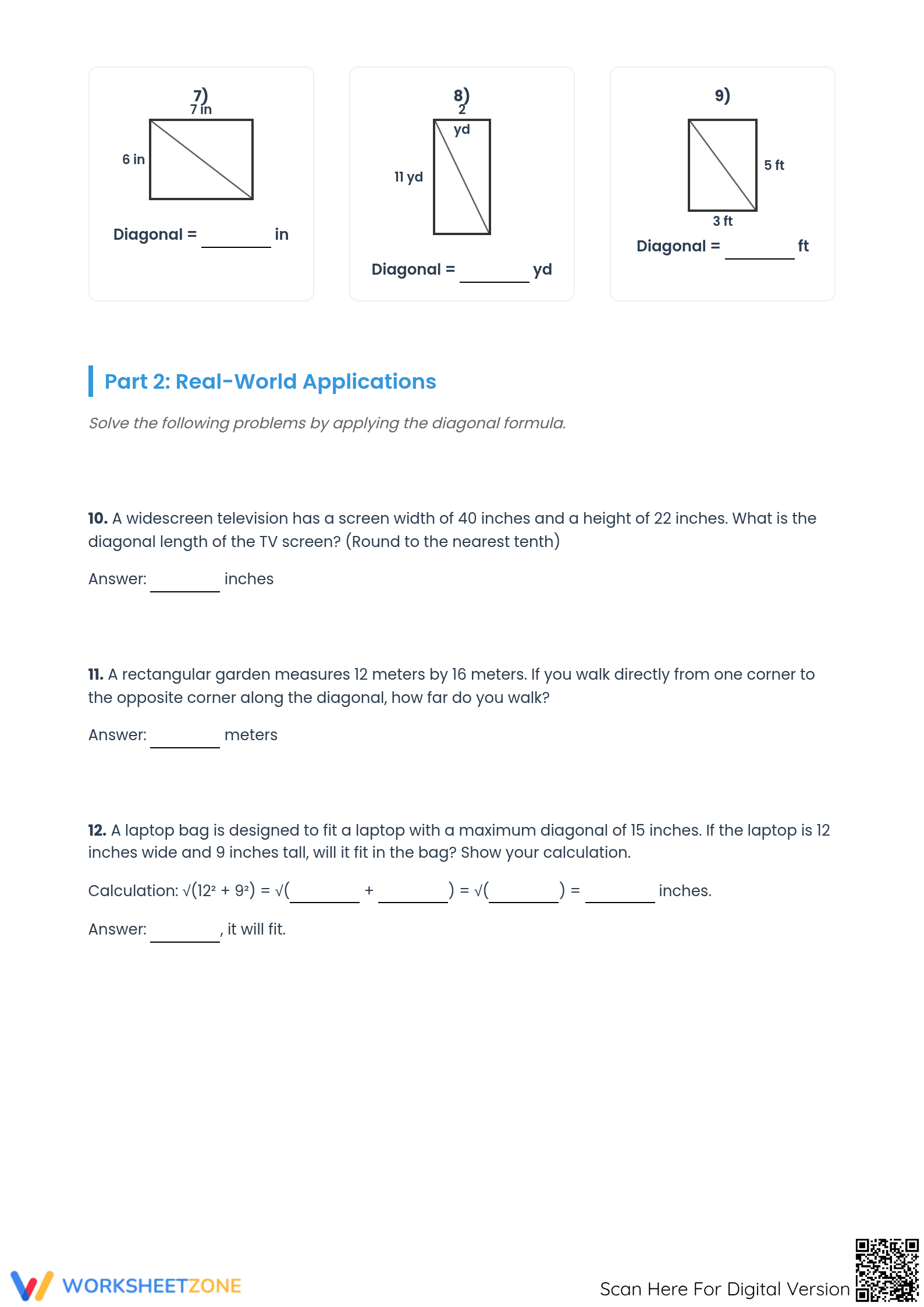
This printable two-page PDF includes a formula reminder at the top to support student autonomy. The first page features nine geometric rectangles with varying units (yards, feet, inches) requiring direct calculation. The second page transitions to three multi-step word problems involving televisions, gardens, and laptop bags, ensuring students can apply their knowledge to practical, everyday contexts.
Skill Progression
- Guided Practice: Provides a clear formula reminder and labeled diagrams for immediate application across six initial problems.
- Supported Practice: Introduces diverse units of measurement to challenge unit consistency and precision in rounding to the nearest tenth.
- Independent Practice: Real-world word problems require students to visualize the right triangle within a context and solve for diagonals without visual prompts.
This layout supports a gradual-release model, moving from explicit scaffolding to independent conceptual application.
Standards Alignment
The primary focus is standard 8.G.B.7, which requires students to apply the Pythagorean Theorem to determine unknown side lengths in right triangles in mathematical and real-world problems. This worksheet specifically addresses the two-dimensional application of the theorem within quadrilaterals. Both standard codes can be copied directly into lesson plans, IEP goals, or district curriculum mapping tools.
How to Use It
Use this worksheet as a primary practice activity during a unit on the Pythagorean Theorem. It works exceptionally well as a formative assessment after introducing the formula. Teachers can observe students during the rounding process to catch common errors. For a collaborative twist, have students compare their calculations for the real-world problems in Part 2 before reviewing the full answer key.
Who It's For
This resource is designed for Grade 8 students or high schoolers in an introductory Geometry course. It provides necessary scaffolding for students with IEPs through the included formula reminder while offering extension opportunities via the application-based word problems. It pairs naturally with an anchor chart on right triangle properties or a direct instruction lesson on the Pythagorean identity.
Effective mathematics instruction relies on the gradual release of responsibility, moving from procedural fluency to conceptual application. According to research from EdReports 2024, standards-aligned materials that bridge the gap between abstract formulas and real-world contexts significantly improve student retention of geometric properties. This Grade 8 resource focusing on 8.G.B.7 provides the necessary repetition to build automaticity in calculating rectangle diagonals while the word problems develop higher-order thinking skills. By requiring students to round to the nearest tenth, the worksheet also reinforces precision in mathematical modeling. Integrating this printable into a structured lesson plan ensures that students meet the rigor of middle school geometry standards. Educational analysis suggests that providing a clear "Formula Reminder" scaffolds the task, allowing learners to focus on the procedural steps of squaring, summing, and taking square roots, which is essential for mastery of the Pythagorean Theorem.


