


























1 / 2
0
Views
0
Downloads


0.0
0
Save
0 Likes
Share
Distance Between Two Points on Coordinate Plane
0 Views
0 Downloads
Paste this activity's link or code into your existing LMS (Google Classroom, Canvas, Teams, Schoology, Moodle, etc.).
Students can open and work on the activity right away, with no student login required.
You'll still be able to track student progress and results from your teacher account.
Information
Description
What It Is:
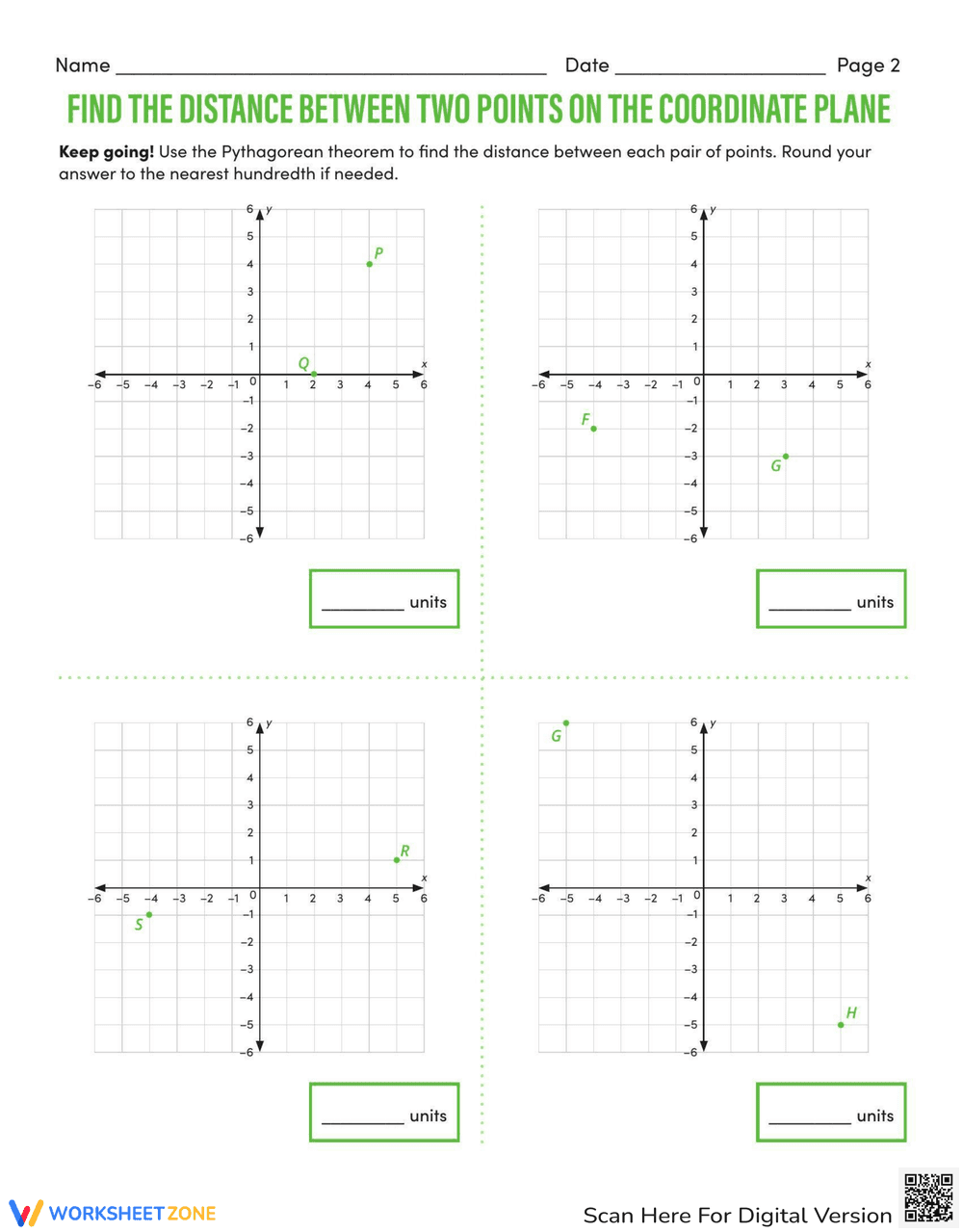
This is a math worksheet focused on finding the distance between two points on a coordinate plane using the Pythagorean theorem. It includes a worked example showing how to draw a right triangle, find the lengths of the legs by calculating the absolute value of the differences in x and y coordinates, and then apply the Pythagorean theorem to calculate the hypotenuse, which represents the distance. The worksheet also provides two practice problems with coordinate planes for students to solve, requiring them to calculate the distance between given points and fill in the blanks with the answer in 'units'.
Grade Level Suitability:
This worksheet is suitable for grades 7-9. It assumes students have a basic understanding of coordinate planes, the Pythagorean theorem, and calculating absolute values. The concepts and application of the theorem to coordinate geometry are typically taught in middle school and early high school.
Why Use It:
This worksheet reinforces the understanding and application of the Pythagorean theorem in a visual and practical way. It connects the theorem to coordinate geometry, helping students visualize distances and relate algebraic concepts to geometric representations. It helps students develop problem-solving skills and spatial reasoning.
How to Use It:
First, review the example provided on the worksheet, understanding how to create the right triangle and calculate the lengths of the legs. Then, for each practice problem, plot the points on the coordinate plane, draw a right triangle connecting the points, calculate the lengths of the horizontal and vertical legs, and use the Pythagorean theorem (a² + b² = c²) to solve for the length of the hypotenuse. Write the final answer, the length of the hypotenuse, in the provided blank space.
Target Users:
This worksheet is targeted towards students learning about the Pythagorean theorem and its applications in coordinate geometry. It is beneficial for students who need extra practice in applying the theorem or for those who learn best with visual aids and worked examples. It is also useful for teachers looking for supplementary materials to reinforce these concepts.
This is a math worksheet focused on finding the distance between two points on a coordinate plane using the Pythagorean theorem. It includes a worked example showing how to draw a right triangle, find the lengths of the legs by calculating the absolute value of the differences in x and y coordinates, and then apply the Pythagorean theorem to calculate the hypotenuse, which represents the distance. The worksheet also provides two practice problems with coordinate planes for students to solve, requiring them to calculate the distance between given points and fill in the blanks with the answer in 'units'.
Grade Level Suitability:
This worksheet is suitable for grades 7-9. It assumes students have a basic understanding of coordinate planes, the Pythagorean theorem, and calculating absolute values. The concepts and application of the theorem to coordinate geometry are typically taught in middle school and early high school.
Why Use It:
This worksheet reinforces the understanding and application of the Pythagorean theorem in a visual and practical way. It connects the theorem to coordinate geometry, helping students visualize distances and relate algebraic concepts to geometric representations. It helps students develop problem-solving skills and spatial reasoning.
How to Use It:
First, review the example provided on the worksheet, understanding how to create the right triangle and calculate the lengths of the legs. Then, for each practice problem, plot the points on the coordinate plane, draw a right triangle connecting the points, calculate the lengths of the horizontal and vertical legs, and use the Pythagorean theorem (a² + b² = c²) to solve for the length of the hypotenuse. Write the final answer, the length of the hypotenuse, in the provided blank space.
Target Users:
This worksheet is targeted towards students learning about the Pythagorean theorem and its applications in coordinate geometry. It is beneficial for students who need extra practice in applying the theorem or for those who learn best with visual aids and worked examples. It is also useful for teachers looking for supplementary materials to reinforce these concepts.


