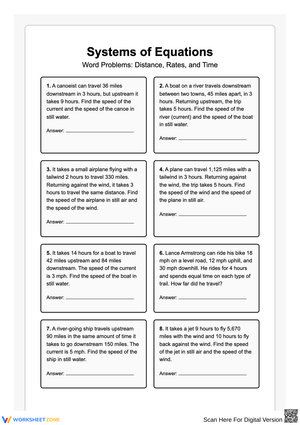
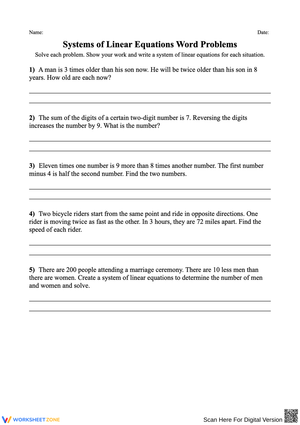
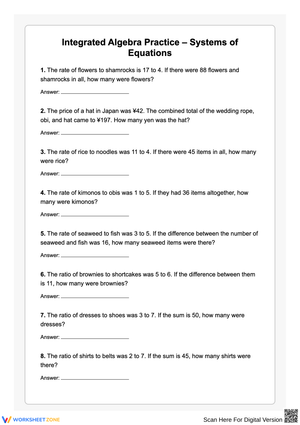
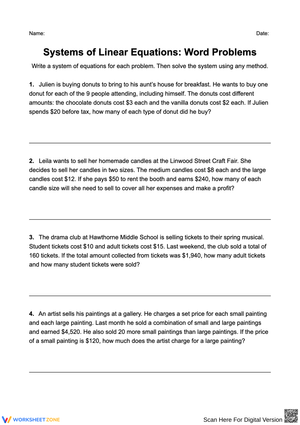
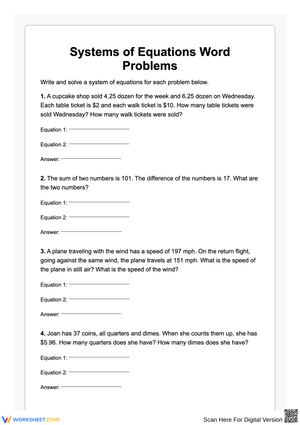
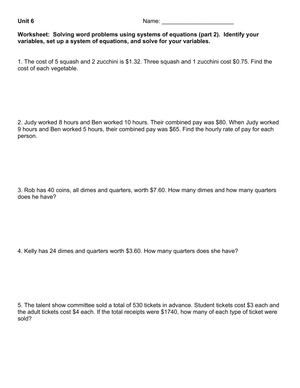
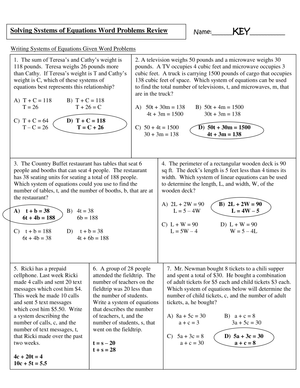
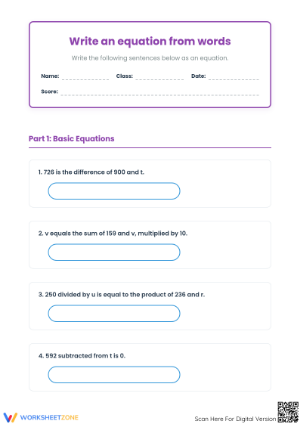
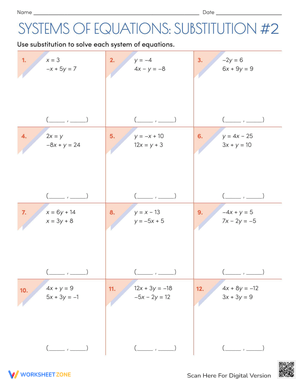
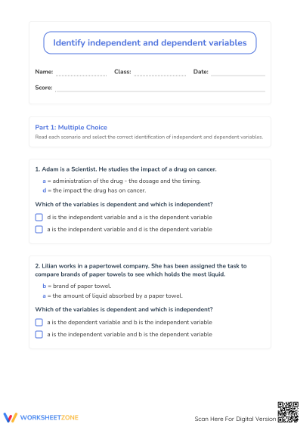
These 8th grade systems of equations word problems pdf worksheets give students practice with the full algebraic modeling process — not just solving once variables are handed to them, but reading a situation, naming two unknowns, writing the system, solving it, and stating what the ordered pair means in the context of the original story. That last piece is where most of the teaching work actually lives. Each worksheet makes student reasoning visible in a format that is easy to use for formative assessment, small-group reteaching, or independent practice.
What Each Worksheet Asks Students to Work Through
The problems are built around real-world contexts — ticket sales, comparing prices at two stores, age relationships, and distance-rate-time situations. Students do not receive equations pre-written. They read a scenario, decide what each variable represents, translate two distinct relationships from the story into two linear equations, solve the system, and then answer the actual question the problem poses. The final interpretation step is required, not optional.
Across the set, students practice all three solution methods:
- Graphing — plotting both lines and identifying the intersection point
- Substitution — isolating one variable and replacing it in the second equation
- Elimination — adding or subtracting equations to cancel out a variable
Some worksheets specify the method. Others leave the choice open and ask students to justify their selection. That variation prepares students for test formats where both kinds of prompts appear — and it surfaces whether students have genuine flexibility or are locked into one approach regardless of the problem structure.
Mistakes That Show Up Repeatedly in Systems Word Problem Work
The most common error is not a solving error — it is a setup error. Students will write one equation confidently, usually the one matching "the sum of the two quantities is..." or "together they cost...", and then stall when searching for the second relationship. They reread the problem, miss the constraint they have not yet captured, and either guess at a second equation or leave it blank. Requiring students to mark every numerical relationship in the problem before writing anything algebraic is usually the most direct fix for this pattern.
A close second is the reversed-variable interpretation. A student defines x as adult tickets and y as student tickets, solves the system correctly, arrives at the ordered pair (12, 30), and then writes "30 adult tickets were sold." That reversal is easy to miss when grading quickly. A prompt on each worksheet — What does x represent? What does y represent? Which value answers the question? — turns this into a self-check habit rather than an afterthought that costs students points on assessments.
Students also consistently stumble on relational language. A problem stating "the drama club sold 14 more student tickets than adult tickets" reliably generates both x + 14 = y and x − 14 = y from students in the same class period. Having students underline phrases like more than, fewer than, and difference, then translate them into symbolic form before writing the full equation, reduces this error in ways that re-explaining the algebra alone does not.
Working These Into the Lesson Block
One problem used as a whole-group think-aloud at the start of class is often more productive than assigning a full worksheet during that same block. Talking through "What are the two unknowns here? How do I know I need two equations?" gives students language they can draw on when working independently. The think-aloud is especially effective when the chosen problem has a tempting but wrong first reading — one where students might initially believe only one equation is needed, so the discussion focuses on why that reading is incomplete.
During partner practice, the most productive structure assigns one student the setup — variable definitions and both equations — while the other handles the solving and interpretation. They switch roles on the next problem. This prevents one student from carrying the full process while the other waits to copy, and it keeps the focus on reasoning rather than speed.
For small-group intervention, these worksheets do useful diagnostic work. If a student writes correct equations but makes arithmetic errors in elimination, the need is procedural fluency. If the student solves accurately once you hand them a pre-written system but cannot construct one from a word problem, the need is in translation and modeling. The 8th grade systems of equations word problems pdf worksheets in this set are particularly useful for that kind of targeted reteaching because the workspace is organized around distinct steps — students cannot skip straight to solving without completing the setup sections first.
For spiral review after the unit ends, one problem per week is usually enough to maintain the skill. Word problems benefit from this kind of revisiting more than symbolic exercises do, because students tend to lose the full define-write-solve-interpret sequence faster than they lose the mechanics of elimination or substitution.
Standard Alignment
These worksheets address CCSS 8.EE.C.8, specifically the expectation that students solve pairs of simultaneous linear equations and apply that skill to real-world situations. Within that standard, 8.EE.C.8b covers algebraic solution methods including substitution and elimination, while 8.EE.C.8c addresses problems where students construct the system themselves from a written context. Most Grade 8 curriculum maps position symbolic systems practice before word problems — typically in the second half of the systems unit — because students need working fluency with solution methods before they can manage the added cognitive load of translating a scenario into algebra. These worksheets fit naturally into that sequence, working best after students have already practiced solving systems that are handed to them in equation form.
Adjusting the Set for Different Learners
For students who need additional support, reduce the language demand without reducing the algebraic reasoning. Provide the variable definitions and ask them to write both equations, or supply one equation and ask them to identify the second relationship in the problem and write it. These adjustments let students practice algebraic thinking without hitting a wall at the reading stage before they ever reach the math.
For students ready for extension, two changes create genuine challenge. First, use problems where neither constraint is stated in a single clean sentence — students must read the full scenario and extract both relationships from embedded context. Second, require students to solve by two different methods and then explain which approach produced a cleaner solution and why. That kind of reflection pushes past procedural fluency into mathematical reasoning about the structure of the problem itself.
When the class is genuinely mixed, assigning the same problem to everyone while varying the prompt level keeps the work parallel enough for whole-group discussion afterward. Some students receive the variable names; others define them independently. The math is the same; the entry point differs.
Frequently Asked Questions
What types of contexts work best for 8th grade systems of equations word problems?
Familiar, low-ambiguity situations work best — ticket sales, comparing two pricing plans, age relationships, and distance-rate-time problems with clear given information. The context should be clear enough that students can focus on algebraic modeling rather than spending cognitive effort decoding an unfamiliar scenario. When the setting is too abstract or exotic, the barrier becomes reading comprehension rather than mathematics, which obscures what students actually know about systems.
Should students always show all four steps — variable definitions, both equations, solving work, and interpretation?
Yes, at least while students are still building fluency with the process. The interpretation step is the one most often skipped, and it is also the step that reveals whether a student genuinely understood the problem. An ordered pair like (4, 7) is not a complete answer if the question asked how much each item costs — students need to specify which value answers which part of the question, using the variable definitions they wrote at the start.
How do I use these worksheets as a formative tool rather than just assigned practice?
Collect the variable-definition step before students continue to solving. That alone gives you fast, actionable information: if the definitions are wrong or reversed, everything downstream will also be wrong. A quick scan of just that section — roughly 30 seconds per paper — tells you whether to stop the class for a brief reteach or let students continue. The 8th grade systems of equations word problems pdf worksheets here are organized so that each step occupies its own section of the workspace, which makes this kind of partial collection practical during independent work time without disrupting the whole class.
How often should students revisit systems word problems after the unit is finished?
Once a week is usually sufficient to maintain the skill without crowding out other review content. A single well-chosen problem at the start of class — brief enough to complete in 8 to 10 minutes — keeps students from losing the full setup-to-interpretation process before it shows up again on a cumulative assessment. The 8th grade systems of equations word problems pdf worksheets in this set include problems across difficulty levels, making it straightforward to pull lower-stakes review items for spiral practice without sourcing a separate resource.













 Interactive Worksheet Maker
 Quiz Maker
 Word Search Maker
 Crossword Puzzle Maker
 Word Scramble Generator
 Sentence Scramble Generator
 Handwriting Worksheet Generator
 Name Tracing Generator
 Fill In The Blank Generator