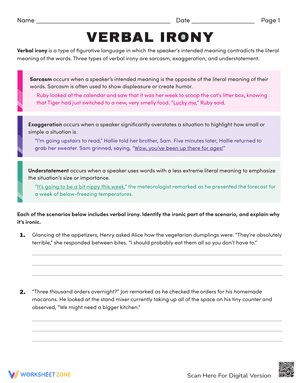
These literary devices printable worksheets for 8th grade push students past the naming stage and into the analytical work 8th grade ELA actually demands — identifying a device, quoting the specific words, and explaining what the author accomplishes with it. That three-part move from recognition to interpretation is where most students get stuck, and a well-built worksheet makes the expectation concrete rather than assumed.
Skills Each Worksheet Builds
At this grade level, the core devices include metaphor, simile, personification, hyperbole, irony (verbal, situational, and dramatic), allusion, imagery, and symbolism. Some worksheets in the set also bring in sound devices such as alliteration or assonance when they appear naturally in the chosen text excerpts.
What separates these from a simple matching exercise is the task structure. Each worksheet moves through four levels of cognitive demand:
- Identification: Students label or select the device present in a line or passage.
- Evidence: Students underline or quote the specific words that confirm their answer — not the whole sentence, just the figurative phrase.
- Effect: Students write one or two sentences explaining what the device does to the tone, mood, characterization, or theme.
- Application: Students write their own example using the same device in a new context.
That last step matters more than it looks. When students have to generate their own hyperbole about a mundane classroom situation, or write a simile designed to create unease rather than warmth, they demonstrate understanding in a way that circling answers never reveals.
Frequent Student Errors Worth Watching For
The confusion between imagery and symbolism surfaces in nearly every 8th grade class that works through these topics. Students often label sensory detail as symbolism because the image "seems important" — a gray sky, a cracked mirror — without recognizing that symbolism requires an object to carry meaning beyond itself in a consistent or purposeful way. A task that asks students to explain why a detail qualifies as symbolic, not just what it might represent, exposes that gap faster than any quiz.
A second persistent problem: students quote too broadly when citing evidence. A student who correctly identifies hyperbole in a passage will often underline the entire sentence rather than the exaggerated phrase. This tells you they found the right area of text but haven't yet learned to read at the word level. The evidence-citing tasks on each worksheet address this directly — students pull exact words, which builds the precision they'll need for extended analytical writing.
The third pattern we see most consistently is effect statements that stay generic: "it makes the writing more interesting" or "the reader feels emotion." Getting students to replace those with specific claims — "the hyperbole makes the narrator sound desperate rather than playful" — is the work these worksheets set up, but the teacher still has to model that move before students will do it independently.
Working These Worksheets Into Your ELA Week
The strongest use of literary devices printable worksheets for 8th grade is as a bridge between reading and analytical writing, not as isolated drills at the end of a unit. A practical sequence: during Monday's warm-up, students work through identification tasks from one worksheet while a class poem is still on the board. Wednesday, partners compare their effect explanations and argue for the better one. By Friday, they're using the device from the worksheet in a descriptive paragraph of their own.
For sub plans, these worksheets hold up better than most because the directions are self-contained and the tasks build in order. A class can complete one worksheet independently while a sub circulates, without needing to explain the assignment. The answer key handles the review when you return.
Station rotation setups work especially well with this set. One station runs identification tasks for students still building recognition. A second station has the effect-explanation prompts for students ready for analysis. A third station challenges advanced readers to compare two devices across two short excerpts and explain which does more work for the author's purpose. One set of worksheets, three different entry points — managed simultaneously without creating three separate handouts.
Adjusting the Set for a Range of Learners
The literary devices printable worksheets for 8th grade work across readiness levels when teachers make a few targeted adjustments. Students who struggle with abstract figurative language benefit from shorter passages — a three-line stanza rather than a full poem — paired with a word bank of device names and a sentence frame: "The author uses ___ when she writes '___.' This creates a feeling of ___ because ___." That structure doesn't lower expectations; it removes the retrieval demand so students can focus on the interpretive thinking.
For students who tear through the identification and effect questions in ten minutes, the real stretch is asking them to explain why the author chose this device over another — why personification instead of simile, why hyperbole rather than a straightforward statement of intensity. That question has no single right answer, which is exactly why it pushes analytical thinking in a way closed tasks cannot.
One practical note: mixing text types builds stronger transfer than staying in poetry all unit. Students often find devices more quickly in poems because the language is compressed, but they also need practice spotting extended metaphors in narrative prose and irony in nonfiction essays. Rotating the genre across worksheets throughout the unit prevents students from treating literary devices as a poem-only skill.
Standard Alignment
These worksheets align most directly to CCSS RL.8.4, which asks students to determine the meaning of words and phrases as they are used in a text — including figurative and connotative meanings — and to analyze the impact of specific word choices on meaning and tone. That standard is notable because it requires students to address both what language means and what it does. The effect-explanation tasks on each worksheet directly operationalize that dual requirement rather than stopping at recognition.
Worksheets that include evidence-citation tasks also address RL.8.1, which asks students to cite the textual evidence that most strongly supports an analysis. In practice, the habit of pulling exact words — rather than paraphrasing — is both a literary device skill and a reading standard being reinforced at the same time.
Frequently Asked Questions
Which literary devices should 8th graders know before entering high school?
The list that matters most: metaphor, simile, personification, hyperbole, irony in its three forms, allusion, imagery, and symbolism. More important than the list is whether students can explain the effect of a device when they encounter it in an unfamiliar text — that analytical move transfers to everything they'll read in high school English.
Students keep confusing imagery and symbolism. What actually helps?
The clearest distinction in practice: imagery is sensory, symbolism is conceptual. An image appeals to sight, sound, smell, taste, or touch; a symbol carries a meaning that extends beyond what the thing literally is. A useful classroom test — if removing the detail from the text would reduce sensory vividness, it's likely imagery. If removing it would lose a layer of meaning about a character, theme, or idea, it's more likely symbolic. Worksheets that ask students to justify the label, not just apply it, push this distinction into deliberate thinking.
How do I use these for formative assessment without creating more grading?
The identification and evidence items are fast to check with the answer key or during a whole-class share. The effect explanations work best as a quick table-talk or gallery walk rather than collected writing. Read the room during those two minutes — the students who stay vague or silent on "what does this device do?" are the ones who need another modeled example before the next worksheet.
Do these worksheets help with standardized test preparation?
State assessments at this grade consistently include passage-based questions about figurative language, author's craft, and word choice — all areas these literary devices printable worksheets for 8th grade address directly. The format of read a passage, identify a technique, and explain its effect mirrors what students encounter on ELA assessments. The open-response items also build the short analytical writing many state tests require.















 Interactive Worksheet Maker
 Quiz Maker
 Word Search Maker
 Crossword Puzzle Maker
 Word Scramble Generator
 Sentence Scramble Generator
 Handwriting Worksheet Generator
 Name Tracing Generator
 Fill In The Blank Generator