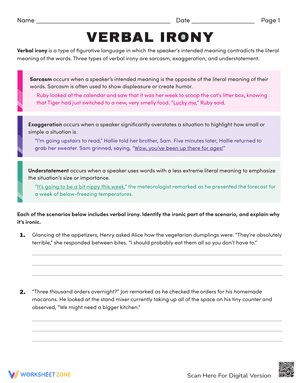
These irony worksheets for 8th grade close a gap teachers encounter constantly: students who can say "irony is when the opposite happens" but cannot explain what the text set up as an expectation, what actually occurred, and why that contrast matters to the meaning. Each worksheet in the set gives students a short reading passage, targeted questions in mixed formats, and explanation prompts that require text-based reasoning rather than a category label alone.
What the Set Covers
The worksheets address verbal, situational, and dramatic irony through passages drawn from fiction, poetry, and drama. Question types vary — some items are multiple choice, others require a written explanation, and several ask for both. That variety matters because selecting an irony type is a different cognitive task from explaining how the contrast between expectation and reality functions in the passage.
Academic vocabulary appears consistently in question stems and response prompts: expectation, contrast, audience knowledge, tone, evidence. Students encounter those terms in context, not only in isolated definitions. Answer keys accompany each worksheet and include brief rationales alongside correct answers — useful for reteaching, substitute coverage, and maintaining consistency when multiple teachers use the same material.
Student Errors Worth Anticipating Before You Teach the Set
Three error patterns appear reliably in this work. The first is collapsing verbal irony into sarcasm. Students treat the terms as interchangeable, which causes them to miss verbal irony that isn't harsh or mocking. A student reading O. Henry will often flag every sardonic comment as sarcasm and skip over the quieter ironic observations — the ones where a narrator says something technically true but clearly intended to mean the opposite.
The second pattern is treating any surprising ending as situational irony. That confusion is stubborn because surprise feels like the defining feature, but irony requires a meaningful structural contrast between what the situation seemed to promise and what it delivered. Students working through "The Necklace" will often write: It's situational irony because I didn't expect the necklace to be fake. That's describing surprise, not the contrast between Mathilde's decade of sacrifice and its complete pointlessness. Prompts that ask students to identify the setup, the expectation, and the actual outcome — in that sequence — break this habit more reliably than reviewing the definition again.
Dramatic irony is hardest because students must hold two simultaneous perspectives: what the character believes and what the audience knows. Most students can recite "the reader knows more than the character" as a definition but stall when they need to identify what the reader knows, when the text revealed it, and why that gap creates tension. The prompts in these irony worksheets for 8th grade require students to answer all three of those questions, which keeps them from earning credit by attaching the right label without doing the underlying thinking.
Building These Worksheets Into Your Instructional Week
One sequence that reduces reteaching later: teach the three types in a direct instruction block, then use one worksheet as guided practice the same day with students working in pairs and defending their answers using the passage text. That discussion surfaces category confusion before it shows up on graded work. Save independent worksheets for the following day. Students who attempt application within minutes of hearing a definition for the first time tend to reach for whichever label sounds closest rather than reading the passage carefully to locate the contrast.
For bell ringers, two items from a worksheet take about eight minutes and do enough work to orient students before close reading a short story or scene. As an exit ticket, one passage item — identify the irony type and cite the phrase that proves it — gives more diagnostic information than a full multiple choice set does. One annotation move worth building in before students answer any item: ask them to mark expected and actual directly in the passage first. That step slows the guessing that produces accidental correct answers, and it makes the written explanation easier to draft because the comparison is already marked on the page.
Adjusting the Worksheets for Students at Different Readiness Levels
Students still building confidence with literary vocabulary do better when they begin with only the multiple choice items on a given worksheet, then add written explanation once the category work feels secure. Sentence frames help at this stage — The irony here is that the reader expects ___, but instead ___ — because they give students a structure for articulating comparison without replacing the thinking itself. Pull the frames once the pattern is established; keeping them too long creates a different problem where students fill blanks without re-reading the passage.
On-level students handle the mixed format as written. The shift between multiple choice and short response within a single worksheet mirrors the structure of most state ELA assessments at this grade, so maintaining that variety is worth it.
Advanced students benefit most from a transfer step beyond the worksheet: after finishing the items, ask them to locate one example of the same irony type in the class novel or their independent reading book and write a brief explanation using the same question format. Irony worksheets for 8th grade pair most naturally with current class texts for this extension — students already hold the reading context in working memory, which lowers the effort cost of locating and explaining new examples without guidance.
Standard Alignment
CCSS.ELA-LITERACY.RL.8.6 is the most direct standard these worksheets address. It asks students to analyze how differences in the points of view of characters and the audience — explicitly naming dramatic irony as an example — create effects such as suspense or humor. The standard places irony at the intersection of craft analysis and audience response, not merely as a vocabulary term to label. Short-response prompts in the set ask students to explain what effect the irony creates for the reader, which is exactly what RL.8.6 requires rather than stopping at identification.
CCSS.ELA-LITERACY.RL.8.4 also connects here. Students analyze figurative and connotative meaning and its effect on tone — and verbal irony is a figurative meaning problem at its core: the surface meaning and the intended meaning diverge, and students must explain both to demonstrate genuine understanding.
Frequently Asked Questions
Which irony types are included?
All three major types: verbal, situational, and dramatic. Students identify each type in short passages, compare how the types operate differently, and explain the contrast between expectation and reality in written responses.
My students keep calling every surprising ending "situational irony." Will these worksheets address that?
That is one of the most common errors the set targets directly. Several prompts ask students to name the setup, the expected outcome, and the actual result before selecting a category. That three-step process makes it much harder to label a twist as situational irony without first demonstrating the meaningful contrast the term actually requires.
Can these be used alongside a novel or short story we're already reading?
Each worksheet is self-contained — no prior reading is needed to complete any item. But the most effective use in many classrooms is pairing a worksheet with a current class text. After completing the items, students locate a parallel example in whatever they're reading and write a brief explanation using the same format. That connection between structured practice and live reading is where the concept tends to move from memorized definition to usable understanding.
Do these help with state assessment preparation?
Irony worksheets for 8th grade that combine identification, short response, and text-evidence explanation prepare students for the analytical reading questions most state ELA assessments include at this level. The mixed question format — selecting an answer and explaining the reasoning behind it — reflects how those tests assess literary analysis more accurately than multiple choice alone.















 Interactive Worksheet Maker
 Quiz Maker
 Word Search Maker
 Crossword Puzzle Maker
 Word Scramble Generator
 Sentence Scramble Generator
 Handwriting Worksheet Generator
 Name Tracing Generator
 Fill In The Blank Generator