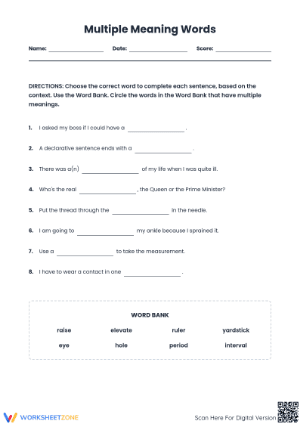
These 8th grade grammar worksheets resources give teachers ready-to-print practice that moves well past naming parts of speech and into the applied grammar work middle school writers actually need. The strongest sets ask students to mark an error, name the rule it breaks, and rewrite the sentence — that sequence is what separates worksheets that produce transfer from ones that only produce compliance. Each worksheet in a strong collection targets one skill sharply enough that students know exactly what they are practicing.
The Skills These Worksheets Target
Grade 8 sits at a specific developmental moment in grammar instruction. Students arriving in August have usually had years of identifying subjects, objects, and verb forms in isolation. What they have not had is sustained practice controlling those same rules inside the longer, denser sentences they now write. A well-structured set of 8th grade grammar worksheets files accounts for that shift by offering both focused drills and passage-level editing tasks side by side.
- Sentence structure: fragments, run-ons, sentence combining, misplaced and dangling modifiers
- Punctuation: commas in compound-complex sentences, semicolons between independent clauses, colons, apostrophes for possession, quotation marks in dialogue and titles
- Verb usage: tense consistency across a paragraph, irregular verb forms, shifts between active and passive voice
- Pronoun work: pronoun-antecedent agreement, vague pronoun reference, nominative versus objective case
- Capitalization and usage: proper nouns in academic writing, titles, commonly confused pairs including affect/effect, who/whom, and lay/lie
- Editing in context: short paragraphs with embedded errors that students mark and revise in full
Editing tasks earn their place in the set because they mirror what students actually do during drafting and revision. Fixing a semicolon error in a sentence strip does not transfer to a revision draft as reliably as finding that same error embedded in a paragraph and deciding what correction fits the surrounding sentences.
Student Error Patterns Worth Knowing Before You Hand These Out
Pronoun case is where 8th graders surprise teachers most. Students who have spent years being corrected for saying "me and my friend" will overcorrect in formal writing and produce constructions like "between you and I" or "she spoke to he and I." The error pattern is hypercorrection — students apply a half-learned rule without understanding what nominative and objective case actually govern. Worksheets that present pronoun pairs in varied sentence positions help students see why the rule changes based on the noun's grammatical function, not just how formal the sentence sounds.
Comma splices at this level often look intentional. Students writing longer, more sophisticated sentences know that two related clauses need to connect somehow, so they reach for a comma — which is closer to correct than nothing, but still wrong. When a semicolon worksheet appears, some students resist it because the semicolon feels overly formal or stylistically cold. A comparison task where students fix the same comma splice three ways — period, semicolon, coordinating conjunction with a comma — tends to work better than a drill that simply asks them to insert the missing punctuation mark.
Vague pronoun reference produces the third consistent pattern. Students write "In the article, they claim..." or "The coach told the players when they arrived..." with no clear grammatical antecedent for they. This error is nearly invisible in isolated sentence drills, where the short context doesn't expose the confusion. It shows up clearly in passage editing tasks, where the unclear reference produces actual reader confusion rather than just a rule violation in the abstract.
Building These Worksheets Into a Weekly Teaching Sequence
A three-step rhythm works well in most 8th grade ELA blocks. On the day of direct instruction, one worksheet gives students immediate structured practice after the mini-lesson — ten to twelve sentences, one skill, pencils moving. The next day, a short editing task in a paragraph lets students apply the same rule in context. Later in the week, mixed review pulls that skill alongside two or three from earlier in the unit. That's where spaced retrieval does its real work, pulling older rules back into active memory before they drift out of reach.
Bell ringers deserve a specific note. Five minutes at the start of class is the right window for a two- or three-sentence correction task, not a full 8th grade grammar worksheets set. Save longer worksheets for the independent practice block or intervention groups. That distinction keeps the bell ringer from eating into reading or writing time and prevents daily grammar practice from feeling like punishment.
Sub plans are a genuinely practical use case. A self-contained worksheet with clear directions and a defined task requires no setup from a substitute and keeps students doing something instructionally real. Pulling two or three worksheets that review recent skills gives the class session structure without requiring the sub to understand where the unit stands. Answer keys help here — students can self-check and flag questions rather than leaving pages sitting until the teacher returns.
Standard Alignment
These worksheets address CCSS.ELA-LITERACY.L.8.1, which covers command of standard English grammar and usage in writing and speaking, including the specific 8th grade expectations for verbals, active versus passive voice, and verb mood. CCSS.ELA-LITERACY.L.8.2 governs capitalization, punctuation, and spelling — the comma, ellipsis, and dash conventions that appear frequently in 8th grade academic and narrative writing. CCSS.ELA-LITERACY.L.8.3 asks students to use language knowledge to make deliberate choices when writing, which is the standard that most directly supports editing tasks rather than isolated drills.
Placement matters. L.8.1 and L.8.2 skills are not new in grade 8 — they are deepened. Students have encountered subject-verb agreement and basic comma rules before; what the standards ask at this level is application inside more complex sentence constructions. The most aligned worksheets present grammar problems in multi-clause sentences and edited paragraphs rather than in simple subject-verb-object frames.
Adapting These Worksheets for Students Working at Different Levels
Students who still need foundational support do well with worksheets that isolate one error type in shorter, more predictable sentences. If a student cannot yet identify an independent clause reliably, a semicolon worksheet built around compound-complex sentences will frustrate rather than teach. A more useful approach has those students work through the simpler sentence-level version of the skill while the rest of the class works with a passage editing task. Both groups practice the same grammar concept — the complexity of the application differs.
Students ready for more challenge benefit from open-ended revision tasks: a paragraph with multiple errors and no annotation, no error count, no signal about what kind of mistake to look for. That format more closely resembles actual proofreading and quickly reveals which rules students hold confidently and which they scan past without noticing. Adding a step where students label each correction by rule type moves the task even further toward metacognitive control of grammar.
For students with IEPs that address written language, reducing the number of sentences on a given worksheet, providing a brief reference card with the target rule stated plainly, and allowing verbal explanation of corrections instead of requiring full written rewrites are practical adjustments that preserve the instructional purpose without eliminating the grammar work. Worksheet accuracy alone does not confirm transfer — following up in a writing conference to check whether the same rule holds in the student's own draft matters more than the score on the practice page.
Frequently Asked Questions
What grammar topics are most important to cover in 8th grade?
Sentence structure, punctuation in complex sentences, pronoun agreement and case, verb tense consistency, and commonly confused word pairs are the highest-priority areas. Editing tasks that ask students to revise errors in connected paragraphs address more than one of these at once and reflect actual writing demands more accurately than single-skill sentence strips. These areas surface in student writing all year and benefit from distributed practice rather than one concentrated grammar unit.
Do these worksheets include answer keys?
Most 8th grade grammar worksheets collections include answer support in some form, though the format varies — separate answer sheet, inline corrections, or a teacher's edition. Before printing a class set, confirm what answer support is included so you are not reconstructing a key from scratch after the fact. For editing tasks with multiple defensible corrections, a note explaining the target error type is more useful than a single keyed answer.
How do I keep grammar practice from turning into busywork?
Keep daily practice short and connect it to something students are writing. A two- to four-sentence correction task as a bell ringer, followed by thirty seconds of class discussion on one contested answer, is more useful than ten minutes of silent fill-in exercises. Selecting the apostrophe worksheet during the same week students are drafting paragraphs heavy with possessives gives them an immediate reason to care about the rule. The worksheet becomes a preparation tool rather than a standalone assignment.
Can these worksheets work for intervention students significantly below grade level?
Yes, with adjustment. Skill-specific worksheets that use straightforward sentence structures work well for students who need to rebuild foundational rules before tackling 8th grade complexity. The most effective intervention approach pairs a simpler-format worksheet with brief small-group instruction on the rule, then checks whether the student can apply that rule in their own writing — not just on the practice task. Completing the worksheet correctly is not the same as owning the concept, and the writing is where that distinction becomes visible.















 Interactive Worksheet Maker
 Quiz Maker
 Word Search Maker
 Crossword Puzzle Maker
 Word Scramble Generator
 Sentence Scramble Generator
 Handwriting Worksheet Generator
 Name Tracing Generator
 Fill In The Blank Generator