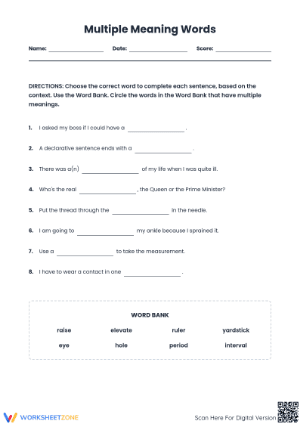
These 8th grade language and vocabulary worksheets resources give teachers focused, grade-specific practice on the word skills that surface in complex text, cross-content reading, and standardized assessments. The set covers context clues, Greek and Latin roots, prefixes and suffixes, figurative language, academic vocabulary, and grammar-linked usage — not as disconnected drills but as short analytical tasks students work through independently. Answer keys are included throughout, which matters when teachers are running word study stations, building sub folders, or checking responses during transitions.
The Skills These Worksheets Build
Grade 8 sits at a specific instructional crossroads. Students are reading longer, denser texts across every subject, but many carry vocabulary gaps from earlier years that were never addressed systematically. Effective practice at this level moves past definition-matching and asks students to do something with words — infer meaning from context, break apart unfamiliar academic terms, recognize when a synonym shifts tone, or explain what an idiom contributes to a passage's meaning.
- Context clues: Students read sentences and short passages, identify signal types — contrast, example, restatement, inference — and use them to determine word meaning.
- Greek and Latin roots: Each worksheet asks students to analyze word parts in multiple words, not just memorize a list. A root like chronos or bene appears across different academic words so students practice transferring what they know.
- Prefixes and suffixes: Affix work supports reading in science and social studies as directly as it does in ELA. Students who can parse -tion, multi-, and anti- move faster through informational text.
- Synonyms, antonyms, and nuance: Students compare semantically close words and choose the best fit for tone, register, or precision — a skill that carries over into writing revision.
- Figurative language: Tasks ask students to interpret idioms, similes, metaphors, and connotation — not simply label them — and explain what effect the language creates.
- Academic vocabulary: Terms like infer, credibility, perspective, and contrast appear repeatedly in literature analysis, argument writing, and classroom discussion. These worksheets give students repeated, contextual exposure.
- Grammar-linked usage: Some worksheets connect word choice to sentence meaning, asking students to revise or select language that makes a sentence more accurate or precise.
Errors Students Make That These Worksheets Help You Catch Early
The most persistent context-clue mistake at Grade 8 is what might be called proximity grabbing. A student spots the target word sitting near a recognizable synonym and writes that synonym as the definition — without reading how the full sentence actually frames the word. Asked to define taciturn from context, a student will often latch onto "quiet neighbor" two words away and miss that the rest of the sentence shows deliberate, chosen withdrawal, not mere quietness. The distinction matters for comprehension, and these worksheets surface it by requiring students to name which type of context clue helped them and justify why.
Root knowledge is another area where surface mastery hides a real gap. Students who can recite that dict means "speak" will still puzzle over edict or malediction in a reading passage, because they learned the root on a vocabulary list, not through repeated use in varied sentences. The roots worksheets address this by placing the same word parts inside different words across multiple tasks — students have to transfer the knowledge rather than recognize a memorized pairing.
A third consistent pattern shows up in synonym work: students treat near-synonyms as interchangeable. Eighth graders asked to choose between tired and exhausted for a character description will frequently pick based on familiarity or word length rather than connotation. The synonym-and-nuance worksheets address this directly by pairing word-choice tasks with a one-sentence justification prompt. That extra step makes the student's reasoning visible, which is where the useful instructional information actually lives.
How to Build These Worksheets Into a Weekly Vocabulary Routine
The most consistent results come from short, regular cycles rather than saving these resources for test-prep week. A four-day structure works well in many Grade 8 ELA blocks: roots and affixes as a five-minute opener on Monday, context clues on Tuesday tied to whatever the class is currently reading, figurative language or synonym work on Wednesday or Thursday, and a mixed-skill review before the end of the week. That rhythm gives students repeated exposure without consuming large chunks of instructional time — most worksheets take between eight and twelve minutes of student work.
These resources also solve the sub-plan problem cleanly. A self-contained worksheet with clear directions and an answer key needs no teacher setup and produces student work that can inform reteaching the next day. For intervention groups, teachers often pull two or three worksheets targeting the same skill — context clues or root analysis, for example — and run them across a pull-out block with brief discussion between each. Students get more than one pass at the skill before moving on, which matters more for retention than a single longer activity does.
The 8th grade language and vocabulary worksheets set also works well as a quick formative check at the end of a unit week. Students complete eight to ten items targeting the week's focus skill, and teachers scan responses before the next class to identify who needs reteaching and who is ready for extension. That diagnostic function is harder to replicate with longer assessments and much easier to pull off with a targeted short worksheet.
Adjusting the Work for Students at Different Points in Their Vocabulary Development
When working with 8th grade language and vocabulary worksheets resources across a mixed-ability classroom, the most practical differentiation move is adjusting the text complexity around the vocabulary task — not swapping out the skill itself. A student who needs additional support on context clues works with a sentence-level prompt containing a strong, clear signal word. A student working at grade level reads a short paragraph where the context clue requires more inference and less obvious cueing. Advanced students take the same base skill further by writing their own example sentence that contains a specific clue type, then trading with a partner to identify it. All three groups are doing context-clue work; what varies is the text depth and the amount of student production.
For students who struggle with figurative language, the most useful adjustment is providing surrounding narrative context before asking for analysis. A student who reads "she turned a blind eye to the problem" inside a short story excerpt has far more to work with than a student who sees the same phrase isolated on a matching task with no context whatsoever. A practical move teachers make is stapling a short passage excerpt to the figurative language worksheet for students who need that grounding first. It adds thirty seconds of prep and noticeably reduces the number of students who freeze before they begin.
Standard Alignment
These worksheets address three Language standards from the Common Core State Standards for Grade 8 English Language Arts. L.8.4 covers determining or clarifying the meaning of unknown and multiple-meaning words through context clues, word parts, and reference materials — the context-clue and root/affix worksheets align directly here. L.8.5 addresses figurative language, word relationships, and nuances in word meaning, connecting to the synonym, connotation, and figurative language worksheets. L.8.6 targets accurate acquisition and use of grade-appropriate general academic and domain-specific vocabulary, which the academic vocabulary strand addresses across both literary and informational reading contexts.
In most Grade 8 ELA pacing guides, L.8.4 and L.8.5 function as ongoing spiral standards rather than single-unit targets — teachers return to them throughout the year as students encounter increasingly complex text. These worksheets support that model because individual resources can be assigned at any point in the year when a specific skill needs reinforcement, not only during a designated vocabulary unit.
Frequently Asked Questions
Can these worksheets be used with students who are reading below grade level?
Yes, with one specific adjustment. Start with worksheets from the context-clue and root/affix strands, since those skills build directly from text rather than assuming prior vocabulary knowledge. For students reading significantly below grade level, a brief teacher-led model before independent work reduces the number of students who stall at the first item. The skill targets stay at Grade 8; the amount of up-front guided practice shifts based on what individual students need.
How is the set organized, and how many worksheets does it include?
The set organizes worksheets by skill strand: context clues, roots and affixes, figurative language, synonyms and nuance, academic vocabulary, and grammar-linked usage. Each strand includes enough worksheets to support a multi-week rotation or a focused intervention sequence. The 8th grade language and vocabulary worksheets format means the full set downloads together and teachers print individual worksheets as needed — by skill, by week, or by student group.
Do the worksheets include answer keys?
Every worksheet in the set includes an answer key. For short-response items, the key provides a model response along with notes on what a complete student answer should include. That specificity makes scoring faster and more consistent when multiple teachers, paraprofessionals, or a substitute are using the materials on the same day.
Can students complete these worksheets digitally rather than on paper?
The PDF format supports digital use through platforms that allow annotation — Google Classroom, Schoology, and similar tools that let students type or mark directly on a PDF file. The original print formatting stays intact, so the worksheets are equally usable on paper or on screen without reformatting on the teacher's end.















 Interactive Worksheet Maker
 Quiz Maker
 Word Search Maker
 Crossword Puzzle Maker
 Word Scramble Generator
 Sentence Scramble Generator
 Handwriting Worksheet Generator
 Name Tracing Generator
 Fill In The Blank Generator