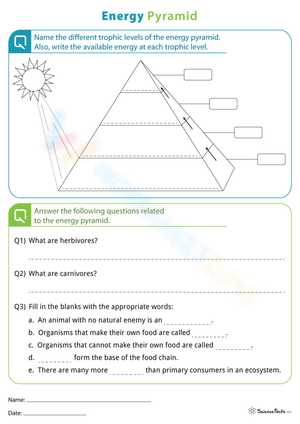
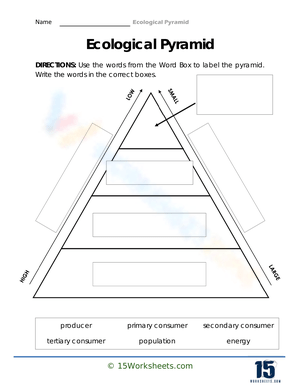
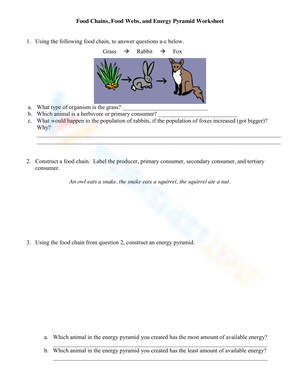
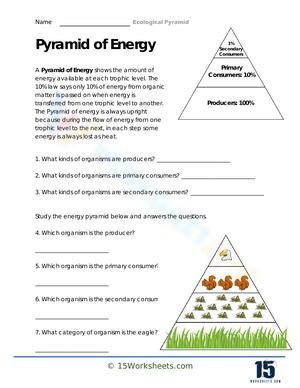
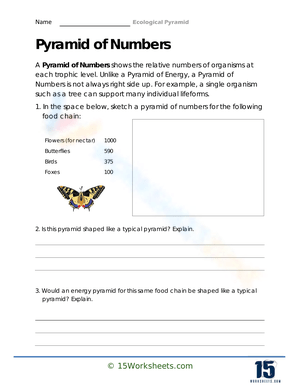
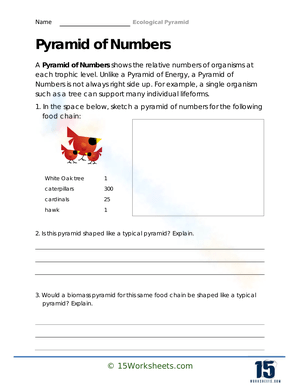
These 7th grade energy pyramid pdf worksheets give middle school science teachers a way to move students past memorizing a shape and into explaining what that shape actually means — why the base is wide, why the top narrows, and what energy transfer looks like when you assign numbers to it. Each worksheet pairs diagram work with short explanation tasks, so the teaching target isn't a filled-in pyramid but a student who can articulate why the hawk population in a grassland is necessarily small. The resources work across direct instruction, partner practice, intervention blocks, and substitute plans.
The Specific Skills Targeted Across the Set
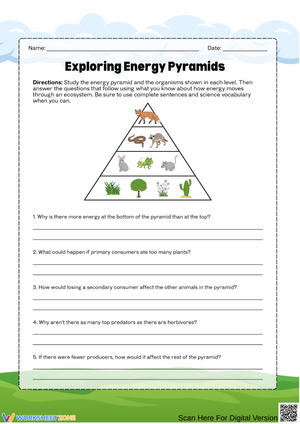
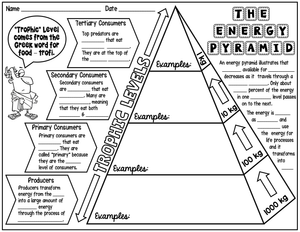
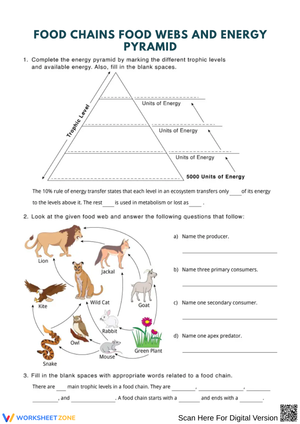
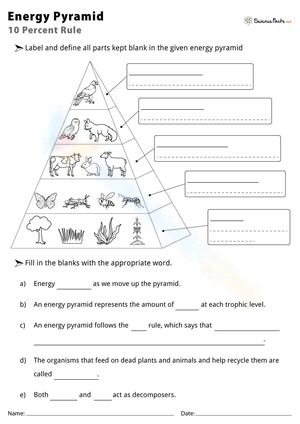
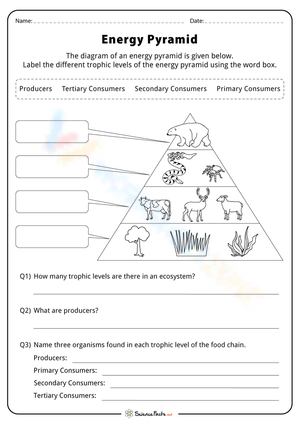
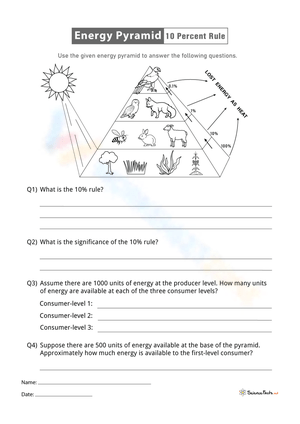
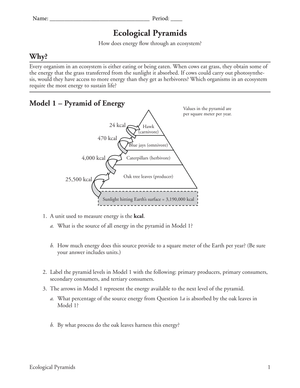
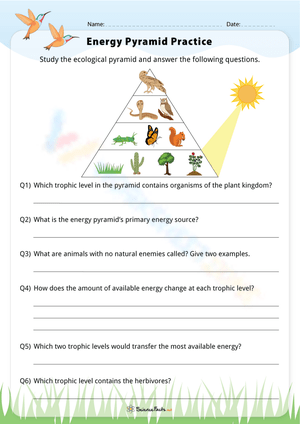
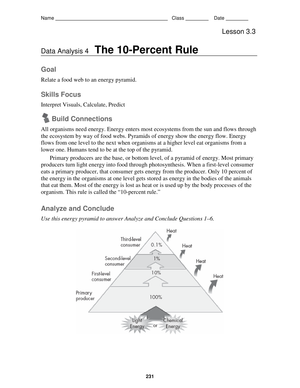
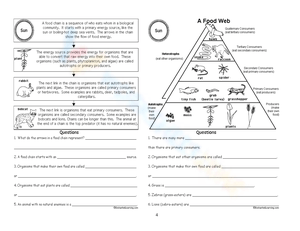
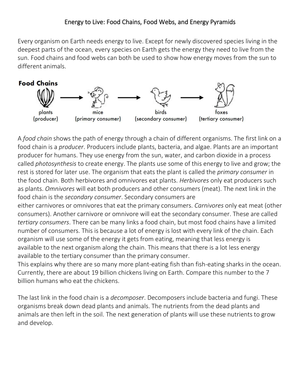
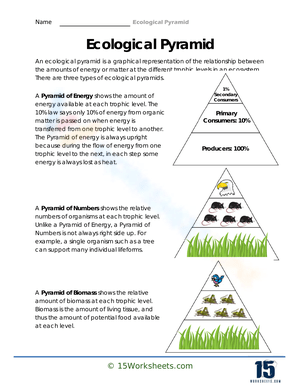
The strongest 7th grade energy pyramid pdf worksheets ask students to work with producers, primary consumers, secondary consumers, and tertiary consumers across several task types — placing organisms correctly, justifying those placements in writing, and connecting the visual structure to energy transfer. The 10% rule appears in multiple formats: as a reading task where students interpret a table of energy values, and as a calculation where they determine how much energy moves from one trophic level to the next. A grassland sequence (grass, mouse, snake, red-tailed hawk) and a marine sequence (phytoplankton, small fish, shark) both appear, giving teachers two ready-to-reference ecosystems for discussion.
One task type that consistently produces useful formative data is asking students to write a single sentence justifying the width of each pyramid level. Students who have only copied labels will stall here. Students who understand energy transfer will write something like "the producers' level is widest because they capture the most energy and every other level depends on that supply." That sentence separates surface familiarity from actual comprehension, and it appears in multiple worksheets across the set.
Other tasks include sorting a list of organisms into correct trophic positions, identifying deliberate errors in sample pyramids drawn incorrectly on purpose, and applying vocabulary terms — trophic level, herbivore, carnivore, producer — in context rather than in isolation. Short-response questions ask students to explain the relationship between producer population health and top-predator numbers, which is the kind of applied reasoning that shows up on standardized ecosystem assessments.
Mistakes Students Make That These Worksheets Help You Catch
The most persistent placement error is putting apex predators at the base. Students associate the bottom of a pyramid with support and importance, so they reason that "the strongest animal holds everything else up." This misunderstanding is worth addressing before independent practice begins — a brief teacher-modeled example with a familiar organism list stops it from getting written in and reinforced on the worksheet itself.
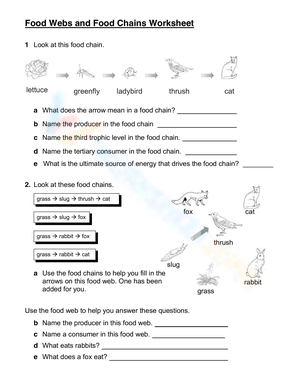
Conflating an energy pyramid with a food web is the second major error, and it is subtler. Both models involve producers and consumers, so students sometimes draw what is essentially a web of arrows and call it a pyramid. A food web maps feeding relationships; an energy pyramid represents how much energy is available at each trophic level. A worksheet prompt that asks students to state a specific energy value — rather than just name a level — exposes this quickly. A student who has truly conflated the two will write something like "grass → rabbit → hawk" when asked to show energy distribution in pyramid form.
The 10% rule generates a separate problem: overcalculation. Students comfortable with fractions sometimes apply the rule with more precision than the model supports, then argue that real ecological data "must be wrong" when it doesn't match their result. At this grade level, the rule works best as a reasoning tool — a way of grasping that most energy is lost between trophic levels — not as a formula with biological precision. Presenting worksheet values as approximations ("about 1,000 units") rather than exact figures reinforces that framing from the first time students encounter the concept.
How to Build These Worksheets Into Your Lesson Plans
The five-minute bell ringer is where these resources see the most consistent classroom use. Placing four organisms — grass, mouse, snake, and red-tailed hawk — and asking students to arrange them into a correct pyramid before the lesson begins requires no setup and gives an immediate read on what carried over from the previous day. The same activity converts directly into an exit ticket at the end of class.
These 7th grade energy pyramid pdf worksheets also fit naturally into station rotations. One station can have students build a food chain; a second converts that chain into an energy pyramid; a third adds the 10% rule and asks students to calculate approximate energy at each level. That sequence lets students see how the three concepts connect without requiring a long teacher-led explanation first. The answer keys included with the set allow students to self-check at the calculation station without waiting for feedback.
For sub plans, one worksheet with an answer key handles a full class period when paired with a short reading task. During intervention blocks, teachers often start with the partially completed version — where the pyramid outline and level names are already in place — then move students to the open-ended format once placement is accurate. For end-of-unit review, pairing one energy pyramid worksheet with a food web question set creates a short synthesis check covering the full ecosystem unit.
Differentiating These Worksheets Across Ability Levels
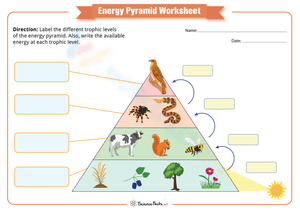
Students who struggle with energy flow concepts often need the pyramid structure given to them before they can focus on organism placement and energy values. Providing a worksheet where the pyramid outline is already drawn — but organism names and numbers are left blank — keeps the task cognitively manageable without removing the conceptual demand. Once placement is accurate, those students can attempt the written explanation tasks with peer support.
For students who place organisms correctly and apply the 10% rule without difficulty, the natural extension is evaluating a flawed pyramid — one where organisms are misplaced or energy values are listed out of order — and explaining specifically what is wrong and why. That shifts the task from recall to analysis. A second option is assigning a different ecosystem (wetland, forest, or open ocean) and asking students to construct their own pyramid using organisms they identify independently, then justify each level in a short paragraph.
The most practical differentiation is built into the task sequence itself: labeling comes before calculation, and calculation comes before written explanation. In a mixed-readiness class, teachers can assign the first two task types broadly and reserve the explanation questions for students who are ready. No additional prep is required beyond deciding where each group stops working.
Standard Alignment
These worksheets align with NGSS standard MS-LS2-3, which asks students to develop a model describing the cycling of matter and flow of energy among living and nonliving parts of an ecosystem. Energy pyramids are one of the most direct classroom models for meeting that standard — students produce a labeled, quantified representation of energy flow that can then be used to make predictions about organism populations. In most 7th grade science sequences, this standard falls in the middle of an ecosystems unit, after food chains and food webs have been introduced and before the class moves into human impact on ecosystems. The 7th grade energy pyramid pdf worksheets in this set map to that instructional placement precisely, functioning as formative practice during the teaching sequence and as review material heading into the unit assessment.
Frequently Asked Questions
What should a 7th grader be able to explain about energy pyramids?
At minimum, a 7th grader should identify producers at the base, name the consumer levels above them, and explain that less energy is available at each successive level. Students meeting the standard can also apply the 10% rule to a given set of energy values and explain why top predators exist in smaller numbers than primary consumers do.
How do I introduce the 10% rule without students treating it as an exact formula?
Frame it as a model, not a precise measurement. Tell students that in most ecosystems, roughly 10% of energy passes from one level to the next — not exactly 10%, but close enough to reason with. Using approximate values in worksheet problems ("about 1,000 units" rather than "exactly 1,000 units") reinforces that framing from the first time students encounter the concept.
What is the difference between an energy pyramid and a food web?
A food web shows feeding connections among many organisms across an ecosystem. An energy pyramid shows how much energy is available at each trophic level. A web can have dozens of overlapping arrows; a pyramid has one clear vertical hierarchy. Both belong in a 7th grade ecosystem unit, but they answer different questions and should be taught as distinct models.
Do the worksheets include answer keys?
Yes. Each worksheet in the set comes with a corresponding answer key, which makes the resources practical for independent review, substitute plans, and small-group intervention where immediate feedback matters but teacher availability is limited.












 Interactive Worksheet Maker
 Quiz Maker
 Word Search Maker
 Crossword Puzzle Maker
 Word Scramble Generator
 Sentence Scramble Generator
 Handwriting Worksheet Generator
 Name Tracing Generator
 Fill In The Blank Generator