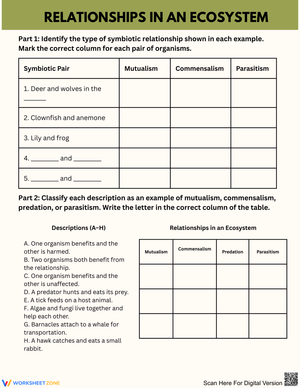
7th grade ecological relationships pdf worksheets give teachers a focused way to address one of the more persistent gaps in middle school life science: students who can rattle off the terms but stall when asked to explain what a scenario actually shows. These worksheets move students through the full range of ecological interaction types — predation, competition, mutualism, commensalism, and parasitism — using organism scenarios, food web connections, and short constructed-response prompts that require reasoning, not just recall. The set works across the ecosystem unit from opening instruction through review and formative assessment.
The Specific Interaction Types Students Work Through
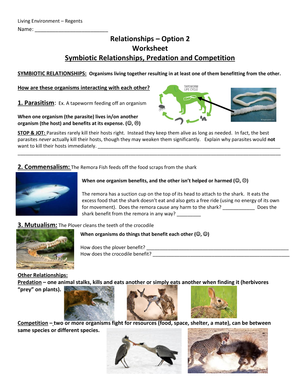
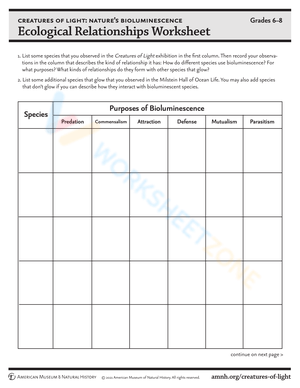
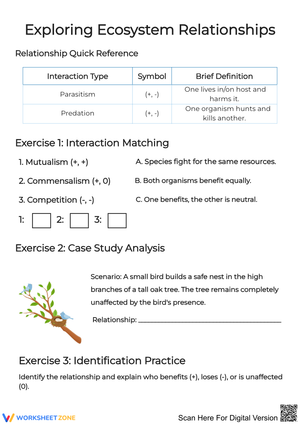
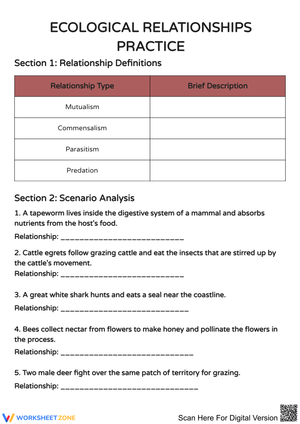
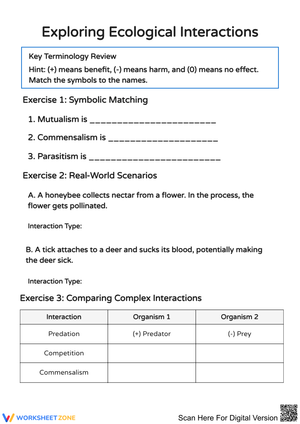
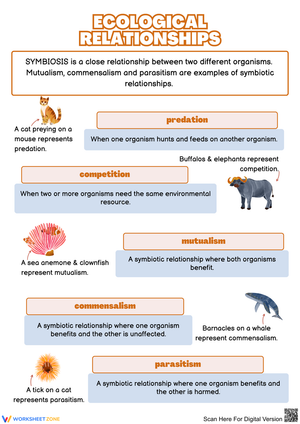
Each relationship type in the set asks something different of students. Predation questions focus on identifying the consumer and the consumed, then tracing population effects — if the wolf population rises, what happens to the deer? Competition questions require students to name the shared resource and explain why both species can't simply avoid the conflict. The three symbiosis types demand the closest attention because they share surface features that reliably trip students up: an organism living on or near another can signal mutualism, commensalism, or parasitism depending on the effect on both parties.
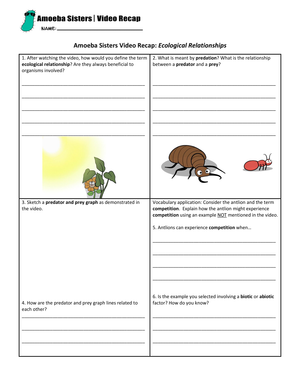
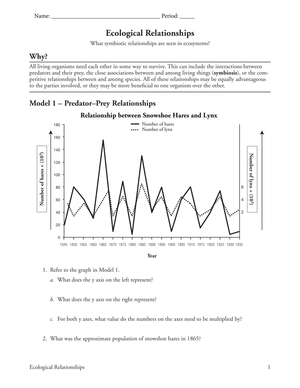
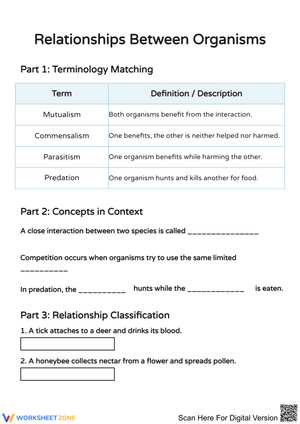
- Predation: one organism hunts and consumes another; students identify predator and prey and explain population-level effects.
- Competition: organisms draw on the same limited resource — food, nesting sites, territory, water — and students explain how that pressure shapes survival outcomes.
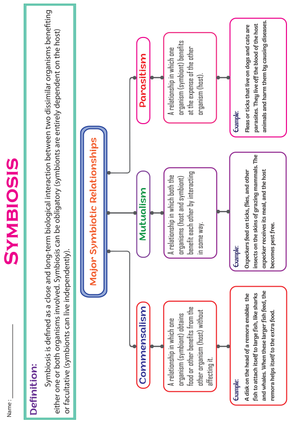
- Mutualism: both organisms receive a measurable benefit; worksheets ask students to name what each party gains, not just label the category.
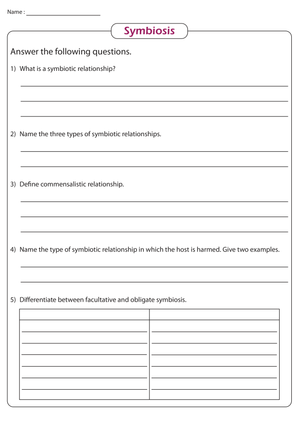
- Commensalism: one organism benefits while the other experiences no measurable change; this is the most frequently mislabeled relationship at the 7th grade level.
- Parasitism: one organism benefits at direct cost to the host, which survives but is harmed; students distinguish this from predation by looking at host survival and ongoing impact.
The scenarios draw from ponds, forests, grasslands, coral reefs, and desert ecosystems, so students encounter a range of organism pairs instead of memorizing one standard example per category.
Errors Worth Anticipating Before You Assign These Worksheets
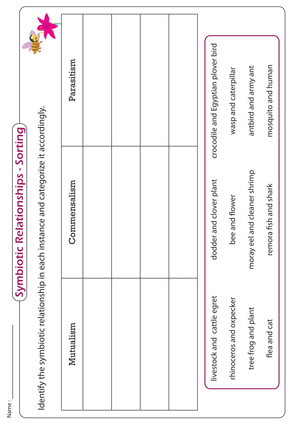
The commensalism-mutualism confusion is the most reliable error in this content area, and it follows a specific pattern. Students read a scenario where an egret walks behind cattle eating insects the cattle disturb from the grass. They write "mutualism" because the egret gets food — and because something about two animals acting in the same space feels mutual. They miss that the cattle receive nothing from the arrangement. Reverse the scenario: barnacles on a whale. Half a class will write "parasitism" because the barnacle is living on another organism, and that physical relationship looks like a tick on a dog to students who are pattern-matching rather than analyzing benefit and harm.
Competition and predation also blur for students who are visualizing a scenario rather than reading it analytically. A wolf chasing an elk reads as predation; two wolves circling the same carcass should read as competition for a limited resource. Students who haven't been explicitly told to look for the shared resource before choosing a category will call both scenarios predation. Asking students to underline the evidence phrase that tells them who gets what — before they label the interaction — redirects them to the text rather than their mental image, and that small step reduces labeling errors more reliably than re-explaining the definitions does.
Parasitism scenarios involving microscopic organisms — bacteria, protists — consistently produce lower accuracy than tapeworm or flea scenarios. The harm is harder to picture when the parasite is invisible. Teachers working through the full set will notice this pattern quickly and can pair those specific worksheets with a brief diagram of parasite-host dynamics before assigning the written tasks.
Building These Worksheets Into the Flow of Your Unit
7th grade ecological relationships pdf worksheets fit naturally at multiple points in an ecosystem unit without requiring heavy planning around them. The most practical sequencing moves predation and competition first — those relationships are the most concrete, and students who work through clear examples of who eats whom and who competes for what develop an analytical habit (who benefits, who is harmed, what resource is at stake) that carries directly into the trickier symbiosis categories. Introducing mutualism, commensalism, and parasitism before students have that habit tends to produce more guessing and less reasoning.
During active instruction, bell ringers work well with single-scenario prompts: display one organism interaction under a document camera, give students two minutes to classify it in writing with evidence, then review as a class before moving on. Station rotations work when different relationship types are assigned to separate stations, with each worksheet anchoring one stop — students rotate through the full set of interactions in roughly forty minutes. For the last eight minutes of a period when there's not enough time for new material, a short classification task closes the lesson without wasted time. Sub plans are straightforward: any worksheet in the set works with no teacher setup beyond printing and dropping in a direction sheet.
Standard Alignment
The tasks in 7th grade ecological relationships pdf worksheets connect directly to NGSS MS-LS2-1, which asks students to analyze data on how resource availability affects organisms and populations — exactly what competition and predation tasks address when students explain why limited resources alter population size. MS-LS2-2 calls for constructing explanations that predict interaction patterns among organisms across multiple ecosystems; the scenario-based and food web questions throughout the set give students structured practice doing that reasoning in writing. Both standards belong to the middle school life science progression's first serious engagement with community ecology. Students in elementary grades studied individual organisms; grade 7 is where they begin reasoning about how interactions among organisms shape whole populations — which is why these relationship types appear at this level rather than earlier.
Differentiating the Set Across Ability Levels
Students who need more structured entry into each worksheet benefit from a before-you-classify routine: find and underline the phrase that describes what each organism gets from the relationship, then mark the relationship type. That step slows down the impulse to guess from memory and puts the evidence on paper before the answer goes in. It also creates something concrete to point to when reviewing incorrect work — the student can see whether they underlined the right phrase and still chose the wrong category, which usually means they misread the outcome rather than the scenario itself.
For students who move quickly through labeling tasks, a single follow-up prompt extends the work without any additional printing: "What would likely happen to both organisms if this relationship ended?" That question requires ecosystem-level reasoning rather than category identification and aligns directly with the predictive thinking MS-LS2-2 targets. A student who completes that prompt for three or four scenarios is doing genuinely different cognitive work than a student finishing the matching section.
7th grade ecological relationships pdf worksheets also support partner work well, particularly in classes with wide readiness variation. Pairing students and requiring one to defend or challenge the other's classification using evidence from the scenario produces productive disagreement — and those disagreements surface the reasoning gaps that whole-class discussion sometimes misses entirely.
Frequently Asked Questions
What ecosystems do the scenarios in these worksheets draw from?
The scenarios use organisms from forests, ponds, grasslands, coral reefs, and deserts. That variety is intentional — students who only encounter clownfish-anemone and oxpecker-rhino examples in every worksheet memorize those pairs rather than learning to analyze any new scenario they encounter. Seeing five different organism pairs illustrating mutualism is more useful than seeing one pair repeated five times.
Are these worksheets better for in-class use or homework?
Vocabulary matching and basic identification tasks travel home without confusion. Scenario analysis and food web questions are stronger as in-class work because students can ask about genuinely ambiguous phrasing — and at this level, some scenarios will seem ambiguous to students who are reasoning carefully rather than guessing. The most common homework assignment in this set is vocabulary reinforcement the night after introducing a new category in class, then returning to scenario work the next day.
How do these worksheets help students distinguish commensalism from parasitism?
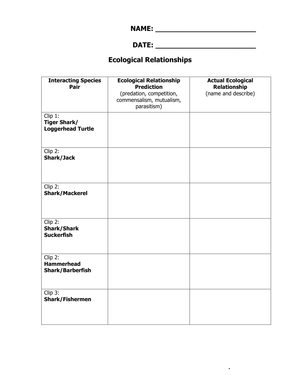
Several worksheets pair scenarios that use the same host organism with two different relationships — a flea on a dog alongside a remora on a shark, for example — and require students to explain the difference in writing. That forced comparison produces more precise reasoning than multiple-choice items because students can't rely on a correct guess. The written explanation also tells teachers exactly where a student's reasoning breaks down, which multiple-choice responses rarely do.
Do the worksheets include answer keys?
Yes. Each worksheet includes an answer key with brief rationale for the scenario-based questions — not just the correct category label, but a sentence explaining why the interaction fits that category. That makes grading constructed-response items faster and gives teachers a ready reference when reviewing answers with the class under a document camera.












 Interactive Worksheet Maker
 Quiz Maker
 Word Search Maker
 Crossword Puzzle Maker
 Word Scramble Generator
 Sentence Scramble Generator
 Handwriting Worksheet Generator
 Name Tracing Generator
 Fill In The Blank Generator