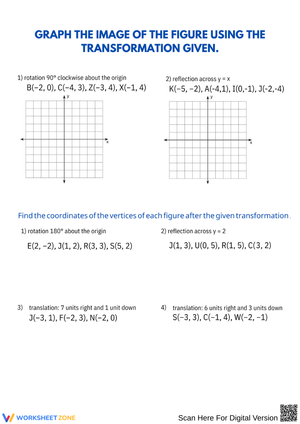
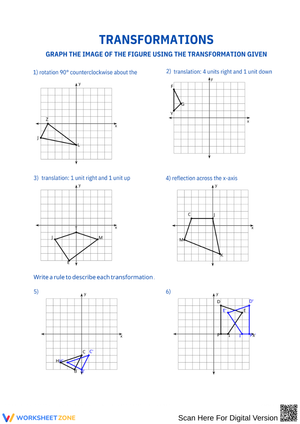
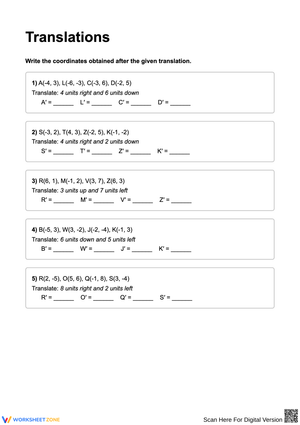
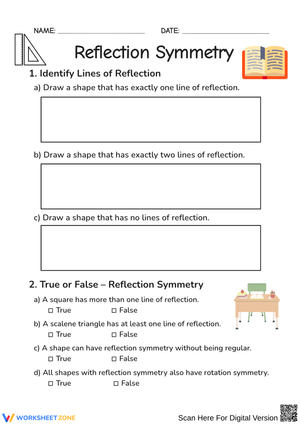
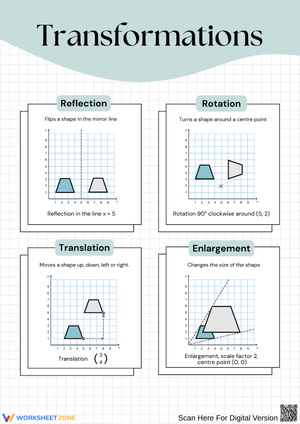
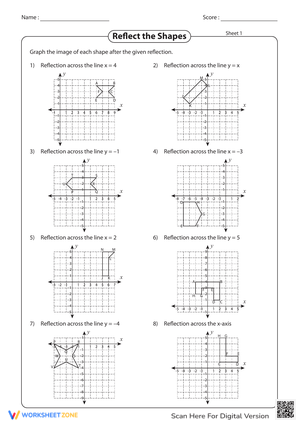
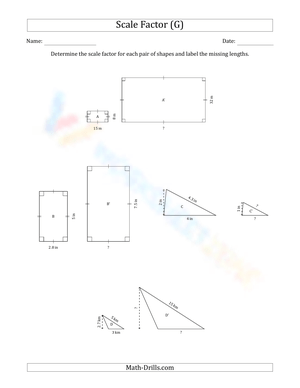
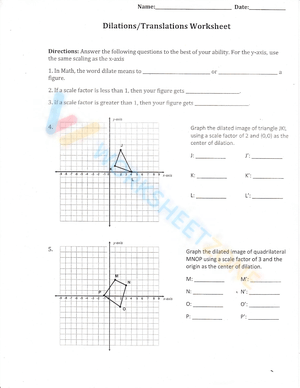
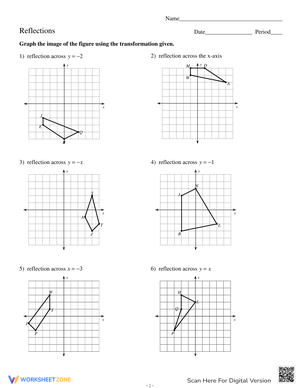
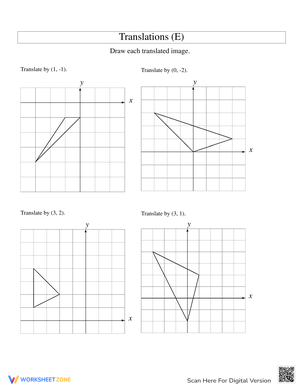
These transformations printable worksheets for 7th grade cover translations, reflections, rotations, and dilations through coordinate plane tasks that ask students to name, perform, and explain figure movement — not just copy steps from a model. Each worksheet targets a specific skill or a focused mixed review, so teachers can pull exactly what the class needs without rebuilding materials from scratch.
Mistakes Students Reliably Make — and What to Watch For
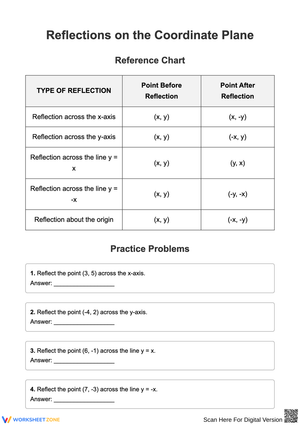
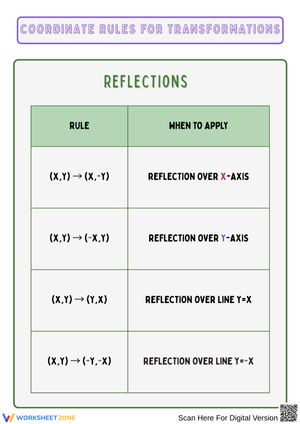
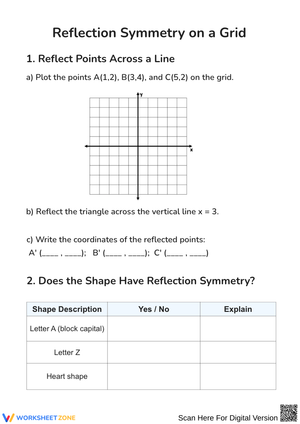
Transformation errors in 7th grade follow predictable patterns. A student who can slide a triangle 3 units right will still write (2, −4) when asked to reflect (−2, 4) across the y-axis, because they negate both coordinates instead of only the x. That sign confusion tied to axis choice appears constantly in student work, and a single focused reflection worksheet usually surfaces it within the first three problems.
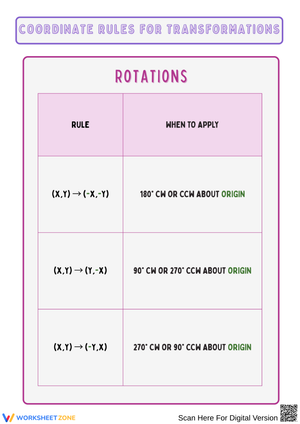
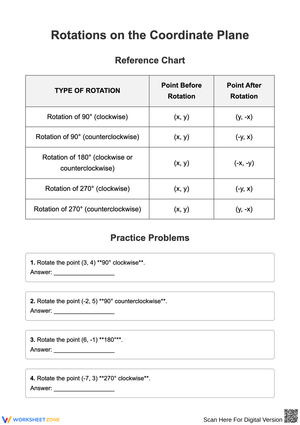
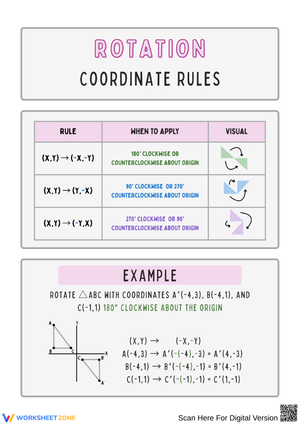
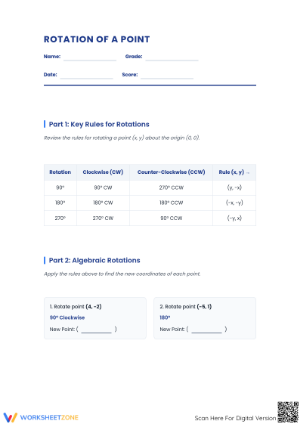
Rotation mistakes are even more consistent. The rule for a 90° counterclockwise rotation around the origin is (x, y) → (−y, x): coordinates swap and one sign changes. Most students either swap without changing signs, producing (3, 2) from (2, 3), or change signs without swapping, producing (−2, −3). A short targeted worksheet on this rule alone separates students who have memorized the procedure from those who understand why both operations happen at once.
Dilation errors tend to surface during scale drawing tasks. Students multiply only one coordinate by the scale factor rather than both, producing a distorted figure rather than a proportional enlargement. When the center of dilation sits anywhere other than the origin, errors compound — students forget to account for the center entirely and treat every dilation as if it originates from (0, 0). Prime notation adds another consistent problem: a significant number of students label the preimage A' and the image A, reversing the convention and misreading every subsequent task in the set.
Skills These Worksheets Build
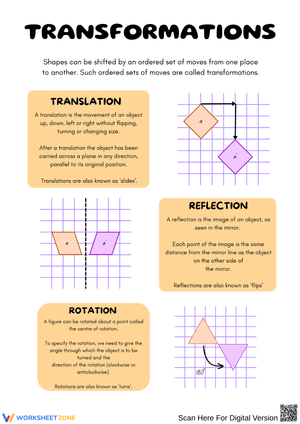
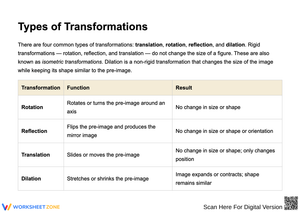
At this grade level, transformation practice centers on four operations, each with distinct vocabulary and coordinate behavior.
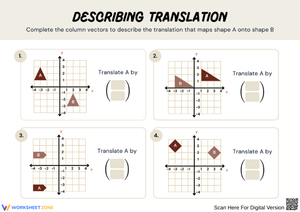
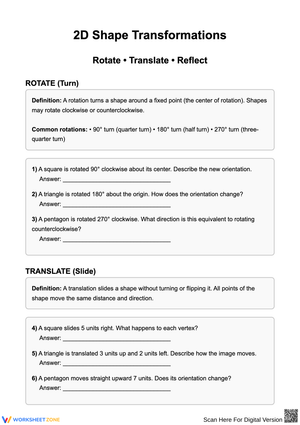
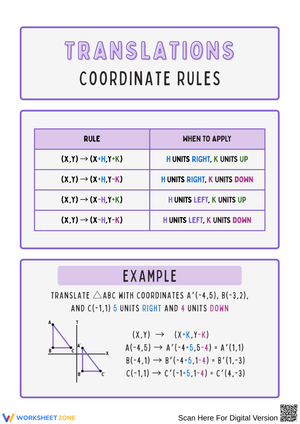
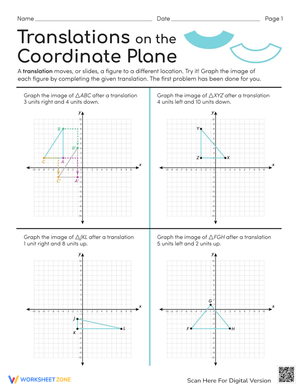
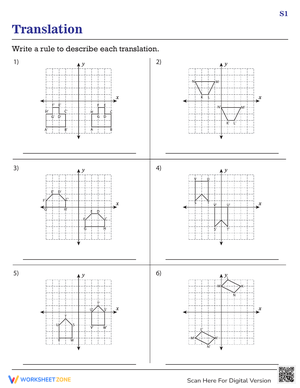
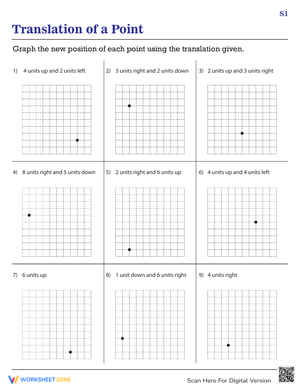
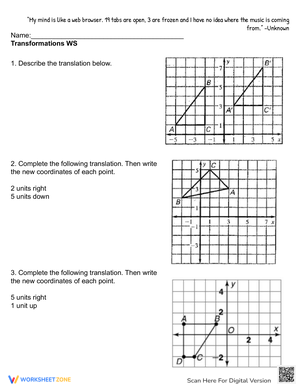
- Translations: Students slide figures horizontally, vertically, or diagonally and write the movement as a coordinate rule — such as (x, y) → (x + 4, y − 2) — rather than just counting squares on the grid.
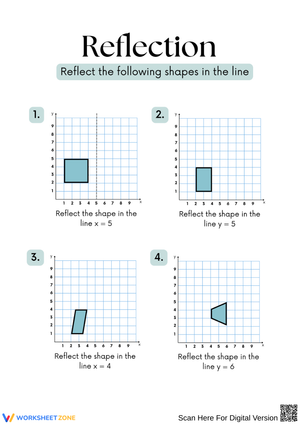
- Reflections: Worksheets address reflections across the x-axis, the y-axis, and the line y = x, since each changes a different coordinate or pair of coordinates and produces its own class of student errors.
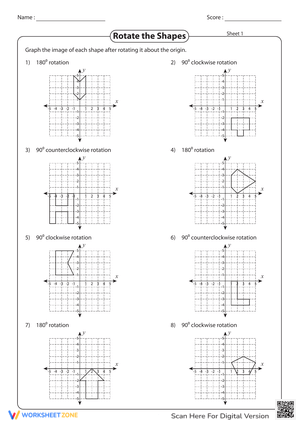
- Rotations: Students practice 90°, 180°, and 270° turns around the origin in both clockwise and counterclockwise directions, applying coordinate rules rather than estimating visually.
- Dilations and scale factors: Students enlarge or reduce figures from a center point, compare side lengths in the preimage and image, and connect scale factor to the proportional reasoning they built in earlier units — particularly ratios and unit rate work.
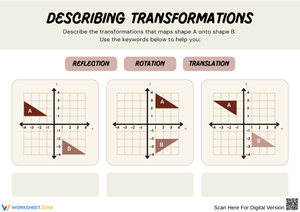
Later worksheets in the set ask students to identify an unknown transformation from a preimage-image pair, write a description in words, or determine whether two figures are congruent or similar. Those tasks require reasoning, not only calculation, and they reveal which students have genuine conceptual understanding versus which ones have a surface-level procedure.
Recommended Strategies for Building These Into Your Lesson Plans
The most natural sequence is to introduce one transformation type at a time, use one worksheet for immediate guided practice after the lesson, and return to a second worksheet two or three days later for spaced retrieval. This pattern holds even in a compressed unit because the worksheets stay focused — students are not switching among all four types before any one of them is stable.
In practice, transformations printable worksheets for 7th grade fit several recurring lesson structures: a five-minute bell ringer pulling two or three problems from a prior skill, a guided-practice period where students work the first half alongside the teacher and the second half independently, or a station rotation where one group graphs while another sorts transformation rules to matching figures. During small-group intervention, a short single-skill worksheet provides faster diagnostic feedback than reteaching from a full lesson — the errors students make on three rotation problems tell you more than re-explaining the rule would.
One routine worth building into the week: after students complete any worksheet, ask one student per table to describe a completed problem aloud before anyone turns in the paper. A student who can say "I reflected point (3, −1) across the y-axis by negating the x-coordinate to get (−3, −1)" has demonstrated more than correct plotting. That verbal habit also surfaces partial understanding quickly — students who say "I just flipped it" without specifying the axis or naming the coordinate change usually need one more targeted worksheet before moving on.
Standard Alignment
Transformation work at this level connects to two standard clusters. Dilation tasks align with CCSS 7.G.A.1, which addresses scale drawings of geometric figures — students apply scale factors and use proportional reasoning to compare measurements in the preimage and image. Translation, reflection, and rotation work builds toward the 8th-grade cluster 8.G.A.1–5, which formalizes the properties of rigid transformations and introduces congruence and similarity through that lens.
Most districts use 7th grade geometry units to introduce all four transformation types before the 8th-grade standards require formal justification. These worksheets fit that instructional timeline: they build procedural fluency and precise vocabulary in 7th grade, which reduces cognitive load when students encounter the same concepts in 8th grade with added abstraction. Teachers who work with these resources in Grade 7 frequently keep them accessible for the following year, when the same students hit 8th grade geometry and benefit from a focused review before the expectations deepen.
Fitting These Worksheets to Different Levels of Learners
The most straightforward adjustment for beginners is worksheet selection: start with simple figures — triangles with labeled vertices at whole-number coordinates close to the origin — and use direct movement language rather than algebraic notation. A student still shaky on the coordinate plane itself should not be writing (x, y) → (x + 3, y − 2) in the first session. Worksheets with small numbers, clearly labeled axes, and room to mark each step directly on the grid keep early practice from becoming an error spiral.
For students ready to go further, transformations printable worksheets for 7th grade that include coordinate rule writing, multi-step transformations, or error-identification tasks push past rote procedure. An error-identification task — "a student reflected (4, 3) across the x-axis and got (−4, 3). What mistake did they make, and what is the correct image?" — asks students to work from the inside out rather than just executing a calculation. Students who can explain another person's error reliably understand the transformation.
Students working significantly below grade level often benefit from a comparison anchor: a laminated reference card showing one worked example of each transformation type alongside the coordinate rule. That tool offloads the memory demand of four separate rules and directs cognitive effort toward applying the rule correctly — which is the actual instructional goal. Once students are consistent, fade the card by folding away one transformation type at a time until they are working without support.
Frequently Asked Questions
Can these worksheets work for 8th grade review, or are they specifically for 7th grade?
Transformation worksheets built at the 7th grade level work well for 8th grade review at the start of the unit, particularly before formally introducing congruence and similarity proofs. The coordinate plane tasks stay relevant through 8th grade, and the error patterns — sign confusion during reflections, coordinate-swap errors in rotations — persist into 8th grade student work. Many teachers keep these resources in their files across both grades.
How many worksheets per transformation type makes a reasonable unit plan?
Two worksheets per type is a practical minimum: one for initial guided practice immediately after the lesson, and one for independent review two or three days later. Mixed-review worksheets toward the end of the unit add a third layer of practice. Units that move to mixed review before students have each transformation stable tend to see higher error rates across the board — the confusion compounds when students must distinguish among types they have not yet internalized separately.
What coordinate plane background do students need before starting?
Students should be able to plot ordered pairs reliably in all four quadrants and identify positive versus negative coordinates before tackling transformations printable worksheets for 7th grade. Students who regularly confuse the x- and y-axes will compound that confusion the moment transformation rules enter the picture. A brief five-problem coordinate plotting check at the start of the unit reveals who needs that prerequisite addressed before transformation work begins — catching it there is far less disruptive than discovering it three lessons in.
What should students who finish the worksheet quickly do next?
Ask them to write a coordinate rule for every transformation they completed — even if the worksheet only required a plotted image. Alternatively, give them a completed problem containing a deliberate error and ask them to identify the mistake and correct it. Both extensions work the same underlying skill at greater depth without requiring a separate resource. The error-correction version, in particular, produces stronger written mathematical reasoning than any additional practice problem would.













 Interactive Worksheet Maker
 Quiz Maker
 Word Search Maker
 Crossword Puzzle Maker
 Word Scramble Generator
 Sentence Scramble Generator
 Handwriting Worksheet Generator
 Name Tracing Generator
 Fill In The Blank Generator