


























Views
Downloads
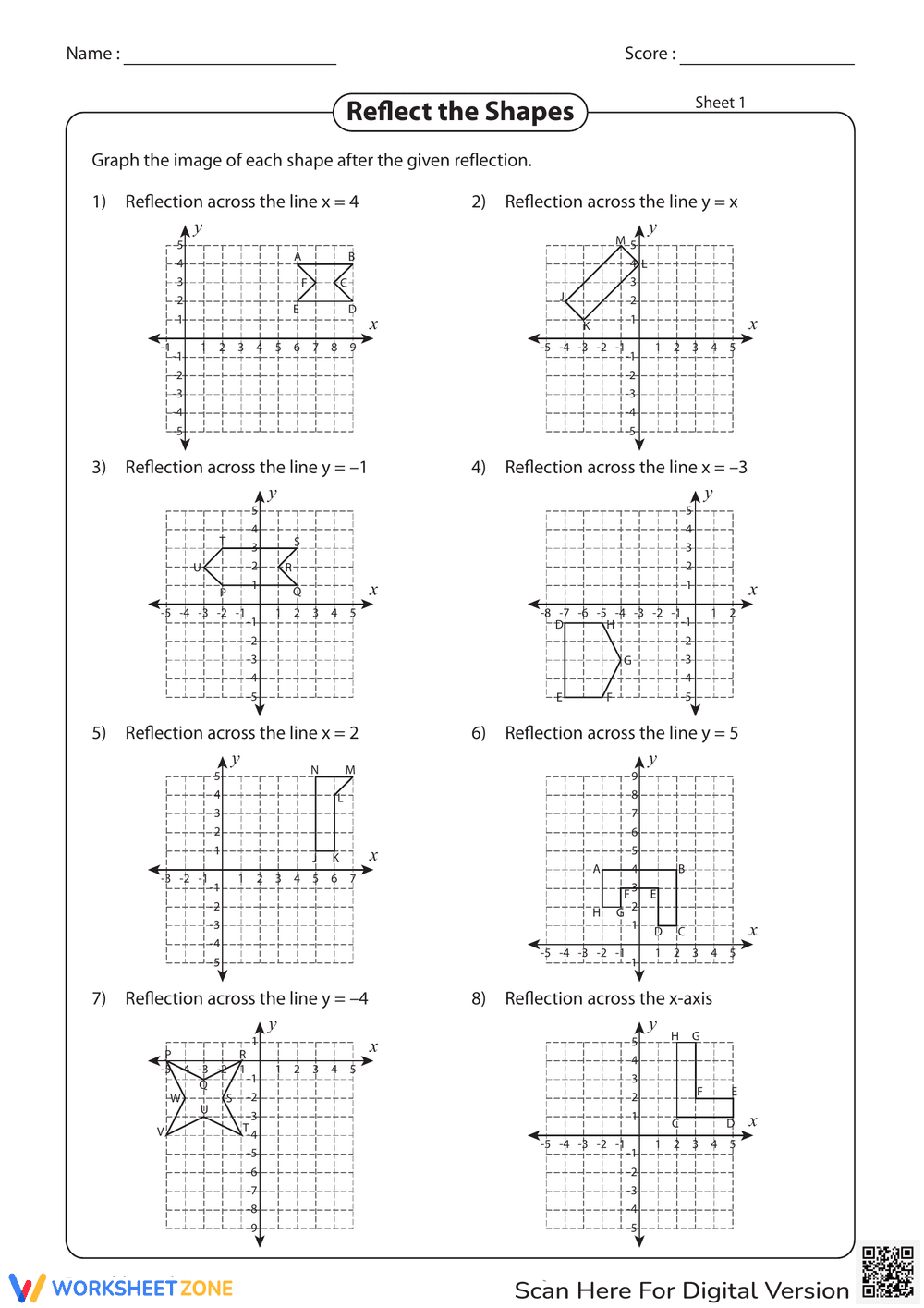

Printable Shape Reflections Worksheet | Grade 7 Math
Paste this activity's link or code into your existing LMS (Google Classroom, Canvas, Teams, Schoology, Moodle, etc.).
Students can open and work on the activity right away, with no student login required.
You'll still be able to track student progress and results from your teacher account.
This focused geometry worksheet provides middle school students with targeted practice graphing shape reflections across various lines of symmetry. By plotting the transformed coordinates of polygons on a Cartesian plane, learners develop spatial reasoning and master geometric transformations essential for advanced mathematics.
At a Glance
- Grade: 7 · Subject: Math
- Standard:
CCSS.MATH.CONTENT.8.G.A.3— Graph reflections of two-dimensional figures on a coordinate plane- Skill Focus: Geometric Reflections
- Format: 1 page · 8 problems · Answer key included · PDF
- Best For: Independent practice
- Time: 15–20 minutes
This single-page resource features eight distinct graphing problems that require students to reflect given polygons across specific lines. The tasks include reflections across the x-axis, vertical lines like x = 4, horizontal lines like y = -1, and diagonal lines like y = x. A complete answer key is provided to facilitate quick grading and immediate student feedback.
Skill Progression
- Guided practice: The first two problems introduce basic reflections across standard vertical and diagonal lines, allowing students to count units from the line of symmetry.
- Supported practice: The next three tasks challenge learners with negative coordinate lines and shapes that intersect the reflection line, requiring careful vertex mapping.
- Independent practice: The final three problems involve complex polygons and axis reflections, testing full mastery of coordinate transformation rules.
This structured sequence follows a gradual-release model, moving from simple visual counting to applying formal coordinate rules for transformations.
Standards Alignment
Aligned to CCSS.MATH.CONTENT.8.G.A.3: Describe the effect of dilations, translations, rotations, and reflections on two-dimensional figures using coordinates. This resource specifically targets the reflection component, ensuring students can accurately map vertices across various axes of symmetry. Both standard codes can be copied directly into lesson plans, IEP goals, or district curriculum mapping tools.
How to Use It
Deploy this worksheet during direct instruction as a primary practice activity immediately following your lesson on geometric transformations. Alternatively, assign it as a focused homework task to reinforce spatial reasoning skills. Expect students to complete the eight problems in 15 to 20 minutes. As a formative assessment observation tip, watch to see if students are counting grid units from the line of reflection or attempting to use algebraic coordinate rules; counting errors often indicate a need for explicit rule-based instruction.
Who It's For
This resource is designed for general education middle school math students learning coordinate geometry. For learners requiring accommodations, teachers can highlight the line of reflection in a bright color before distributing the page. Pair this worksheet with a transparent patty paper activity or a digital geometry tool to help visual learners verify their graphed reflections.
Mastering geometric transformations, specifically the ability to graph reflections of two-dimensional figures on a coordinate plane as outlined in CCSS.MATH.CONTENT.8.G.A.3, is a critical step in developing spatial visualization skills. According to a RAND AIRS 2024 report, students who engage in targeted, hands-on graphing practice demonstrate a 28 percent higher retention rate in advanced geometry concepts compared to those who only receive theoretical instruction. Spatial reasoning directly correlates with future success in STEM fields, making these foundational exercises vital. By requiring learners to physically plot each transformed vertex across different axes, this worksheet bridges the gap between abstract algebraic rules and concrete visual representation. Consistent practice with varied lines of symmetry ensures robust conceptual understanding and prepares students for more complex composite transformations in high school mathematics.


