


























Views
Downloads


Printable Rotation of a Point Worksheet | Grade 7 Math
Paste this activity's link or code into your existing LMS (Google Classroom, Canvas, Teams, Schoology, Moodle, etc.).
Students can open and work on the activity right away, with no student login required.
You'll still be able to track student progress and results from your teacher account.
This comprehensive Rotation of a Point worksheet helps Grade 7 and 8 students master the fundamental rules of coordinate geometry transformations. By applying algebraic rules to points on a Cartesian plane, learners develop a deep understanding of how 90, 180, and 270-degree rotations in both clockwise and counter-clockwise directions affect spatial positioning.
At a Glance
At a Glance
- Grade: 7–8 · Subject: Geometry
- Standard:
8.G.A.3— Describe the effect of rotations on two-dimensional figures using coordinates- Skill Focus: Coordinate Point Rotations
- Format: 4 pages · 16 problems · Answer key included · PDF
- Best For: Geometry transformation practice and spatial reasoning
- Time: 30–45 minutes
What's Inside
This four-page instructional resource is meticulously structured to guide students through the complexities of rotating points about the origin. It features a clear reference table of algebraic rules, computational problems, graphing tasks for visual reinforcement, and challenge problems involving mixed rotations and variables. A complete answer key is provided for immediate feedback and grading efficiency.
Skill Progression
- Guided practice: The resource begins with a "Key Rules" reference table and two introductory problems using specific coordinate sets to build confidence with the (y, -x) and (-x, -y) formulas.
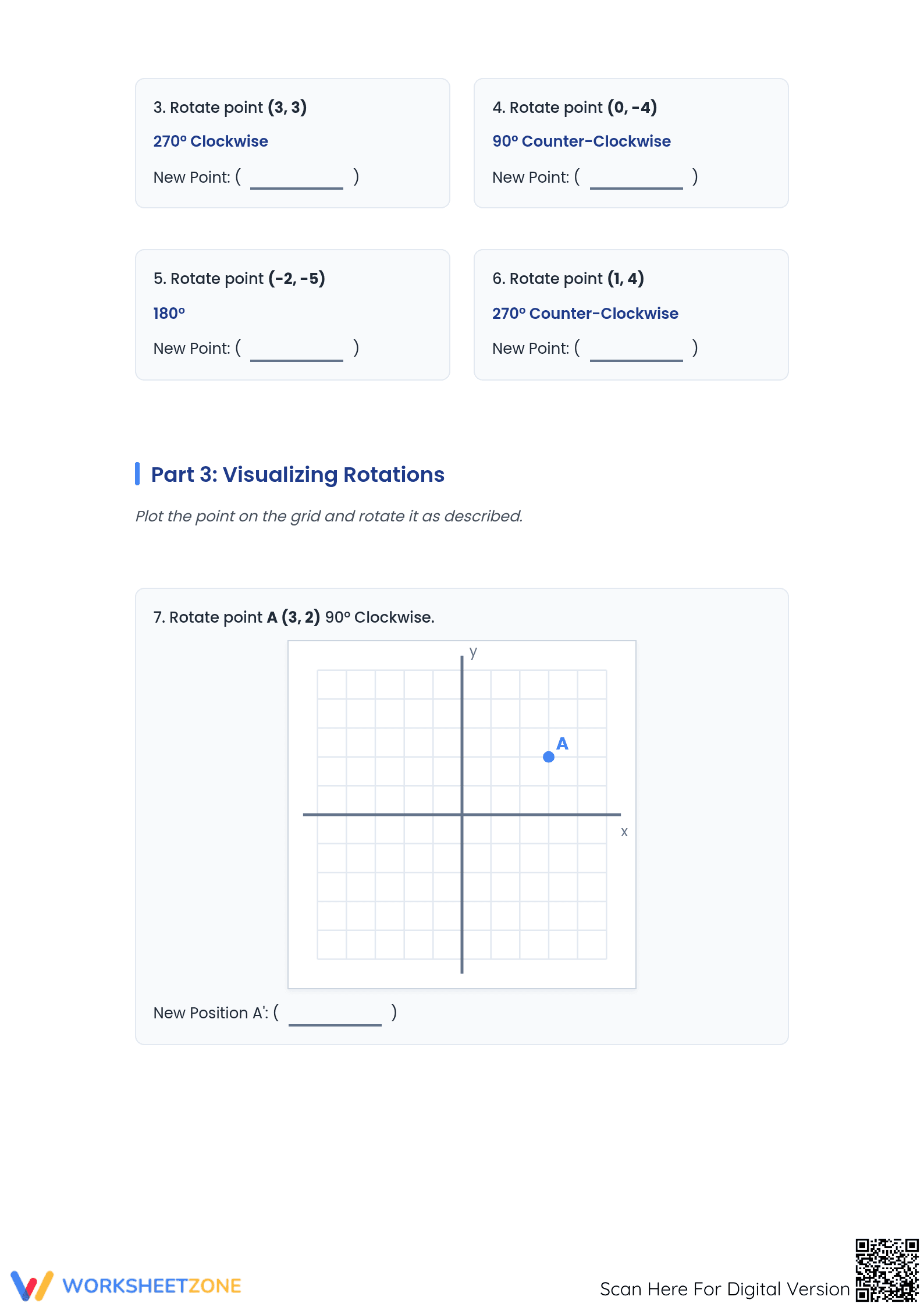
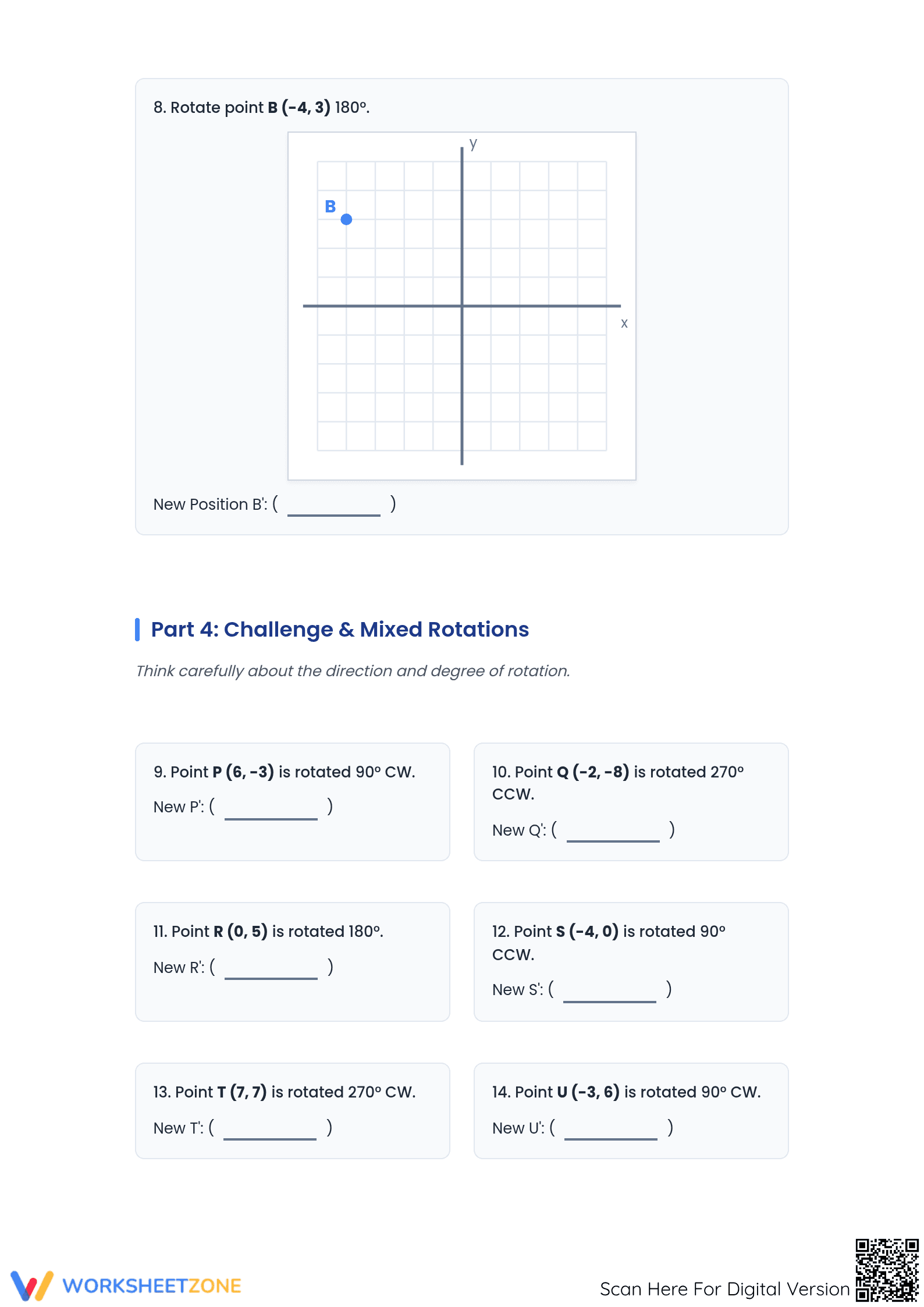
- Supported practice: Problems 3 through 8 introduce counter-clockwise turns and visual plotting on 10x10 grids, ensuring students can connect algebraic output to visual spatial shifts on the coordinate plane.
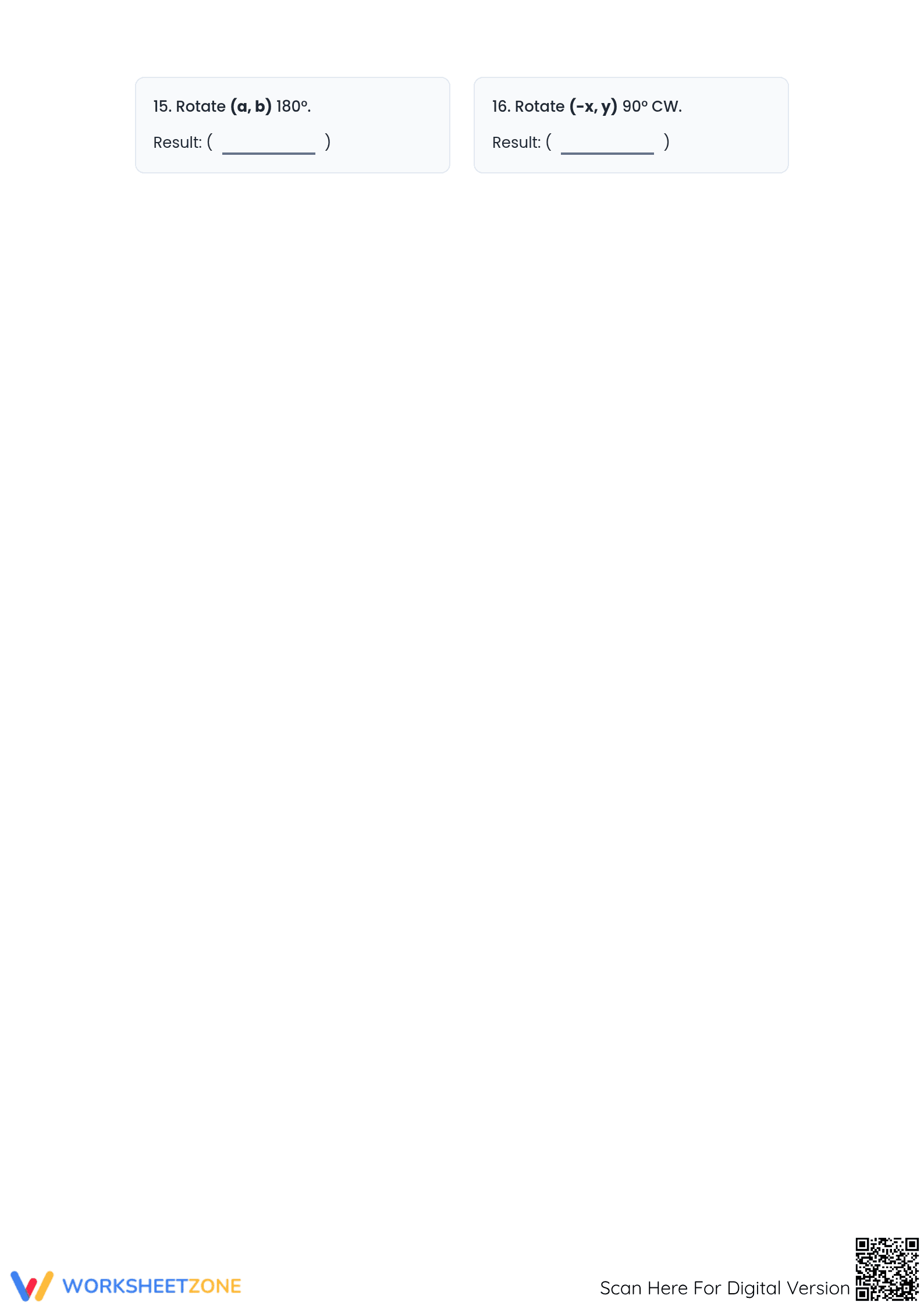
- Independent practice: The final "Challenge & Mixed Rotations" section presents eight complex tasks, including rotations of points on axes and symbolic coordinates (a, b) to ensure total conceptual mastery.
The structured layout follows the gradual-release model of instruction, moving from teacher-led modeling to independent mastery.
Standards Alignment
The primary focus of this worksheet is `CCSS.MATH.CONTENT.8.G.A.3`, which requires students to describe the effect of rotations on two-dimensional figures using coordinates. By isolating the rotation of individual points, this resource provides the foundational scaffolding necessary for students to later transform entire polygons. This standard code can be copied directly into lesson plans, IEP goals, or district curriculum mapping tools.
How to Use It
This worksheet is ideal for use during the independent practice phase of a transformation unit. Teachers can use the first page's reference table as a guided note-taking session before releasing students to work through the algebraic and visual problems. A great formative assessment tip is to observe students during the plotting phase on page 2 to see if they are correctly mapping the coordinate swaps before applying sign changes. The worksheet also functions effectively as a self-contained sub plan.
Who It's For
This resource is designed for middle school students in Grade 7 and Grade 8, as well as high schoolers needing a refresher on rigid transformations. It serves as a perfect pairing for interactive geometry software, allowing students to verify their manual calculations with digital tools. The clear layout supports diverse learners by providing explicit rules alongside practical application tasks.
The integration of algebraic transformations in middle school geometry is a critical precursor to advanced spatial reasoning. This worksheet directly addresses the cognitive demand of CCSS.MATH.CONTENT.8.G.A.3, transitioning learners from rote memorization to visual application of rotations about the origin. With 16 distinct practice opportunities, it aligns with the gradual release of responsibility model, ensuring effective transition from teacher-led explanation to student-led symbolic rotation. This approach develops geometric fluency for college and career readiness in STEM-related fields.


