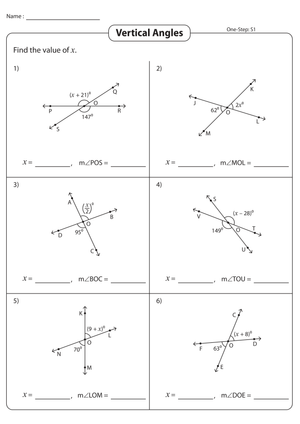
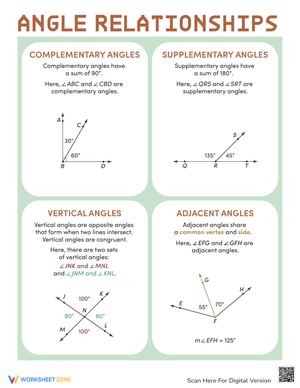
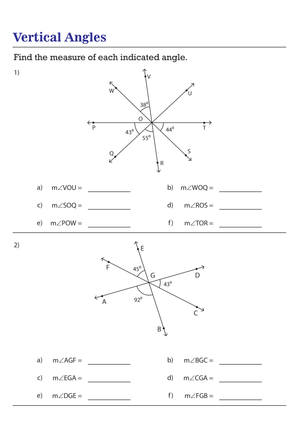
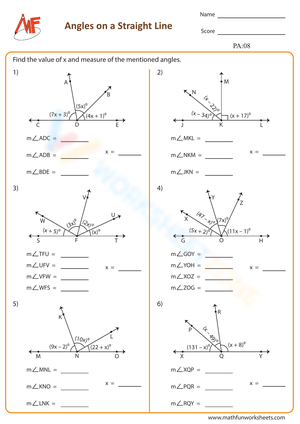
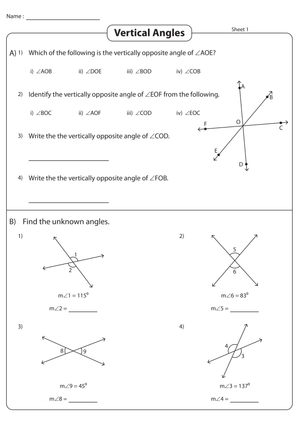
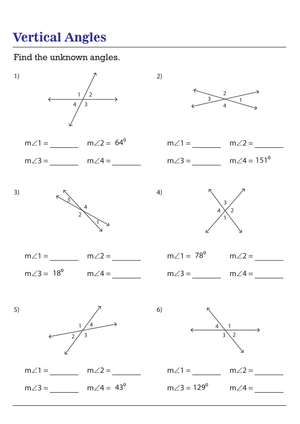
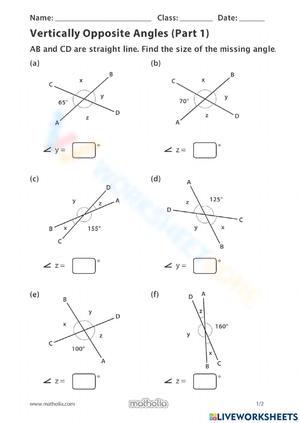
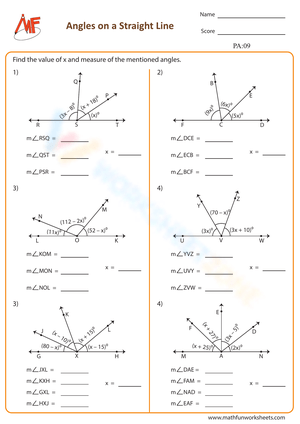
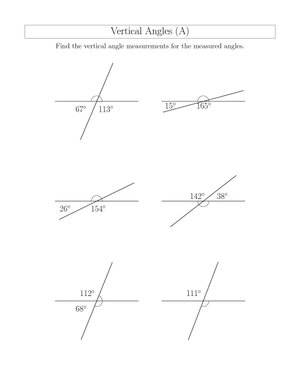
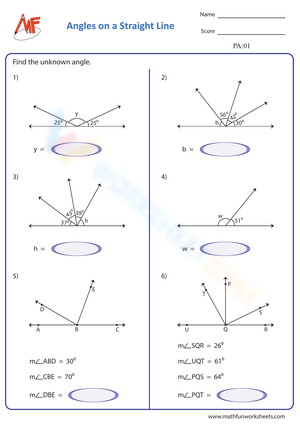
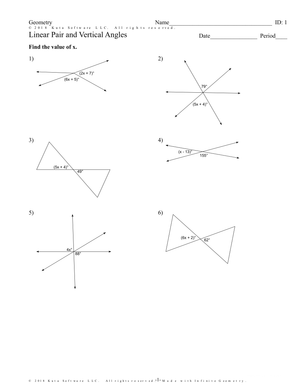
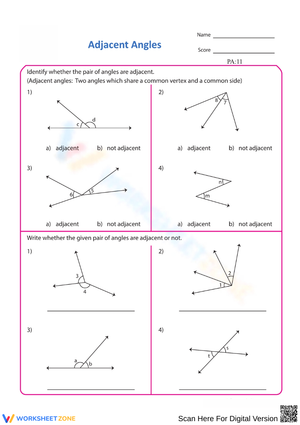
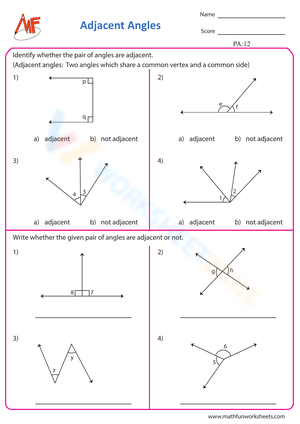
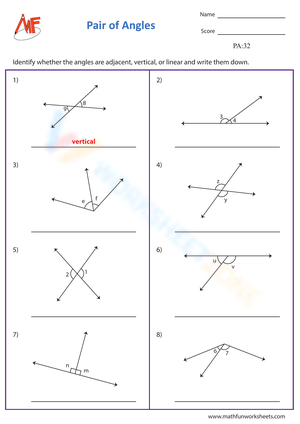
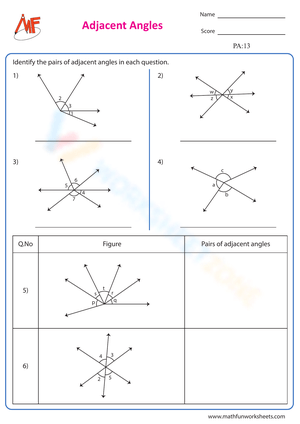
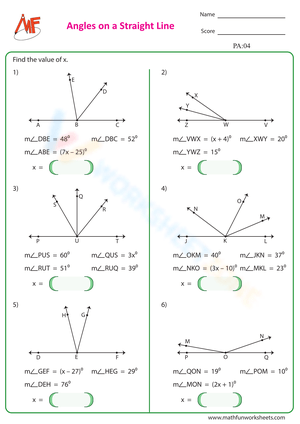
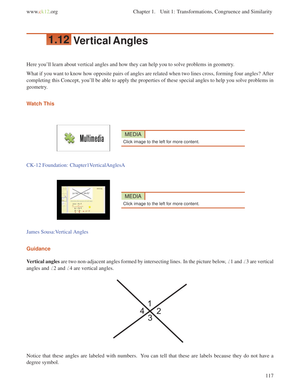
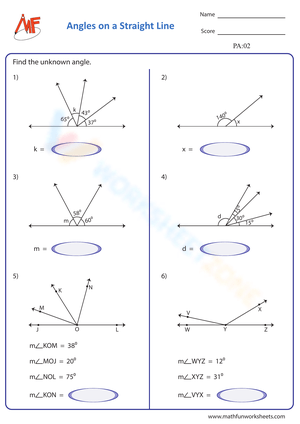
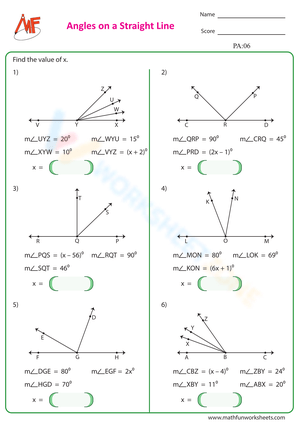
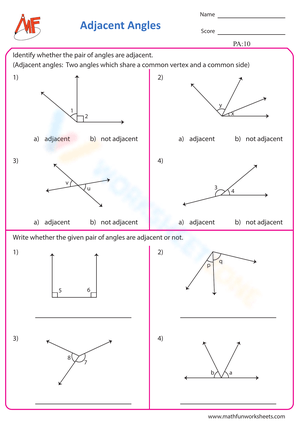
These 7th grade vertical angles worksheets resources zero in on one of the most teachable moments in geometry instruction — the instant a student sees that two angles formed across an intersection aren't just roughly equal, they're always exactly congruent. Each worksheet targets a distinct stage of that understanding: identifying which angles are vertical in a diagram, explaining why their measures must match, and solving equations when one or both angles carry a variable expression. An answer key is included, so the set works for independent desk practice, pair work, station rotations, or homework review without requiring the teacher to check every paper by hand.
The Specific Skills Each Worksheet Builds
Vertical angles land at a precise conceptual moment in 7th grade geometry — after students have learned to name rays and classify angles, but before they encounter the more demanding relationships of parallel lines cut by a transversal. What they need at this stage is clarity on three connected facts: that two straight lines crossing at a point create two pairs of opposite angles, that each pair shares equal measures, and that this relationship holds regardless of how steeply the lines are tilted. Each worksheet addresses one or more of these facts rather than treating the topic as a single undifferentiated skill.
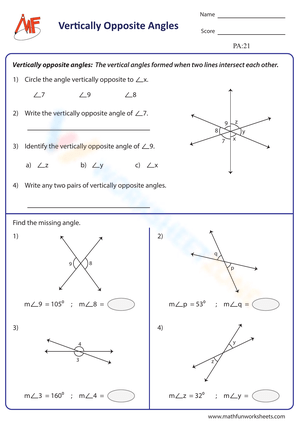
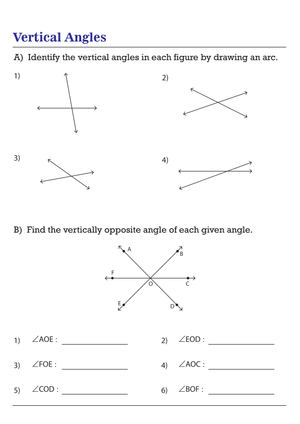
Identification tasks ask students to mark or name vertical angle pairs within a given diagram. These look simple, but students regularly mislabel them — more on that below. The set then moves into missing-measure problems, where one angle is labeled numerically and students determine its vertical partner, and then into algebraic problems where both angles carry expressions such as 2x + 15 and 5x − 12. Students set those expressions equal, solve for x, and substitute back to verify the angle measure. That substitution step is non-negotiable for catching arithmetic errors, and the worksheets build in space for it so students don't skip it.
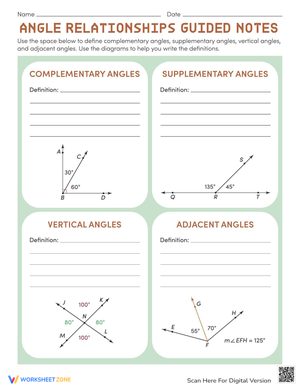
Several worksheets in the set also pair vertical angles with adjacent angles in the same diagram. That combination matters because students who can identify vertical pairs in isolation frequently lose track when adjacent and vertical angles appear together — which is exactly the situation they encounter on assessments.
Student Errors Worth Watching For and Correcting
The most persistent error in this topic is a conceptual one, not a careless mistake. Students often see two angles that are physically close together and label them as vertical simply because the angles look similar in size. They're reading visual proportion rather than spatial relationship. Vertical means opposite across the intersection point — not next to each other and approximately equal-looking. This is where the 7th grade vertical angles worksheets resources deliver immediate diagnostic value: the diagrams deliberately include cases where an adjacent angle and a vertical angle have similar but not identical measures, which means students who guess by visual size will get the wrong answer and know it.
A second error surfaces the moment students move into equation-solving. When a problem presents two vertical angles labeled 3x + 8 and x + 40, students who understand the relationship set those expressions equal and solve. But a common wrong move is to add the expressions and set the sum equal to 180 — treating the relationship as supplementary rather than congruent. This happens because students who recently worked on supplementary angle problems default to that procedure when they see two angle expressions in the same diagram. Asking students to underline the word vertical in each problem before writing any equation is a small habit that cuts this error noticeably.
Building These Worksheets Into Your Lesson Plan
The most effective sequence runs three moves: teacher model, guided pair discussion, then independent work. Project one problem from a worksheet and work through the identification and equation steps aloud. Then have students complete two or three problems with a partner, requiring them to say out loud why the angles are vertical before writing anything down. Solo practice on the remaining items follows. The conversation step between the model and independent work is where the conceptual understanding firms up — students who can explain the relationship in words make far fewer errors when they write equations.
The 7th grade vertical angles worksheets set fits naturally into warm-up routines as well. Three to five identification or missing-measure problems at the start of class keep angle vocabulary active across a multi-week geometry unit without eating into new instruction time. For sub plans, the worksheets print cleanly and need no setup beyond the answer key — a genuine advantage when the topic involves diagrams and visual accuracy matters.
For review ahead of assessments, the mixed-type worksheets — those combining identification, missing-measure, and algebraic problems in a single set — are the most useful. They reflect what students actually encounter in test items: a variety of question formats built from the same underlying relationship.
Adjusting These Worksheets for a Range of Learners
Students who are still consolidating basic angle concepts work best on identification and single-value problems. A useful entry task is giving these students a diagram with one angle already labeled as 124° and asking them to mark all four angle measures at the intersection — naming both vertical pairs and filling in all four values. That problem type requires genuine understanding of the congruence relationship without introducing any algebra.
On-level students are ready for one-step equation problems: set two vertical angle expressions equal, solve for the variable, substitute back. The back-substitution check is worth insisting on here. Students who skip it may calculate x correctly but then state an incorrect angle measure, which they only notice when the answer key contradicts them. Building the verification habit into every equation problem pays dividends later in the year when problems carry more steps.
For students who finish early or need an extension, add a written reasoning prompt alongside a completed diagram: Explain why setting 2x + 15 equal to 5x − 12 is the correct setup for these two angles, and describe what you would change if the angles were supplementary instead of vertical. That question demands mathematical precision well beyond calculation. Color-coding is another practical adjustment — having students mark each vertical pair in a matching color before solving helps those who understand the concept but lose track of angle positions in more complex figures with multiple intersection points.
Standard Alignment
These worksheets address CCSS 7.G.B.5, which requires students to use facts about supplementary, complementary, vertical, and adjacent angles to write and solve equations in multi-step problems. In classroom terms, this standard typically appears mid-unit in 7th grade geometry — after angle classification work and before triangle angle-sum relationships. Vertical angles are a natural entry point into 7.G.B.5 because the congruence property is a single, clean fact. Once students commit it to memory, they apply it immediately to equation-solving without needing additional geometric reasoning to get started. The 7th grade vertical angles worksheets set addresses this standard through all three problem types: identification, missing-measure, and algebraic.
Frequently Asked Questions
What makes vertical angles different from adjacent angles?
Vertical angles are opposite each other at an intersection and do not share a side. Adjacent angles share a side and sit next to each other at the same intersection. The two are easy to confuse when students are reading a diagram quickly, which is why worksheets that include both types in the same figure build more durable recognition than those that show only vertical pairs in isolation.
Are vertical angles always congruent, or only in certain cases?
Always congruent. This is the one fact students need to fully internalize, because setting the angle measures equal is the foundation for every equation in the set. When students hesitate on this point, it usually signals they've memorized the vocabulary without building the underlying geometric understanding. More diagram practice — marking pairs before solving — is the right response, not more equation practice.
How many problems should a vertical angles worksheet include?
Somewhere between 8 and 14 problems covers the practical range. Fewer than 8 doesn't provide enough variety to tell whether students can apply the relationship across different diagram configurations. More than 14 tends to crowd the figures and leaves students insufficient room to annotate or show equation work. Problem count matters less than whether the types are genuinely mixed: some identification, some missing-measure, and some algebraic.
Can students who haven't yet learned to solve equations use these worksheets?
Yes. The identification and single-value problems require no algebra at all — students mark angle pairs and record congruent measures. The one-step equation problems only require setting two expressions equal and solving for one variable. More complex items appear in the extension problems only, so teachers can assign selectively to avoid placing students at an algebra ceiling before they're ready.













 Interactive Worksheet Maker
 Quiz Maker
 Word Search Maker
 Crossword Puzzle Maker
 Word Scramble Generator
 Sentence Scramble Generator
 Handwriting Worksheet Generator
 Name Tracing Generator
 Fill In The Blank Generator