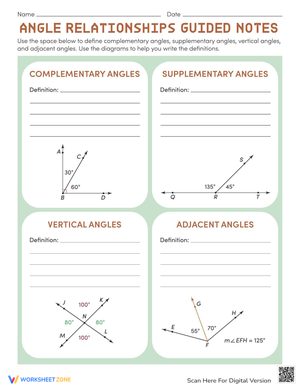
Complementary Angles worksheets for 7th Grade
These complementary angles worksheets for 7th grade cover three distinct phases of the concept: identifying complementary pairs by definition, calculating missing angle measures through one-step arithmetic, and writing algebraic equations when one or both angles are expressed as variable expressions. That last phase is where most of the grade-level challenge lives, and the set gives students enough varied practice to make the algebraic setup feel routine rather than unfamiliar on assessment day.
The Specific Skills Each Worksheet Targets
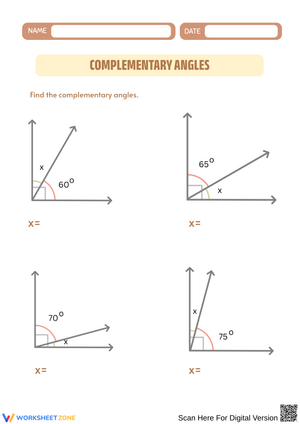
The progression across the set mirrors the conceptual path most students need. Early worksheets ask students to determine whether two labeled angle measures form a complementary pair — work that amounts to adding two values and comparing to 90. Then the focus shifts to finding a missing angle when one measure is known: if one angle is 37°, the complement is 53°. Straightforward, but students need repetition with this before algebra enters the picture.
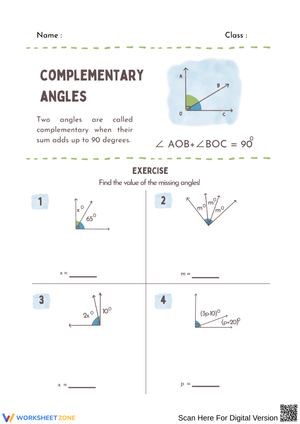
The algebraic worksheets are where the real 7th-grade thinking happens. Students receive two angles expressed as expressions — say, (4x − 3) and (2x + 9) — and must write the equation (4x − 3) + (2x + 9) = 90, combine like terms to get 6x + 6 = 90, solve for x, and then substitute back to confirm that both angle measures actually sum to 90. That verification step is where students either build or skip the habit of checking their work. Some worksheets also present this as a multi-step word problem, requiring students to translate a verbal description into an algebraic equation before solving — a format that appears directly on most state assessments tied to this standard.
Mistakes Students Make That Are Worth Addressing Directly
The most persistent error is treating the variable solution as the final answer. A student who correctly solves 6x + 6 = 90 and arrives at x = 14 writes "x = 14" and stops, never substituting back to find the two actual angle measures. After four or five steps of algebra, the variable solution feels like the finish line. Requiring students to write out both angle measures explicitly — every single time — corrects this faster than re-explaining the procedure.
A second recurring problem is the adjacency assumption. Students see complementary angles modeled most often as a ray dividing a right angle into two parts, so they build a mental rule that complementary angles must share a vertex and a ray. When a diagram presents a 30° angle and a 60° angle in completely different locations with no shared vertex, some students reject the pairing outright. The definition — any two angles whose measures sum to 90°, regardless of position — has to be stated plainly and revisited with non-adjacent examples early in the unit.
Then there's the complementary-versus-supplementary swap. Students who are learning both angle relationships simultaneously sometimes write an equation summing to 180 when the problem involves a right angle. The mnemonic that the "C" in complementary bends into a 9 (for 90°) and the "S" in supplementary bends into an 8 (for 180°) gives students a quick mental check during independent work. Two minutes spent on that trick before the first worksheet saves a lot of re-teaching later.
Standard Alignment
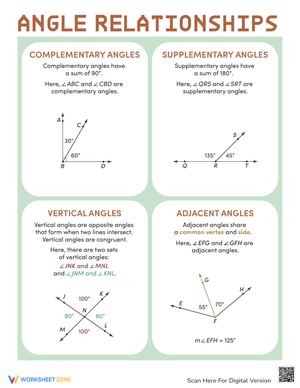
Each worksheet aligns to CCSS 7.G.B.5, which requires students to use facts about supplementary, complementary, vertical, and adjacent angles to write and solve simple equations for an unknown angle in a figure. The complementary angles worksheets for 7th grade address the "write and solve" demand directly — not just recognition of angle relationships, but the full algebraic process of formalizing those relationships as equations and solving them. Within 7.G.B.5, complementary angle problems sit at the entry-level end of the standard's difficulty range; the worksheets that include algebraic expressions push toward the more complex problems the standard also expects students to handle.
How to Work These Worksheets Into Your Lesson Plans
Most teachers find these worksheets most effective in one of three spots: as guided practice directly after direct instruction, as a warm-up review three or four days into the unit to consolidate the concept before moving to supplementary and vertical angles, or as a targeted assignment for students who showed gaps on an exit ticket. The warm-up use deserves specific emphasis — five minutes at the start of class, with students working one algebraic equation problem independently, surfaces confusion before it compounds. Reviewing two or three student responses aloud during that warm-up gives the whole class a chance to hear the verification step modeled again without requiring a full re-teach.
For the algebraic worksheets specifically, a quick whole-class model before independent work prevents the most common procedural errors. Write one equation on the board — (2x + 5) + (3x − 10) = 90 — and narrate the steps aloud: combine like terms, isolate the variable, substitute back. Once students watch that sequence once with teacher narration, the worksheets provide the practice volume they need to internalize it.
Differentiating These Worksheets for a Range of Learners
Students who are not yet fluent with one-step equations benefit from working only the identification and basic calculation worksheets first. The complementary angles worksheets for 7th grade are structured so those foundational worksheets stand alone — assigning algebraic expression problems before arithmetic fluency is solid creates a situation where students are learning two skills simultaneously and neither one lands cleanly. Keep the variable expressions for the second pass, once those students have the arithmetic version down.
For students who move through the set quickly, a productive extension is asking them to write their own complementary angle problems using algebraic expressions and swap with a partner to solve. This requires constructing an equation that produces valid angle measures — both greater than 0° and less than 90° — which means working backward from the constraint. That reversal is considerably harder than solving a given problem, and it reveals whether a student genuinely understands the relationship or is just executing a memorized procedure.
Frequently Asked Questions
Do complementary angles have to be adjacent?
No. Two angles are complementary whenever their measures add up to 90°, regardless of where they appear in a diagram. The adjacent case — a ray dividing a right angle into two parts — is the most common visual representation, but it is not the definition. Students need to work with non-adjacent examples early so the "must be touching" assumption doesn't persist into multi-step problems.
What is the difference between complementary and supplementary angles?
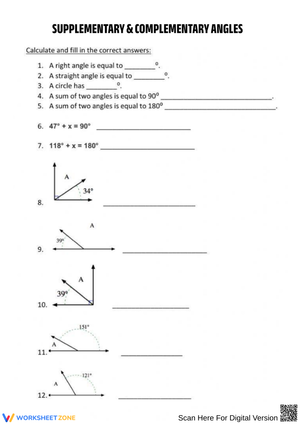
Complementary angles sum to 90°; supplementary angles sum to 180°. The mathematical distinction is simple. The instructional challenge is that students learn both types simultaneously under 7.G.B.5 and swap the target sums more often than teachers expect. The complementary angles worksheets for 7th grade address only the 90° relationship, so assigning them before supplementary angle work gives students time to build one equation structure solidly before introducing the second.
How long do the algebraic worksheets typically take in class?
Most students in an on-level 7th-grade class finish an algebraic worksheet in 12 to 18 minutes. Students who slow down at the "combine like terms" step add another four or five minutes. Planning for 20 minutes gives enough time for the teacher to circulate and catch errors — particularly the "stop at x" mistake — before students have completed the entire worksheet incorrectly.
Can these worksheets serve as a brief unit assessment?
Yes. The worksheets that present both angle measures as variable expressions function well as short unit checks. Assign three or four problems, collect them, and look for two specific errors: students who stop at the value of x rather than finding both angle measures, and students who sum to 180 instead of 90. Those two error patterns alone indicate which students need re-teaching before the class moves on to supplementary and vertical angles.
Clear All