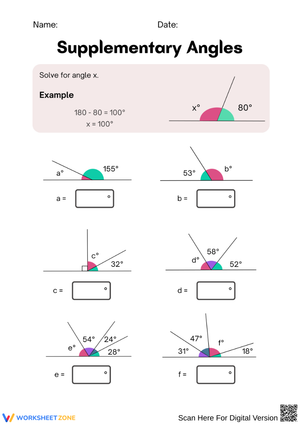
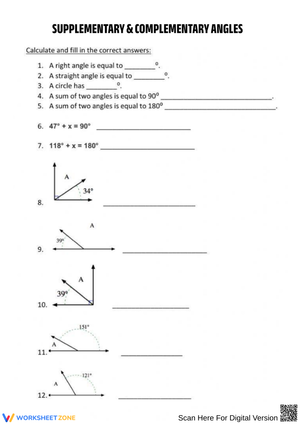
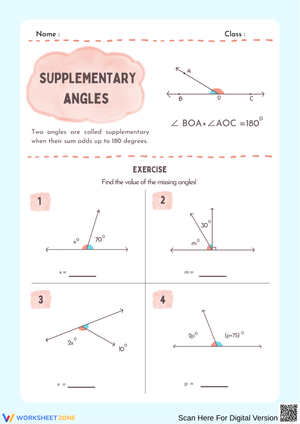
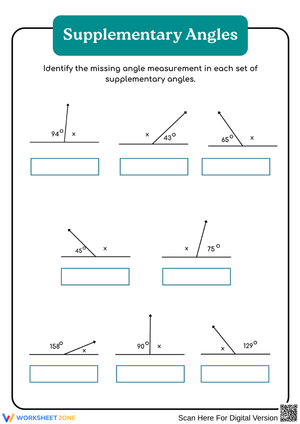
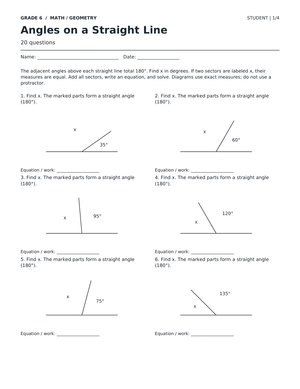
These 7th grade supplementary angles worksheets resources cover angle identification, missing-measure calculations, and equation solving—all built around the 180-degree relationship students need to own by the end of a middle school geometry unit. Each worksheet builds toward application rather than stopping at definition recall.
What Students Actually Practice
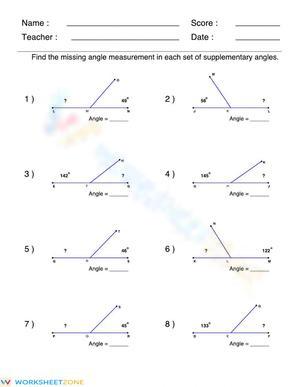
The core task in the early worksheets is identification: given two angle measures or a diagram, students decide whether the pair is supplementary. That sounds simple, but it surfaces early misconceptions quickly. From there, students move into missing-measure problems—subtracting a known angle from 180—and eventually into algebra, where they set up and solve equations like x + 65 = 180 or 2x + 40 = 180 before calculating the actual angle measure.
- Identifying supplementary angle pairs from diagrams and given measures
- Finding missing angles by subtracting from 180 degrees
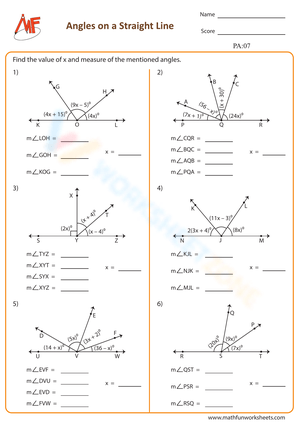
- Setting up and solving one- and two-step equations involving angle expressions
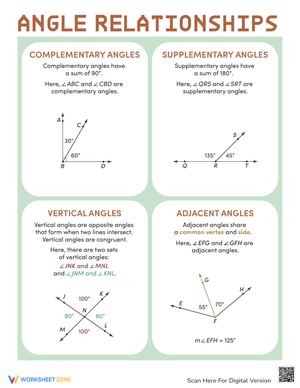
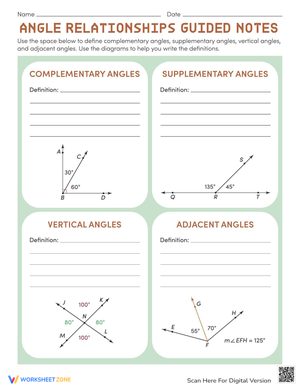
- Distinguishing supplementary angles from complementary, vertical, and adjacent pairs
- Reading and labeling straight-line diagrams correctly
Pulling together 7th grade supplementary angles worksheets resources that span all three levels—identification, numerical calculation, and algebraic application—means teachers don't need to hunt for separate materials when different students are ready for different kinds of problems.
Frequent Student Errors Worth Watching For and Correcting
The most persistent error isn't arithmetic—it's definitional. Students who correctly identify supplementary angles in a straight-line diagram will often reject a non-adjacent pair as "not supplementary because they're not touching." Present them with an angle of 110 degrees and a separate angle of 70 degrees in different locations on the same worksheet, and a significant portion of the class will hesitate or answer incorrectly. Including non-adjacent examples disrupts that overgeneralization before it calcifies into a testing pattern.
The second error to anticipate: the complementary-vs.-supplementary swap. Students confuse the 180-degree total with the 90-degree total, and the confusion spikes during the week when both types appear together. The error clusters around problems where the given angle falls between 40 and 60 degrees—values that feel familiar from complementary angle work. When a student writes 47 + 43 = 90 and marks it supplementary, the problem isn't a failure to understand angle pairs; they defaulted to the wrong target sum. Asking students to write "sum = 180°" in the margin before solving each problem catches this before a wrong answer gets committed to paper.
Third: students who reach the algebraic worksheets often solve for x and stop, especially when the expression is something like 2x + 5. They find that x equals 35 and treat that as the final answer. Problems that explicitly ask for the angle measure—not just the variable value—address this directly and build the habit of finishing the problem all the way through.
Smart Ways to Work These Worksheets Into Your Week
Early in a geometry unit, one worksheet works well as a class-wide sorting activity—students mark angle pairs as supplementary or not and write a one-sentence justification. That structure reveals quickly who already has the 180-degree relationship solid and who needs more foundational work before equations make sense.
The algebraic worksheets land best as independent practice after a direct instruction block. A workable sequence: model two equation problems at the board, move students into the worksheet for about 12 to 15 minutes, then spend the final few minutes checking one or two problems together. Two-step problems—where students simplify an expression before applying the 180-degree rule—make strong discussion anchors because students sometimes take different valid routes to the same answer.
Near the end of a unit, a mixed-review worksheet that asks students to sort supplementary from complementary from vertical angles gives better formative data than a single-type practice set. 7th grade supplementary angles worksheets sets that include this kind of comparison work are worth keeping through benchmark review, not just the original unit.
One small classroom routine worth adopting: have students write "sum = 180°" in the margin before working each problem. It looks trivial. It isn't. During the week when students are also working with complementary angles, that written anchor reduces the target-sum swap error more reliably than a verbal reminder at the start of class.
Adapting Each Worksheet for Different Learner Readiness Levels
Students who aren't yet secure with the subtraction approach benefit from starting with the identification and missing-measure worksheets using whole-number angle measures and clean straight-line diagrams. Pairing those students with a reference card that states "supplementary = 180°" beside "complementary = 90°" removes the vocabulary interference long enough for arithmetic practice to build the relationship. Once they can find missing measures fluently, moving them into the equation worksheets is a natural next step.
For students working ahead of grade level, the algebraic worksheets push into challenging territory without requiring above-grade content. An extension that works without additional materials: after completing the set, students write their own supplementary angle equations using variables, then trade with a partner to solve and verify. Students who can construct the problem have internalized the constraint—not just executed a procedure—and that distinction matters when the same reasoning appears in multi-step geometry problems later in the year.
Standard Alignment
CCSS 7.G.B.5 asks students to use facts about supplementary, complementary, vertical, and adjacent angles to write and solve simple equations for an unknown angle in a figure. These worksheets address that standard at multiple levels: identification tasks build the factual foundation the standard assumes, and the equation problems are the precise application it targets. One alignment detail worth noting—7.G.B.5 specifically expects students to write an equation, not just compute a missing value. Worksheets that include a setup step where students write the equation before solving are better aligned to that expectation than formats that skip directly to calculation.
Frequently Asked Questions
Do supplementary angles have to be adjacent?
No. Two angles are supplementary if their measures sum to 180 degrees, regardless of position. They can form a straight angle when placed side by side, but adjacency is not part of the definition. Including non-adjacent examples on practice worksheets directly targets the assumption that supplementary angles must be "touching"—one of the most common errors in 7th grade angle work.
How do these worksheets handle supplementary and complementary angles appearing together?
Several worksheets in the set mix both types so students classify relationships rather than assume every problem targets the same sum. That deliberate mixing is what makes the practice transfer to assessments, where students can't determine the angle type from context clues alone.
Are these appropriate for students who haven't fully developed algebraic fluency?
Yes. The set progresses from numerical problems—subtract from 180, done—to expression-based problems that require setting up and solving equations. Students who aren't yet fluid with equations can work through the identification and missing-measure worksheets and still build a solid grasp of the core concept. The algebraic worksheets extend the work for students who are ready for that layer.
How do these fit alongside a textbook-based curriculum?
These work best as additional practice alongside a textbook lesson rather than as a replacement for it. A textbook introduces the concept and models examples; 7th grade supplementary angles worksheets materials provide the independent repetition a single textbook problem set rarely delivers. They also adapt well for homework, substitute-day assignments, or the independent-practice rotation in a stations lesson.













 Interactive Worksheet Maker
 Quiz Maker
 Word Search Maker
 Crossword Puzzle Maker
 Word Scramble Generator
 Sentence Scramble Generator
 Handwriting Worksheet Generator
 Name Tracing Generator
 Fill In The Blank Generator