


























1 / 2
0
Views
0
Downloads


0.0
0
Save
0 Likes
Share
Angles on a Straight Line Worksheet – Solve for x and Angle Measures
0 Views
0 Downloads
Paste this activity's link or code into your existing LMS (Google Classroom, Canvas, Teams, Schoology, Moodle, etc.).
Students can open and work on the activity right away, with no student login required.
You'll still be able to track student progress and results from your teacher account.
Information
Description
What It Is:
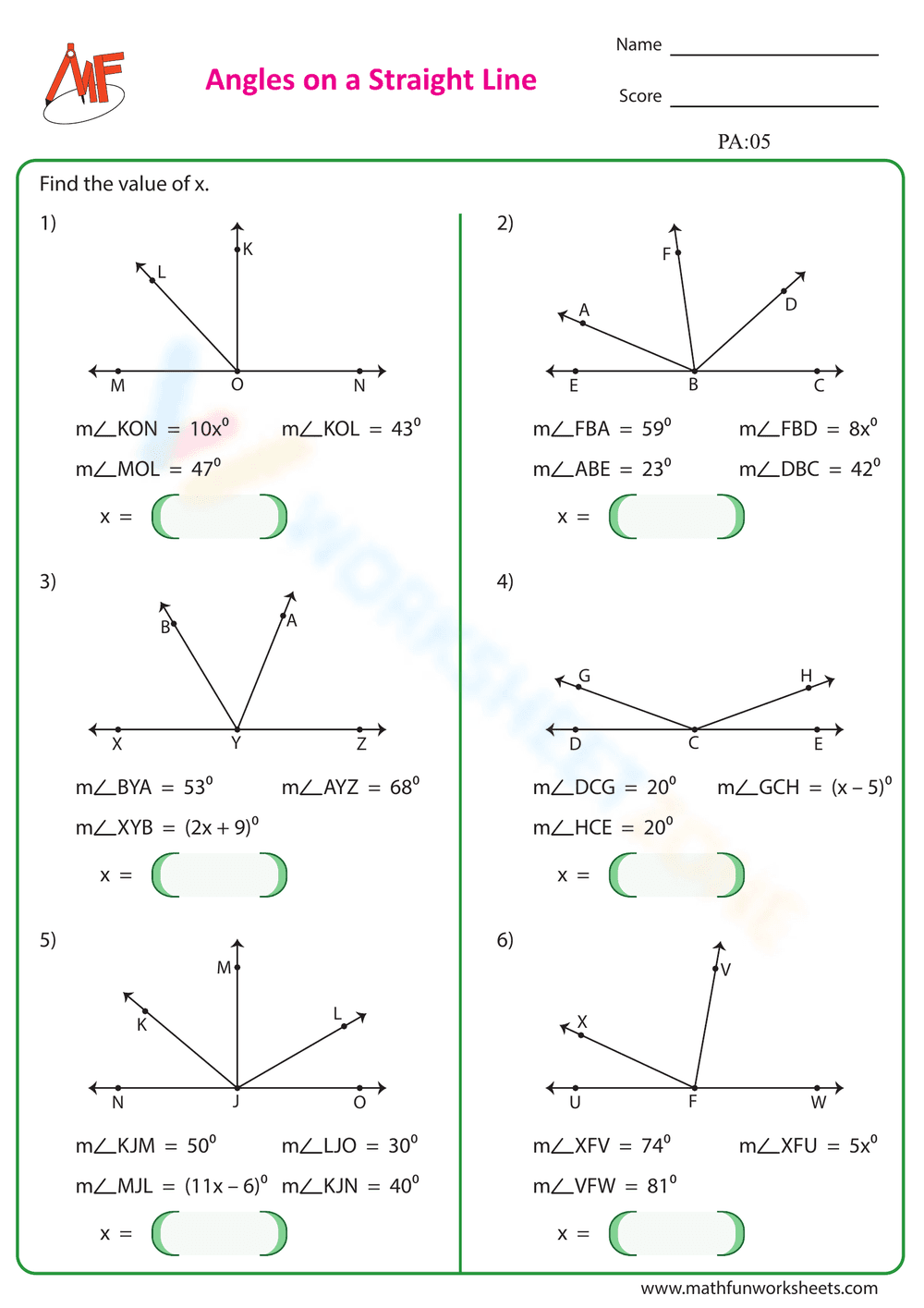
A geometry practice worksheet that teaches students how to use straight-line angle relationships to solve for the variable x and determine unknown angle measures. Each problem presents rays and intersections where angles form linear pairs or straight angles, giving students structured algebraic and geometric practice.
Why Use It:
This worksheet strengthens students’ understanding of straight-line angle relationships, linear pairs, and supplementary angles. It builds algebra skills by requiring students to set up and solve equations involving variables within angle expressions. The problems reinforce precision, reasoning, and the ability to interpret geometric diagrams.
How to Use It:
• Look at each diagram and identify straight angles or linear pairs.
• Use the rule that angles on a straight line add up to 180°.
• Write equations based on the given angle expressions.
• Solve for x and substitute back to find the required angle measures.
• Check that all values satisfy the straight-line angle relationship.
Grade Suitability:
Best suited for Grades 6–8.
• Grade 6: Introduction to supplementary angles and solving simple equations.
• Grade 7: Applying algebraic reasoning to angle relationships.
• Grade 8: Strengthening multi-step geometric equation solving.
Target Users:
Teachers, students, homeschoolers, and tutors focusing on supplementary angles, solving for unknowns, and interpreting angle diagrams in middle school geometry.
A geometry practice worksheet that teaches students how to use straight-line angle relationships to solve for the variable x and determine unknown angle measures. Each problem presents rays and intersections where angles form linear pairs or straight angles, giving students structured algebraic and geometric practice.
Why Use It:
This worksheet strengthens students’ understanding of straight-line angle relationships, linear pairs, and supplementary angles. It builds algebra skills by requiring students to set up and solve equations involving variables within angle expressions. The problems reinforce precision, reasoning, and the ability to interpret geometric diagrams.
How to Use It:
• Look at each diagram and identify straight angles or linear pairs.
• Use the rule that angles on a straight line add up to 180°.
• Write equations based on the given angle expressions.
• Solve for x and substitute back to find the required angle measures.
• Check that all values satisfy the straight-line angle relationship.
Grade Suitability:
Best suited for Grades 6–8.
• Grade 6: Introduction to supplementary angles and solving simple equations.
• Grade 7: Applying algebraic reasoning to angle relationships.
• Grade 8: Strengthening multi-step geometric equation solving.
Target Users:
Teachers, students, homeschoolers, and tutors focusing on supplementary angles, solving for unknowns, and interpreting angle diagrams in middle school geometry.


