These expository writing printable worksheets for 7th grade cover the full arc of explanation writing — from constructing a focused controlling idea to drafting body paragraphs that actually earn their place on the page — without requiring a standalone multi-day project every time a teacher wants students to practice the form. Grade 7 marks the CCSS shift from "write about a topic" to "examine a topic and convey ideas through the selection and analysis of relevant content," which is a meaningful developmental jump. Each worksheet in the set targets one distinct part of that process so instruction and feedback stay focused.
The Specific Skills Targeted Across the Set
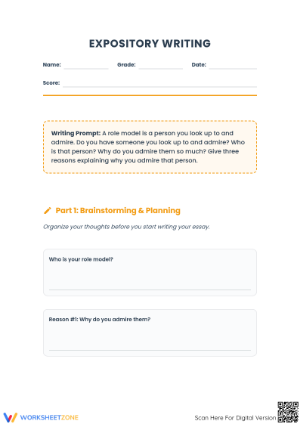
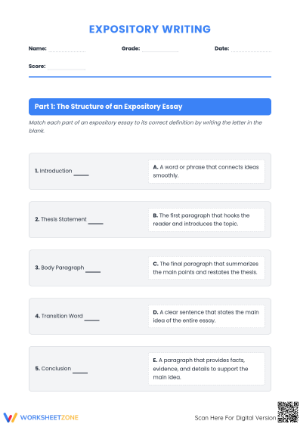
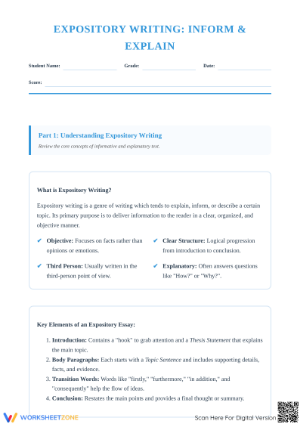
The worksheets zero in on the moves that separate a strong expository response from a loosely organized one. Students write controlling ideas that state what will be explained — not what the writer thinks or believes. They practice building topic sentences that advance a specific aspect of the main explanation rather than simply restating it. Evidence work asks them to select details that genuinely explain a point, distinguish those from details that merely describe, and articulate the connection between the two.
- Controlling idea and thesis: Narrowing the explanation to what can actually be supported in the space given, rather than gesturing at a broad topic.
- Topic sentences: Opening each body paragraph with a sentence that advances — not restates — the central explanation.
- Relevant supporting detail: Identifying facts, text evidence, and examples that do explanatory work rather than fill space.
- Transitions: Using connective language that signals logical movement, not just sequence — moving beyond "first, next, then, finally" into genuine cause-effect and elaboration phrasing.
- Formal register: Keeping the tone purposeful and organized, particularly for students who default to conversational phrasing under timed conditions.
- Synthesis conclusions: Reinforcing what was explained rather than restating the introduction nearly word-for-word.
Frequent Student Errors Worth Watching For and Addressing
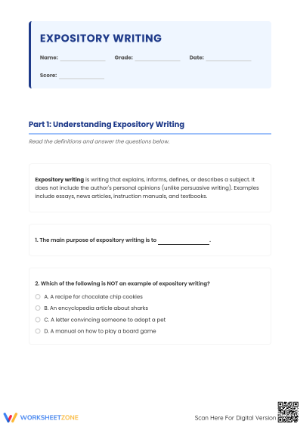
The most persistent pattern in Grade 7 expository writing is opinion drift. When a prompt asks students to explain how a community water treatment process works, or how a historical event unfolded, many students slide into arguing a position within a few sentences — often without realizing they've changed modes. Expository and argumentative writing feel similar to students because both involve evidence and organized paragraphs. A worksheet that explicitly names the distinction and gives students a short set of sentences to label as "explaining" or "convincing" interrupts that confusion before it calcifies into a habit.
A second pattern worth catching early: students who understand they need evidence but consistently choose details that describe rather than explain. A student writing about how the water cycle affects regional climate might write "Evaporation happens when water turns into vapor" — accurate, but it doesn't do the explanatory work. The student has cited a definition and stopped. Worksheets that ask students to complete the sentence "This shows that..." or "This matters because..." push them past description-as-evidence more effectively than marginal feedback does.
Conclusions are the third trouble spot. Left on their own, many 7th graders write conclusions that mirror their introduction nearly word-for-word. A worksheet focused exclusively on conclusions — showing two examples side by side, one that synthesizes and one that merely echoes — gives students a concrete target they can apply to their own drafts without needing another full writing cycle to see the difference.
Building These Worksheets Into Your Weekly Instruction
The most efficient approach is to sort expository writing printable worksheets for 7th grade into three classroom stacks before a unit begins: build worksheets that introduce a skill with a model and guided practice, apply worksheets that ask students to use the skill in a short draft, and fix worksheets that ask students to revise weak writing. The sequence doesn't have to be strictly linear — teachers can pull from any stack depending on where the class is — but having them pre-sorted saves planning time mid-unit.
Weekly rhythm matters for building writing stamina. On Monday, a 10-minute warm-up might ask students to read a model paragraph and mark the controlling idea, topic sentences, and one piece of evidence. Midweek, a 20-minute worksheet has them draft one body paragraph from a provided prompt and organizer. On Friday, they use a focused revision checklist — four questions about evidence, transitions, topic sentence clarity, and off-topic details. That pattern gives three meaningful writing touches per week without requiring a full lesson devoted exclusively to writing every day.
For units tied to nonfiction reading, pair each worksheet with a short text — a two-paragraph article excerpt, a chart, or a primary source — so students have content to explain rather than having to generate ideas from nothing. This reduces the mental load of the task and keeps students focused on the organizational moves rather than on deciding what to write about. That pairing also keeps writing instruction visibly connected to reading comprehension, which matters for how students transfer these skills to assessment tasks.
Standard Alignment
The expository writing printable worksheets for 7th grade in this set align primarily with CCSS W.7.2, which requires students to write informative and explanatory texts that examine a topic and convey ideas through the selection, organization, and analysis of relevant content. The sub-standards break that expectation into teachable moves: W.7.2a covers introducing a topic and previewing organizational structure; W.7.2b covers the use of facts, definitions, and text evidence; W.7.2c covers transitions that create cohesion; W.7.2d covers precise language and domain-specific vocabulary; and W.7.2f covers conclusions that reinforce rather than repeat the explanation. Each worksheet targets one or two of those sub-standards rather than all of them simultaneously, which makes it easier to match a specific worksheet to a specific instructional gap rather than treating the standard as a single undifferentiated goal.
Teachers working in states with modified ELA frameworks will find these skills appear under equivalent informative or explanatory writing strands at the seventh-grade level. The organizational focus also maps cleanly onto most district writing rubrics, making it straightforward to use these worksheets for both instruction and pre-assessment of rubric-specific criteria.
Adapting These Worksheets for a Range of Learners in the Same Room
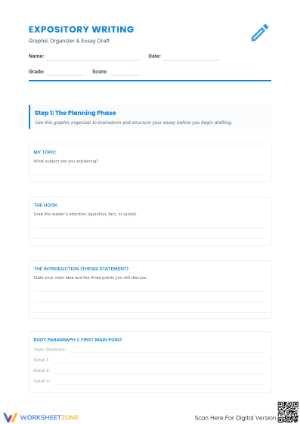
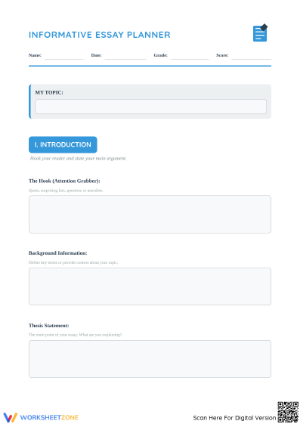
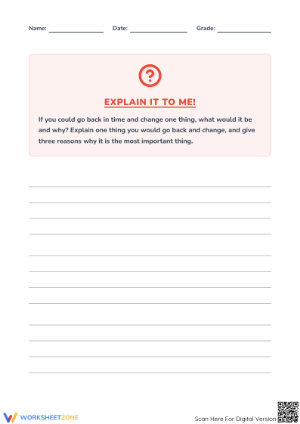
The most practical approach in a mixed-readiness class is to use the same prompt across all groups but vary the amount of structural support on each worksheet. Students who need more guidance get an organizer with labeled sections for thesis, three evidence points, and a conclusion — plus a bank of transition words and a sentence frame for the topic sentence. Students working at or above grade level get the prompt and open writing space with only a revision checklist at the bottom. Both groups practice the same skill; the difference is how much of the worksheet does the organizational thinking for them.
For students who struggle with the distinction between explaining and arguing, a sorting worksheet — where they read six sentences and mark each as "explains" or "argues" — works well as a pre-writing task before asking them to draft anything. It surfaces the confusion directly and gives teachers a quick formative read without requiring a full paragraph response. Students who already understand the distinction can skip the sort and move directly to drafting.
On the other end of the readiness range, students who draft fluently but write vague conclusions benefit from a worksheet that presents three draft conclusions for the same prompt and asks them to rank and annotate each one. That task pushes toward metacognitive thinking about what conclusions actually accomplish — which tends to be more productive than simply marking "weak conclusion" on their own paper and expecting revision to follow.
Frequently Asked Questions
What is the difference between expository and argumentative writing at the 7th-grade level?
Expository writing explains or informs — the writer's job is to help the reader understand something clearly. Argumentative writing takes a position and attempts to convince. Grade 7 students frequently conflate the two because both involve evidence and organized paragraphs. The most direct way to separate them in instruction is to ask: is the writer increasing the reader's understanding, or trying to change the reader's opinion? Expository worksheets keep students anchored to the first goal and give them a framework for recognizing when they've drifted toward the second.
How long should a 7th-grade expository response typically be?
Length depends on the task, not a fixed rule. A single well-developed paragraph with a clear topic sentence, two or three pieces of specific evidence, and a closing sentence is a legitimate expository response for a timed or low-stakes task. The expository writing printable worksheets for 7th grade in this set include both paragraph-length and multi-paragraph formats so teachers can match the task to the time available and the unit goal rather than always requiring a full five-paragraph structure.
Can these worksheets be used for state assessment preparation?
Yes. Most state ELA assessments at the 7th-grade level include an extended writing task that asks students to explain a topic or respond to a text in an explanatory mode. The skills these worksheets target — controlling idea, evidence integration, logical transitions, and synthesis conclusions — directly reflect what those tasks require. Using the worksheets as low-stakes rehearsal in the weeks before testing gives students practice with the writing moves themselves, not just familiarity with the test format.
Do these worksheets work for writing intervention groups?
They fit intervention well because each worksheet targets a specific skill rather than asking students to produce a complete essay. A small group working on evidence selection can spend 20 minutes on a single worksheet that asks them to read four detail options and identify which one actually explains the given point — and why the others fall short. That kind of bounded, focused task is more useful in an intervention setting than assigning a full draft and hoping students internalize the feedback afterward.












 Interactive Worksheet Maker
 Quiz Maker
 Word Search Maker
 Crossword Puzzle Maker
 Word Scramble Generator
 Sentence Scramble Generator
 Handwriting Worksheet Generator
 Name Tracing Generator
 Fill In The Blank Generator