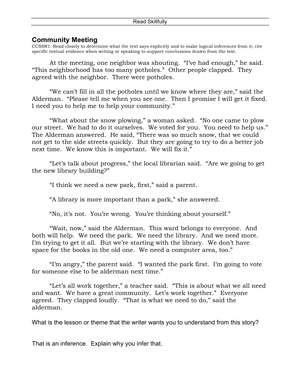
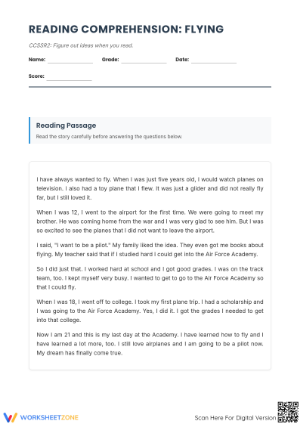
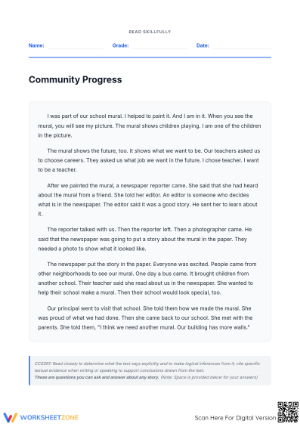
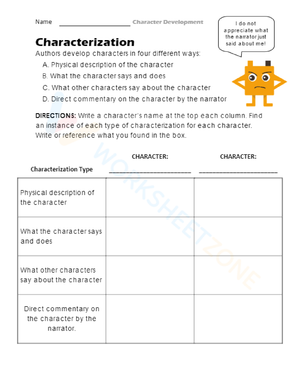
These close reading passages worksheets for 7th grade give teachers annotatable texts paired with questions that send students back into the passage rather than rewarding general impressions or prior knowledge. The skill focus is deliberate: inference, central idea, vocabulary in context, evidence selection, and text structure — the moves Grade 7 readers are expected to handle independently by year's end. Because students write directly on each worksheet, annotation becomes a built-in step rather than an afterthought.
The Specific Skills Each Worksheet Targets
Seventh grade is the year when comprehension stops being enough. Students who could get by in fifth and sixth grade by summarizing accurately start running into demands that require genuine analysis — explaining how a detail develops a theme, or why a specific word shifts a paragraph's tone. These worksheets address that transition directly rather than treating surface-level reading and deep reading as the same task.
- Citing textual evidence: Students quote or paraphrase specific lines. Questions are constructed so that vague recall produces wrong or incomplete answers.
- Drawing inferences: Passages include implied meaning that students must name and support using two or more textual details, not one general impression.
- Central idea and theme: Each worksheet asks students to identify what matters most and trace how individual details accumulate toward it across the passage.
- Vocabulary in context: Questions target words where author choice carries real analytical weight — not tier-one vocabulary, but terms where the right word reveals something about tone, argument, or character.
- Text structure: Students identify organizational patterns and explain why a particular structure fits the content or serves the author's purpose.
- Author's craft and purpose: Informational passages push students to analyze how a writer introduces, develops, and supports a central claim rather than just identifying it.
The set includes both literary and informational passages, which matters because each text type calls on a somewhat different version of these skills. Students practicing inference in a short story are using character behavior and dialogue as their evidence base; students practicing inference in an argument piece are working with explicit and implied claims. Both are necessary if the goal is transferable reading skill rather than narrow genre fluency.
Errors Worth Catching Before They Solidify
The most common error in 7th grade close reading is not misreading the text — it's answering from memory rather than returning to it. A student who correctly recalls that a character felt betrayed will write "she felt betrayed" without locating a sentence that demonstrates it. The answer isn't wrong, but the habit is. These worksheets help surface that problem because text-dependent questions require pinpointing a specific moment rather than summarizing a feeling, and a student who hasn't reread cannot do that accurately.
Vocabulary questions produce a predictable error pattern as well. Students frequently substitute a familiar synonym for the target word without checking whether that synonym fits the sentence's logic. If a passage uses "deliberate" to describe a character's slow, calculated movements, a student who substitutes "on purpose" may miss the connotation of control and precision that the question is actually asking about. Requiring students to copy the surrounding sentence before writing their definition addresses this directly — it forces engagement with context rather than isolated word recognition.
On evidence selection: students anchor responses to whatever caught their attention during a first read rather than rereading for the strongest possible support. Asking students to number the sentence in the passage that best supports each answer, before they begin writing, slows the guessing and makes their reasoning visible — both to themselves and to any teacher doing a quick formative check on written responses.
Building These Worksheets Into Your Instructional Week
Teachers searching for close reading passages worksheets for 7th grade often need resources that drop into existing routines without restructuring the week. These work in several slots. As a bell ringer, a short excerpt with two targeted questions fills 10 to 12 minutes and gives students a clear task from the moment they sit down — no transition confusion, no dead time before the lesson starts. On days with a mini-lesson on inference, text structure, or central idea, one worksheet serves as the follow-up independent practice, reinforcing the modeled skill without requiring a separate resource.
Whole-class modeling is particularly effective when the teacher projects the passage, annotates aloud through the first read, and then releases students to complete the second read and questions independently. That gradual release structure keeps cognitive load manageable without removing productive challenge — students understand the process before being asked to apply it alone. The same worksheet used for whole-class instruction on Monday can move to a small reteaching group on Thursday; the text stays grade-level, but the discussion slows down and the teacher can address specific errors directly.
For sub plans, a self-contained worksheet with clear written directions works better than almost any other option. Students know the task, it requires no facilitation, and the work collected afterward gives the returning teacher real information about where the class is with annotation and evidence-based writing.
Literary vs. Informational: Why the Balance in the Set Matters
If students only practice close reading with fiction, they begin to treat all texts as stories — looking for characters and conflict even when a passage is an argument or explanation. Seventh graders need regular informational reading not just to prepare for standardized assessments but because the analytical moves transfer differently across text types. Tracing how a nonfiction author builds a central claim is a distinct skill from tracing how a narrator's limited perspective shapes a story's meaning. Students need practice with both versions of that thinking.
Literary passages in the set support characterization, point of view, theme, and the analysis of figurative language and dialogue. Informational passages target central idea, how an author introduces and develops supporting evidence, and the relationship between text structure and a reader's understanding. Paired-text worksheets add another layer by requiring students to synthesize or contrast what two different texts say about a related topic — that comparative task is among the most demanding moves at this level, and students need repeated exposure before it feels natural rather than overwhelming.
Cross-curricular topics raise engagement consistently. A passage about the science of memory, a historical speech excerpt, or a first-person essay about a teen experience gives students something to care about while keeping the analytical focus on the text itself rather than on background content knowledge.
Standard Alignment
These worksheets align to the Common Core State Standards for English Language Arts at the Grade 7 level, primarily within the Reading Literature and Reading Informational Text strands. The most consistently addressed standards are CCSS.ELA-LITERACY.RL.7.1 and RI.7.1, which require students to cite several pieces of textual evidence to support analysis and inferences; RL.7.2 and RI.7.2, covering the determination of theme or central idea and analysis of how it develops across a text; RL.7.4 and RI.7.4, addressing the meaning of words and phrases including figurative and connotative meanings; and RI.7.3, which asks students to analyze interactions among individuals, events, and ideas in a text. In classroom terms, these are the standards that appear most frequently on district benchmark assessments and state reading evaluations at this grade level, which makes these worksheets a natural fit for both daily practice and pre-assessment review.
Adjusting the Worksheets for a Range of Learners
Teachers looking for close reading passages worksheets for 7th grade to use in tiered instruction can keep the core passage identical across groups and vary the response expectations instead. That approach preserves grade-level rigor — all students engage with the same text at the same complexity — while adjusting the support structure for different learners. Emerging readers benefit from having two or three high-stakes vocabulary words activated before the reading begins, not through full definitions but through enough context that those words are recognizable when students encounter them in the passage.
For students who freeze when facing an open-ended analytical prompt, a simple annotation system removes some of that paralysis: a star for important details, a question mark for sections that confused them, and a box around unfamiliar words. That physical interaction with the text during the first read gives them something to reference when they return to answer questions. On-level students complete the worksheet as written. Advanced readers receive an extension prompt — evaluating how a single sentence shapes the reader's understanding of the whole passage, or comparing the structural choices across two worksheets studied in the same unit.
For multilingual learners, sentence frames for evidence-based responses remove the language barrier without removing the analytical demand. "The author shows this when ____" or "This detail matters because ____" gives students a place to begin writing while keeping the thinking at grade level.
Frequently Asked Questions
What reading skills should a 7th grade close reading worksheet cover?
The most important are citing textual evidence, drawing inferences, determining central idea or theme, analyzing vocabulary in context, and identifying text structure. Questions should be genuinely text-dependent — students who skip the passage should not be able to guess their way through them. For students who are ready for more, open-ended questions about author's craft or comparative analysis across texts add meaningful challenge without requiring a separate assignment.
How long should a passage be on a close reading worksheet for 7th grade?
Short enough to reread two or three times within a single class period, but long enough to carry genuine complexity. In practice, most useful excerpts run between 200 and 500 words. Shorter texts work well for targeted skill practice or bell ringers; slightly longer passages give students more evidence to draw from when the task involves extended written response or comparative work.
Should the set include both fiction and nonfiction passages?
Yes, and rotating between them matters. Literary passages develop skills in theme, characterization, and craft; informational passages build fluency with central idea, argumentation, and how authors develop and structure ideas. A rotation that includes both text types — and occasionally a paired-text worksheet asking students to compare across formats — gives 7th graders the range they need to handle different reading situations without treating one text type as fundamentally harder than another.
Are close reading passages worksheets for 7th grade practical for use in mixed-ability classrooms?
They are, as long as the differentiation lives in the task expectations rather than the text. Keeping the same passage across all ability levels maintains grade-level rigor; adjusting the number of required responses, the type of annotation expected, or the complexity of the writing prompt adjusts support without lowering the ceiling for any group of students.












 Interactive Worksheet Maker
 Quiz Maker
 Word Search Maker
 Crossword Puzzle Maker
 Word Scramble Generator
 Sentence Scramble Generator
 Handwriting Worksheet Generator
 Name Tracing Generator
 Fill In The Blank Generator