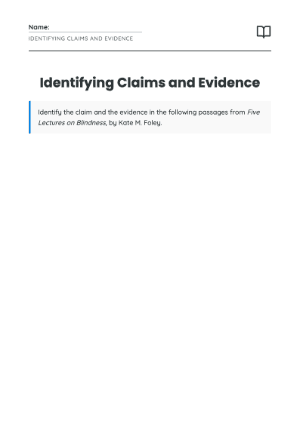
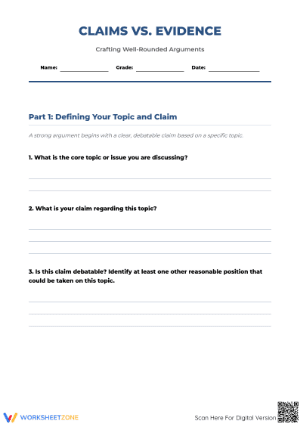
These claim evidence reasoning worksheets for 7th grade give teachers a reliable entry point into one of the hardest writing moves to teach at this level: the reasoning step. Students can usually find a quote, but they are far less consistent about explaining why that quote matters — and without that explanation, the whole response collapses into summary. The set addresses this gap through a deliberate progression of identification, guided construction, and independent writing, built around grade-appropriate passages in both fiction and informational text.
The Specific Skills Targeted
Each worksheet isolates one part of the CER structure before asking students to produce the whole thing. Early tasks have students read a short sample response and label the claim, evidence, and reasoning. Then they move to sorting exercises, deciding which statement is a claim versus an observation or summary. That distinction matters because 7th graders routinely write claims that restate the topic rather than take a position — "This story is about loyalty" is not a claim; "The author shows that loyalty can cause more harm than good" is.
Evidence work in the set focuses on selection and accuracy. Students underline possible supporting details, then rank them by relevance. This slows down the tendency to grab the first quote that looks useful without checking whether it actually connects to the claim. Paraphrasing tasks push students to restate details in their own words — a skill that often reveals whether they actually understood the passage or just copied it.
- Claim writing: students revise weak or off-target claims to make them arguable and text-specific.
- Evidence selection: students rank and justify multiple possible details from the same passage.
- Reasoning construction: students complete sentence-level explanations connecting evidence back to a stated claim.
- Full-paragraph writing: students produce a complete CER response with two pieces of evidence, each followed by reasoning.
Frequent Student Errors Worth Watching For
The most persistent error is what teachers often call evidence dumping — a student writes a strong claim, drops in two quotes, and considers the job done. The reasoning sentences are either missing or reduced to "This shows my claim is true." When you see that pattern in a stack of papers, students are not failing to write; they are failing to think through what the evidence actually proves. These worksheets help surface that gap because reasoning has its own prompt line or sentence frame on each worksheet — students cannot skip it by accident.
A second error is prompt drift in the claim itself. When the question asks students to argue how a character's motivation drives the plot, a common 7th grade response starts with "In the story, the character does several things." That sentence describes without arguing. The worksheets address this directly by including claim-revision tasks — students read a weak claim and rewrite it to take a clear, specific position. That revision practice pays off during whole-class discussion because students begin to articulate what makes one claim stronger than another rather than treating all answers as equally valid.
A third pattern: students choose evidence that is accurate but peripheral. A passage about a character's courage might include ten usable details; students frequently select the most dramatic one rather than the most relevant one. Ranking exercises in the set force that evaluation to happen explicitly before any writing begins.
Smart Ways to Work These Worksheets Into Your Week
The most effective use pattern I have seen is pairing a short identification worksheet at the start of a reading unit with a full-paragraph task at the end. The first worksheet plants the vocabulary — claim, evidence, reasoning — while students are still reading closely for understanding. The final worksheet asks them to bring that reading into a written argument. The gap between those two points gives students time to absorb the text before producing analysis, which reduces cognitive load on both tasks simultaneously.
Bell ringers are another productive slot. A passage plus one prompt takes about 10 to 12 minutes when the text runs 100 to 150 words. Students write, you do a quick pair-share, and you collect the papers. By Friday, you have four or five data points per student showing where reasoning is developing and where it is still missing — more formative data than most teachers get from a week of class discussion alone.
Claim evidence reasoning worksheets for 7th grade also fit naturally into intervention blocks. When a student's longer essay shows weak reasoning, pulling out one targeted worksheet for small-group reteaching is faster and more focused than reworking the whole essay. The isolated format keeps feedback specific to the skill that actually broke down.
Standard Alignment
The set addresses CCSS.ELA-LITERACY.W.7.1, which requires students to write arguments supported by relevant evidence and clear reasoning. It also connects directly to CCSS.ELA-LITERACY.RI.7.1 and RL.7.1, both of which require students to cite multiple pieces of textual evidence when supporting analysis and inferences. In practice, those reading standards and the argument writing standard are inseparable — you cannot demonstrate RI.7.1 without the reasoning move that W.7.1 demands. These worksheets sit at that intersection intentionally, making them equally useful during reading instruction and writing instruction.
Adjusting the Worksheets for a Range of Learners
For students who struggle to get started, the most effective adjustment is reducing the passage length and providing sentence-level frames for the reasoning step specifically — not the whole paragraph. Frames like This detail matters because it shows that... or The author includes this to suggest that... prompt students to produce actual analysis rather than just restating the quote. Removing those frames as students gain confidence is straightforward; the underlying task stays the same.
Stronger writers move off the frames quickly and benefit from tasks that ask for more than two pieces of evidence or that require addressing a counterargument in the same paragraph. Claim evidence reasoning worksheets for 7th grade that include a challenge prompt alongside the core task give advanced students somewhere to go without requiring a separate assignment to be built from scratch. The parallel structure also makes peer review more productive — students at different levels are working with the same passage and claim, so direct comparison is possible.
For multilingual learners, the visual separation of the CER structure on the page does real work. When claim, evidence, and reasoning each have their own labeled box or line, students can match the term to its function without tracking it across unmarked paragraphs. That layout clarity matters more than most teachers realize until they watch a multilingual student work through a worksheet that lacks it.
Frequently Asked Questions
Do these worksheets come with answer keys or rubrics?
The set includes both. Each passage-based task has a sample strong response and a brief rubric that scores claim, evidence, and reasoning separately. Scoring each part independently — rather than giving one holistic score — helps teachers give targeted feedback and helps students understand exactly where their response succeeded or fell short.
What reading level are the passages?
Passages target a 7th grade reading range, roughly Lexile 970L to 1100L for informational text and a comparable range for literary passages. The set includes both text types so teachers can use these worksheets across a unit whether they are teaching a novel excerpt or an article-based reading task.
Can these worksheets be used for test preparation?
Yes, and the format maps directly onto constructed-response prompts on many state assessments. Students who regularly practice producing a claim, selecting relevant evidence, and explaining the connection are well-prepared for timed writing tasks because the structure is already familiar before the test date. Using claim evidence reasoning worksheets for 7th grade under mild time limits — about ten minutes for a short response — gives students realistic practice at the pace assessments require.
How long does a typical CER task take to complete?
A guided worksheet with sentence frames runs about 15 to 20 minutes for most 7th graders. A full independent paragraph task without frames, depending on passage length, takes 20 to 30 minutes. Both fit inside a standard class period when paired with a brief model or whole-class discussion beforehand.















 Interactive Worksheet Maker
 Quiz Maker
 Word Search Maker
 Crossword Puzzle Maker
 Word Scramble Generator
 Sentence Scramble Generator
 Handwriting Worksheet Generator
 Name Tracing Generator
 Fill In The Blank Generator