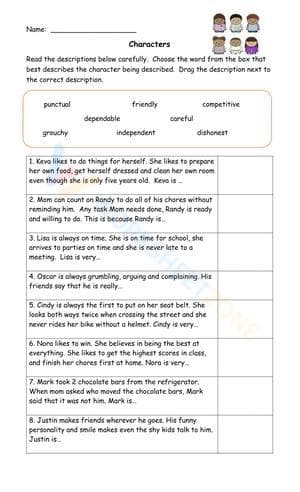
These 7th grade short story worksheets resources give ELA teachers a self-contained reading lesson that holds up independently — story, questions, and analysis prompts organized within each worksheet to cover the skills seventh graders are expected to control by the end of the year. Each worksheet pairs a short fiction passage with targeted work on plot structure, character motivation, conflict, theme, inference, and evidence-based response. The set comes as printable PDFs, which means they copy cleanly, distribute quickly, and work equally well for class periods, homework, and sub coverage.
Concepts Each Worksheet Builds
Seventh grade is the grade where students stop summarizing and start analyzing — or at least, that's the expectation. These worksheets hold students to that standard. The questions don't ask "what happened" in isolation; they ask how specific story elements work together to create meaning.
- Plot structure: Students identify rising action, turning points, and resolution, then explain how those moments connect rather than just listing them in sequence.
- Character motivation and change: Students articulate what a character wants, what gets in the way, and how the character's thinking or behavior shifts across the story.
- Conflict types: Questions ask students to name and explain the central conflict — internal, person vs. person, or person vs. circumstance — and connect it to larger story meaning.
- Theme statement: Students write a full thematic sentence rather than a topic word. The questions push toward statements like "ambition without empathy leads to isolation" rather than stopping at "ambition."
- Inference: Students draw conclusions the text implies and identify the specific details that support them.
- Vocabulary in context: Questions ask students to use surrounding sentences to determine word meaning rather than relying on prior knowledge alone.
- Evidence selection and labeling: Students cite specific actions, dialogue, or description — and on several worksheets, label the type of evidence they chose, a habit that sharpens how they think about what counts as proof.
Frequent Student Errors Worth Watching For
Theme questions produce the most consistent errors at this grade. Students write "the theme is friendship" or "the theme is loyalty" — a topic, not a theme. Even students who clearly understood the story will collapse a complex idea into a single noun and call it done. Because these worksheets require a full thematic statement and ask students to support it with evidence from the text, that pattern surfaces quickly. Teachers can address it directly in class rather than discovering it for the first time on a unit assessment.
Evidence selection is the other consistent trouble spot. Many seventh graders treat "evidence" as "any quote from the story." They copy long passages because more text feels safer than committing to one precise phrase. A student might argue that a character is deeply selfish, then cite a line where the character simply walks away from a conversation — an action that shows behavior but does nothing to explain internal motivation. The questions on these worksheets ask students to select the single best detail to support a specific claim, which forces the kind of deliberate text-mining that passive reading never requires.
Building These Worksheets Into Your Weekly Lesson Plan
The most straightforward use is a skill-focused reading day: students read the story independently, work through the questions, and the last ten minutes of class go to whole-group review of one or two contested questions — the ones where students circled different evidence or landed on different themes. That structure works well mid-week when a novel unit needs a pause or when the pacing calendar has an open slot.
Bell ringers are another reliable use — not the full worksheet, but a short excerpt with one inference question, particularly effective on Monday mornings when students need something low-stakes before heavier instruction. Sub plans are where 7th grade short story worksheets resources consistently earn their keep: the self-contained structure means a substitute can distribute, monitor, and collect without needing to understand the surrounding unit. One addition worth including in the sub instructions: ask students to label each piece of evidence they cite as action, dialogue, or description. That small requirement takes no extra prep but raises the quality of what students turn in significantly.
Standard Alignment
These worksheets address three CCSS ELA standards for grade 7 that tend to be assessed together but are often taught in isolation. RL.7.1 requires students to cite several pieces of textual evidence to support analysis of explicit and implied meaning — the evidence-selection and inference questions directly address this. RL.7.2 asks students to determine a theme and analyze how it develops across the text, which is exactly what the theme-statement questions and story-tracing prompts require. RL.7.3 focuses on how setting, plot, and character interact, a skill the conflict and motivation questions build directly. In practice, these three standards reinforce each other: a student who can cite precise evidence (RL.7.1) and track how a character's decisions compound over time (RL.7.3) is positioned to articulate a defensible, text-supported theme (RL.7.2) rather than guessing at one.
For teachers in non-CCSS states, the same skills appear under TEKS 7.6 (literary elements) and comparable state frameworks. These 7th grade short story worksheets resources align closely enough to transfer without revision for most state standards at this grade level.
Adjusting the Set for Mixed-Ability Classrooms
For students who struggle with the reading itself, pre-teaching three to five vocabulary words before the story removes a barrier without lowering the analytical demand. Reading the passage aloud together before students work independently is another low-prep approach that helps — especially for students whose decoding is slower than their actual comprehension ability. For inference questions specifically, a simple two-column graphic organizer labeled "what the text says" and "what it means" gives those students a concrete way to see that inference is a two-step move, not a leap of intuition.
Advanced readers benefit from extension prompts that ask them to explain how two story elements — setting and internal conflict, for instance — work together to develop the theme. The written response slots on each worksheet accommodate extensions like this without printing anything additional. A quick verbal add-on also works: ask students who finish early to write an alternative ending that would change the story's theme, then explain in one sentence what the new theme would be. That kind of task reveals how deeply a student understood the original story's structure.
Frequently Asked Questions
What skills do these short story worksheets cover?
Each worksheet targets core fiction analysis skills: plot structure, character motivation and change, conflict types, theme development, inference, vocabulary in context, and textual evidence. Most worksheets also include at least one short written response, which gives students practice building a claim and supporting it with specific details from the passage.
How long does each worksheet take to complete in class?
Most students need 25 to 40 minutes for reading and questions combined. Classes that also complete the written response section typically use a full 45-minute period. If the story is assigned as homework the night before, the in-class portion can run closer to 20 minutes, leaving time for discussion and review.
Are answer keys included?
Yes. Keys are included for both the selected-response and short-answer questions. For open-ended prompts, the keys provide model responses that show what thorough student thinking looks like — useful both for grading and for leading a class debrief after students have completed the worksheet.
Can these work for students reading below grade level?
They can, with a few strategic adjustments. Pre-teaching vocabulary, reading the story aloud, and pairing students strategically all reduce the reading barrier without changing the analytical expectations. A full set of 7th grade short story worksheets resources offers enough variety that teachers can match story complexity to student readiness while holding the skill expectations steady across the class.















 Interactive Worksheet Maker
 Quiz Maker
 Word Search Maker
 Crossword Puzzle Maker
 Word Scramble Generator
 Sentence Scramble Generator
 Handwriting Worksheet Generator
 Name Tracing Generator
 Fill In The Blank Generator