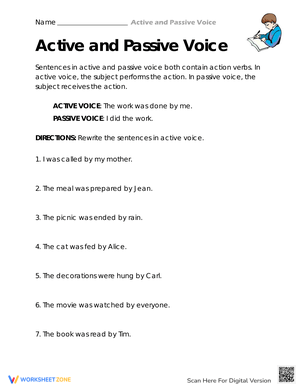
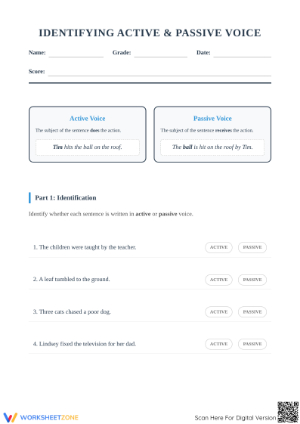
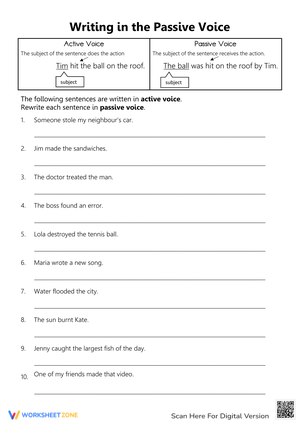
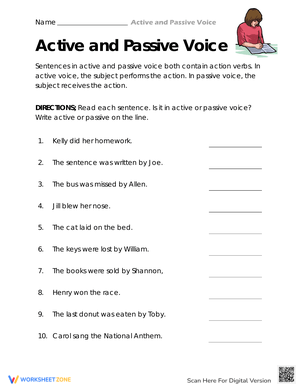
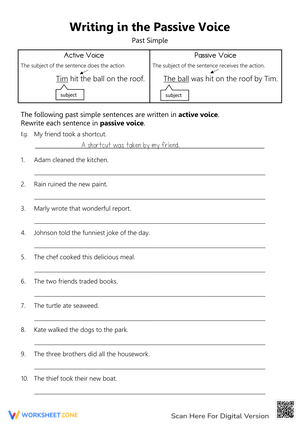
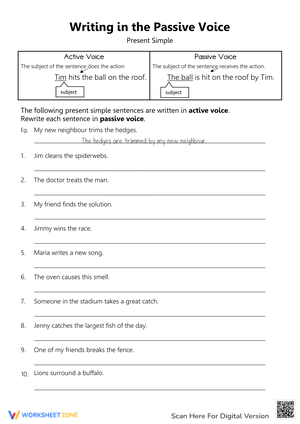
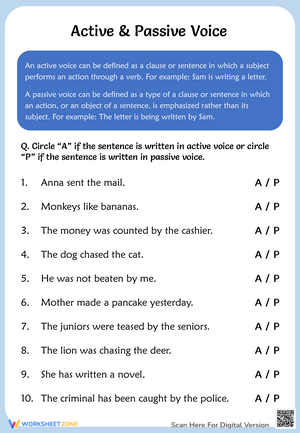
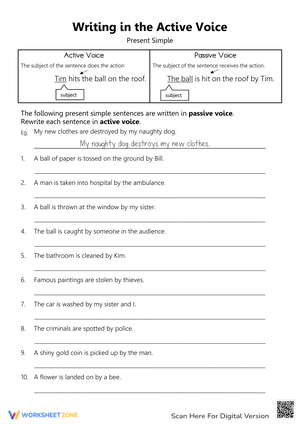
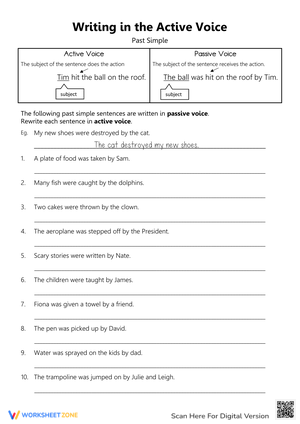
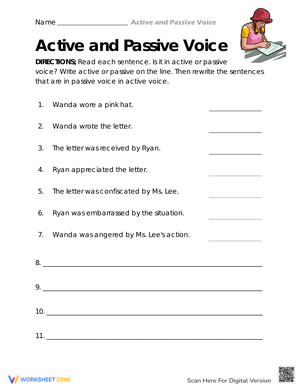
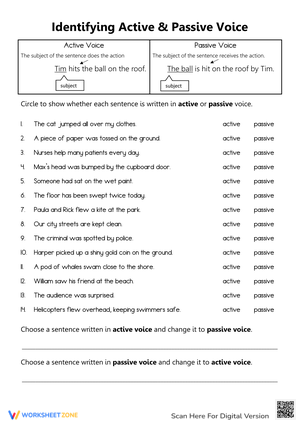
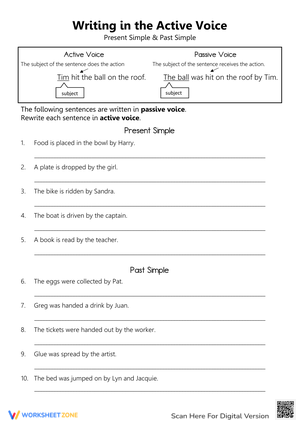
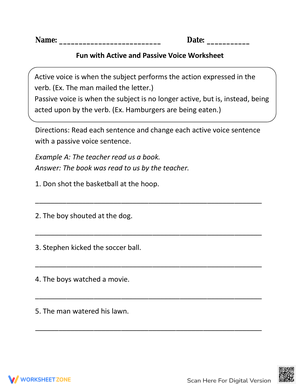
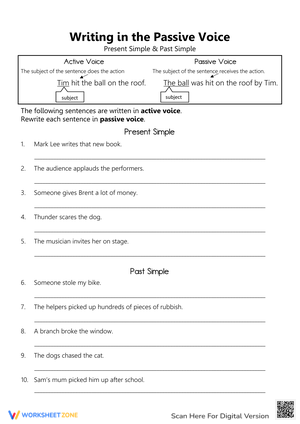
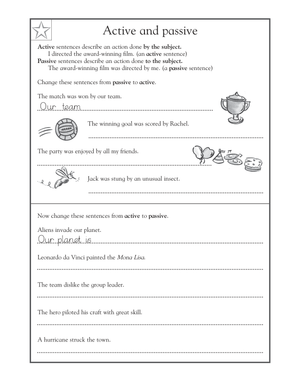
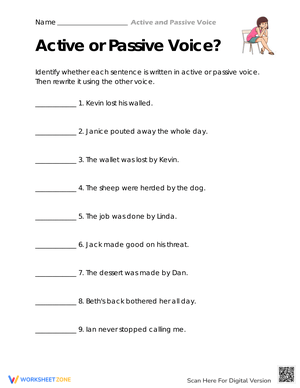
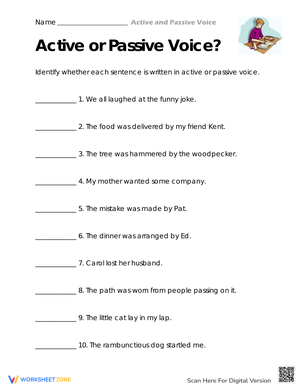
7th grade active and passive voice printable worksheets give teachers something they rarely have enough of: grammar practice that fits a real lesson period without requiring a separate planning session to prepare. The set covers sentence identification, voice conversion, and paragraph editing — three distinct tasks that build on each other and connect directly to the revision decisions 7th graders need to make in their own writing.
What Each Worksheet Asks Students to Do
Each worksheet targets a specific layer of the skill. The first layer is recognition: students read a sentence and determine whether the subject performs the action or receives it. The second is conversion: students rewrite sentences, shifting from active to passive or passive to active. The third — and most transferable to actual student writing — is editing: students work through a short paragraph that overuses passive constructions and revise it for clarity and directness.
Sentence complexity increases across the set. Early items use short, transparent constructions like The coach selected the team or The trophy was awarded by the judges. Later items include longer sentences where passive voice is harder to spot — constructions like The lab results had been recorded before the final measurements were taken — where students must locate the helping verb and past participle inside a more complex clause. That range is deliberate: recognizing voice in denser sentences is the skill students need before they can reliably catch passive constructions in their own drafts.
Each worksheet also includes a purpose-based comparison task. Students see two versions of the same sentence and decide which fits the intended context better. This keeps the practice from becoming a simple elimination exercise and begins building the judgment 7th graders need when they revise explanatory paragraphs or literary analysis responses.
Where 7th Graders Consistently Go Wrong With Voice
The most predictable error is conflating passive voice with linking verb constructions. A student who sees The cafeteria was loud will often mark it passive because it contains "was" — but "was" there functions as a linking verb, not a passive auxiliary. No action is being received by any subject. This misread is genuinely persistent: students need several rounds of targeted practice before they stop applying the "any sentence with 'was' must be passive" shortcut.
A second consistent error appears during conversion tasks. Students who label a passive sentence correctly will sometimes remove the agent phrase rather than reposition it. Asked to rewrite The essay was graded by the teacher, they produce The essay was graded — still passive — instead of The teacher graded the essay. They've dropped "by the teacher" without moving "the teacher" into the subject slot. Watching for this during independent practice tells teachers exactly which students haven't yet internalized the subject-verb-object shift that passive-to-active conversion requires.
There's also an overcorrection pattern at the other end: students who've been told passive voice is wrong will revise it out of sentences where it works. The suspect was arrested at midnight is an appropriate passive construction — the focus belongs on the suspect, not the officers. Worksheets that ask students to justify their revision choices, rather than simply rewrite, push them past avoidance and toward genuine voice control.
Fitting These Worksheets Into a Real Week of Instruction
An identification worksheet makes an effective Monday warm-up during the first two weeks of a voice unit. Students spend about eight minutes labeling sentences, then the class reviews two or three contested items — the ones where students most often split — in a brief whole-class discussion. That five-minute conversation typically produces more durable understanding than another ten minutes of silent drill.
For a complete lesson block, a reliable sequence runs like this: four or five minutes of direct teaching with modeled examples on the board, one identification worksheet completed independently, a brief partner comparison, then answer-key review with discussion. On a later day, run the conversion worksheet for independent practice and follow it with the paragraph-editing task as a closing activity or the next morning's warm-up. Spacing these three task types across several days, rather than covering all of them in a single sitting, builds stronger retention through spaced retrieval.
7th grade active and passive voice printable worksheets also run well in a station rotation — one station for identification, one for sentence conversion, one for paragraph editing. That structure lets you circulate to wherever students most need your attention, which is usually the editing station, where the reasoning behind each revision isn't as obvious as it is in isolated sentence work.
Modifying the Set for Students at Different Starting Points
For students who are still shaky on verb phrase identification, underline the verb phrase on the identification worksheets before distributing them. That removes one cognitive step and lets students focus on the actual skill: determining whether the subject acts or is acted upon. Once they make that call consistently, stop underlining.
On-level students handle mixed-format worksheets well — identification and conversion in the same worksheet, followed by a short editing task. This is the format that runs most cleanly as a whole-class assignment without adjustment.
Students who need additional challenge benefit from a metacognitive add-on: after converting or editing a sentence, they write one sentence explaining why the active or passive version is more effective in that context. That step shifts the task from grammar exercise to rhetorical reasoning. You can also direct these students to locate examples of purposeful passive voice in published nonfiction — science writing and news reporting are reliable sources — and bring two or three examples back for class discussion.
Standard Alignment
Active and passive voice is explicitly addressed in CCSS.ELA-LITERACY.L.8.1.B, which calls for students to "form and use verbs in the active and passive voice." Most 7th grade ELA teachers introduce the concept before students reach 8th grade, so that recognition and basic conversion are already in place when students encounter the standard formally. These 7th grade active and passive voice printable worksheets support that instructional timeline: the earlier exercises build accurate identification, while the later editing and comparison tasks develop the judgment needed for standard-level mastery. Teachers working with state standards that explicitly place voice instruction at 7th grade will find the full range of tasks — from basic identification through paragraph editing — covers the skill as those standards define it.
Frequently Asked Questions
Do these worksheets include answer keys?
Yes. A separate answer key accompanies each worksheet, which makes independent work, substitute plans, and next-day review manageable without additional teacher prep.
Can this set work with 6th graders or as an early 8th grade review?
The sentence complexity targets 7th grade throughout. Strong 6th graders who have already worked with verb phrases can manage the identification worksheets; the conversion and editing tasks are likely too demanding without prior instruction. For 8th grade, the set works as a unit entry point or a post-break review before moving into more advanced revision work. The 7th grade active and passive voice printable worksheets in this set stay at grade level across all tasks — they are not simplified for intervention use.
My students keep marking linking verb sentences as passive — is that addressed?
Directly. The identification worksheets include linking verb sentences alongside genuine passive constructions so students have to distinguish between them rather than applying a surface "look for was" rule. Encountering both types in the same practice set — rather than seeing them in isolation — is the most reliable way to break that habit before it calcifies into a persistent misunderstanding.
In what order should I assign these worksheets across a unit?
Start with identification, then move to conversion, then assign the editing worksheet. The tasks build on each other: students who can't reliably identify passive voice will make unreliable conversion attempts, and students who can't convert accurately will make arbitrary changes during editing. Running the worksheets out of that sequence tends to produce more confusion than it resolves.












 Interactive Worksheet Maker
 Quiz Maker
 Word Search Maker
 Crossword Puzzle Maker
 Word Scramble Generator
 Sentence Scramble Generator
 Handwriting Worksheet Generator
 Name Tracing Generator
 Fill In The Blank Generator