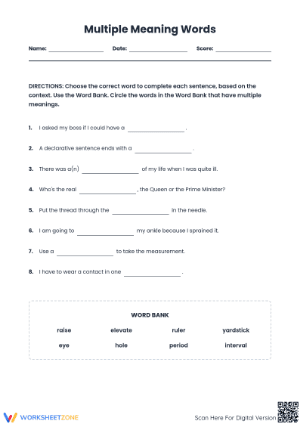
These 7th grade grammar worksheets resources target the specific conventions middle school students need to control before their writing can move forward — sentence structure, verb agreement, pronoun clarity, and the punctuation decisions that show up in every paragraph they write. Each worksheet focuses on one of those skill areas with enough practice to reveal whether students understand the rule or have only memorized an example.
Skills These Worksheets Build
The set covers the grammar concepts that receive the most instructional attention in grade 7 — not as isolated terms to memorize, but as tools students use when they draft and edit. Skills across the worksheets include:
- Sentence structure: identifying and correcting fragments, run-ons, and comma splices in context sentences
- Subject-verb agreement: matching verbs to subjects across intervening phrases and with collective nouns
- Pronoun reference and case: clear antecedents, nominative versus objective forms, and vague reference correction
- Verb tense consistency: maintaining tense within a passage and recognizing when shifts break meaning
- Punctuation: commas with coordinating conjunctions, apostrophe use in possessives versus contractions, and quotation mark placement
- Commonly confused words: there/their/they're, its/it's, your/you're, affect/effect, and similar pairs that appear in student writing on a daily basis
- Editing passages: correcting a short paragraph containing multiple errors — the closest thing on a worksheet to actual revision work
The developmental shift at seventh grade matters here. Most students in this grade have encountered all of these terms before, but labeling a pronoun is a very different task from knowing when a pronoun reference is actually vague. These worksheets ask students to move from recognition to correction to application — an important progression that prepares them for editing their own writing.
Frequent Errors Worth Watching For and Addressing
Seventh graders carry a predictable set of grammar confusions that surface reliably, not as random mistakes but as patterns that repeat across classrooms. The most persistent one: a student who correctly identifies a comma splice in a labeled exercise will still write "I wanted to go, it was raining" in their own draft without flagging it as an error. The rule they can state and the rule they apply while composing operate in two different mental tracks, and worksheets that ask students to find errors inside a paragraph — rather than in a stripped-down sentence frame — help close that gap.
Pronoun case produces a specific kind of confident wrong answer. Students write "between you and I" with certainty because "I" sounds more formal, and formal feels more correct to a seventh grader. Subject-verb agreement breaks down most reliably when a prepositional phrase sits between the subject and the verb — "the quality of her sentences are strong" is the version that shows up in student papers, not the simple paired example from a grammar textbook. Apostrophes follow a similar pattern: students who would never write "its' " in isolation produce it inside a paragraph without noticing. Editing worksheets that embed errors in short prose catch these habits in a way that isolated sentence frames cannot.
Making These Worksheets Work Inside Your Planning
The most effective way to use these resources is to match the format to the instructional moment rather than moving through the set in sequence. A skill-specific worksheet works best immediately after direct instruction, while the concept is fresh. Editing passage worksheets — where students correct a flawed paragraph — belong after a writing mini-lesson on revision, so students transfer the skill to context rather than letting it stay abstract. The 7th grade grammar worksheets set covers enough distinct skill areas that teachers can pull one worksheet in response to what they see in student writing any given week, which makes the resources more useful than a grammar workbook that locks teachers into one fixed direction.
For pacing, the shorter skill-specific worksheets fit a focused warm-up — the 10 minutes at the start of class before a writing workshop block opens. The editing passage format suits a full 15 to 20 minutes, either as structured review or a partner activity. Sending one targeted worksheet home after instruction works especially well for verb tense and pronoun reference, where a second pass through the concept — without the noise of initial instruction — helps students consolidate what they practiced in class.
Differentiating These Worksheets for a Mixed-Readiness Classroom
A realistic seventh grade class includes students who still need work on basic sentence boundaries alongside students who already write controlled compound-complex sentences and need to refine punctuation within them. These worksheets accommodate that range. For students still working on identifying subjects and verbs, assign skill-specific worksheets that stay on a single target and avoid the cognitive load of mixed formats. For students who grasp identification but need to build accuracy, the correction and editing formats push them toward active decision-making rather than circling answers.
When the 7th grade grammar worksheets set is used with stronger writers, the highest-value activity is usually finishing each worksheet and then writing two or three original sentences that demonstrate the same rule — or explaining in writing why a specific answer is wrong. Students who can articulate the error understand it differently than students who arrive at the correct answer by feel. For students who need more support, completing only the correction items on an editing worksheet, or working through alternating items with teacher input, keeps the work accessible without changing the skill being practiced.
Standard Alignment
These worksheets align to the Language strand of the Common Core State Standards, with particular relevance to CCSS.ELA-LITERACY.L.7.1 (demonstrating command of the conventions of standard English grammar and usage when writing or speaking) and CCSS.ELA-LITERACY.L.7.2 (demonstrating command of capitalization, punctuation, and spelling). In instructional terms, L.7.1 covers the structural skills — sentence types, pronoun case, verb tense consistency, and subject-verb agreement — while L.7.2 covers the surface decisions students make during editing: comma placement, apostrophe use, and quotation marks. Both standards expect application, not just identification, which is why worksheets that ask students to rewrite and correct — rather than only underline or circle — are the stronger match.
Frequently Asked Questions
Are these worksheets suited for daily warm-ups, or do they work better as longer class activities?
Both formats appear in the set. Skill-specific worksheets with 8 to 12 focused items fit a 10-minute warm-up without eating into writing time. Editing passage worksheets take closer to 15 to 20 minutes and suit a more structured review period or a partner correction activity. Having both types available means teachers can match the task to the time available on a given day.
Do the worksheets include answer keys?
Yes. Every worksheet includes an answer key. This makes the resources practical for independent practice, peer correction, small-group reteaching, and sub plans — situations where the teacher cannot check every response in real time. Answer keys also support the kind of quick self-correction that gives students immediate feedback before errors get reinforced.
At what point in a unit do these worksheets fit best?
Skill-specific worksheets work best immediately after direct instruction, when students need focused practice before the concept fades. Mixed-review and editing worksheets work better mid-unit or before a writing assessment, when the goal is to reactivate earlier skills through spaced retrieval rather than introduce something new. The 7th grade grammar worksheets resources are built to serve both roles, which is why organizing the full set by skill area — rather than assigning worksheets in a fixed sequence — gives teachers the flexibility to respond to what students actually need on a given week.
Are these appropriate for students who struggle with reading?
The directions on each worksheet are brief, and the examples at the top are concrete. For students with reading challenges, reading the directions aloud before independent work is usually enough to get everyone started without a lengthy explanation. The editing passage worksheets use short paragraphs — typically three to five sentences — which limits the reading demand while still requiring students to make real grammar decisions rather than respond to isolated multiple-choice items.















 Interactive Worksheet Maker
 Quiz Maker
 Word Search Maker
 Crossword Puzzle Maker
 Word Scramble Generator
 Sentence Scramble Generator
 Handwriting Worksheet Generator
 Name Tracing Generator
 Fill In The Blank Generator