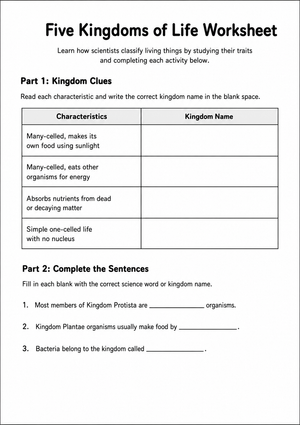
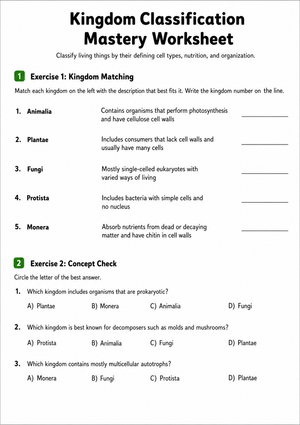
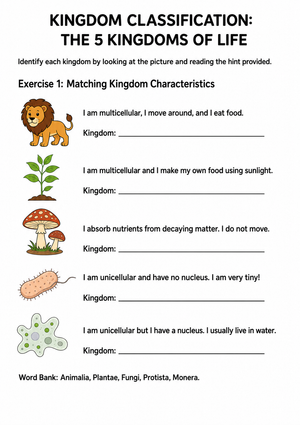
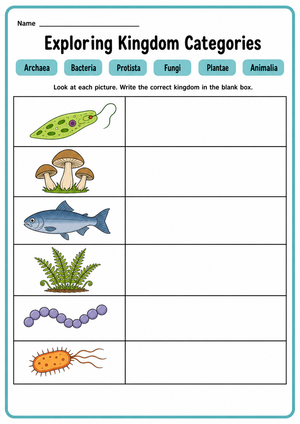
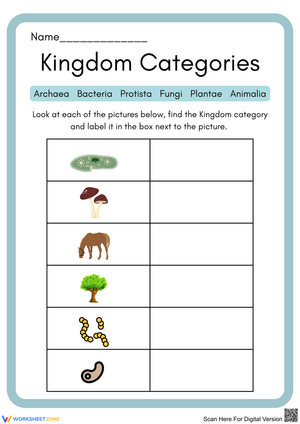
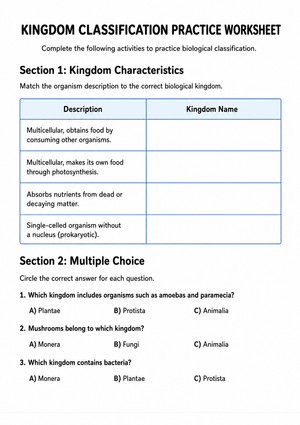
These kingdom classification worksheets for 6th grade give life science teachers a structured set of practice resources for one of the most conceptually demanding shifts in middle school science: moving students from a rough "plants vs. animals" mental model to a six-kingdom framework where cell type, nutrition strategy, and cellular organization determine where an organism belongs. Each worksheet targets a different skill—matching, sorting, compare-and-contrast, or short written justification—so students build toward accurate classification rather than guessing from appearance.
Mistakes Students Make That These Worksheets Surface Early
The most persistent error in sixth-grade classification work is the fungi-plant conflation. Students see a mushroom, note that it stays rooted in one place, and write "Plantae" without checking how it actually gets food. Absorption-based heterotrophs confuse students who have only applied the producer/consumer split between Animalia and Plantae. A well-chosen worksheet prompt—something like List two traits that place this organism in Fungi rather than Plantae—catches this error before it hardens into a fixed assumption.
A second predictable error is treating all microscopic organisms as interchangeable. Students who correctly identify that both Archaebacteria and Eubacteria are prokaryotic often stop there, as if that shared trait makes the kingdoms identical. The same conflation happens with Protista: an amoeba moves, so students write "Animalia," skipping cell-type evidence entirely. That movement-equals-animal assumption is deeply embedded by the time students reach 6th grade, and repeated sorting practice with unfamiliar examples—not lectures—is what reliably dislodges it.
Students also treat "kingdom" and "taxonomy" as synonyms. When a short-answer item asks for the kingdom and a student writes "taxonomy: Animalia," it signals a conceptual gap that written-response items catch far better than multiple-choice formats do.
The Specific Skills Targeted
Each worksheet in the set focuses on one or more of the following, with later worksheets combining skills so students transfer knowledge rather than just repeat it:
- Cell type identification: Students distinguish prokaryotic from eukaryotic cells and connect each to the appropriate kingdom or kingdoms.
- Unicellular versus multicellular comparison: Students determine whether an organism is made of a single cell or many, and use that as one piece of classification evidence alongside other traits.
- Nutrition mode categorization: Students sort organisms as producers, consumers, decomposers, or absorbers, then connect each mode to a kingdom.
- Structural trait application: Students use the presence or absence of cell walls, chloroplasts, and other basic features as classification markers.
- Trait-based written justification: Students write one or two sentences explaining a classification decision by citing two or three specific traits—not just the organism's name or a surface observation.
That last skill is worth highlighting. Many 6th graders correctly mark "Fungi" on a matching item and then write "because it doesn't move" on the accompanying short-answer prompt. That observation is not wrong, but it is not a scientific classification criterion. Worksheets that require written justification reveal exactly that gap and show students—in their own writing—what counts as classification evidence.
Building These Worksheets Into a Life Science Unit
The strongest placement for these resources is the day after initial instruction, when students have heard the six kingdoms introduced but have not yet worked through unfamiliar examples. Starting class with one sorting worksheet before discussion raises the quality of that discussion—students arrive with a specific error or question rather than a blank stare. The mistakes they make during independent practice become the content of the whole-group conversation.
For station rotations, separate the task types across centers: one station uses the compare-and-contrast worksheet to set two kingdoms side by side, another uses the organism-sorting format with ten or twelve examples, and a third focuses on the short written-response worksheet as a near-independent activity. Keeping task types in separate stations prevents format overload and lets each center do one cognitive job well.
These kingdom classification worksheets for 6th grade also function as low-prep formative checkpoints. Pull one section and use it as a Monday bell ringer, then return to the same section on Thursday after additional instruction. That before-and-after comparison gives teachers concrete student work showing whether the shift from appearance-based guessing to trait-based reasoning actually happened—which is harder to document through class discussion than through written responses.
For sub plans, use worksheets that include a completed example item near the top so students can orient themselves without teacher support. For reteaching sessions, narrow the task before expanding it: ask students to sort by one trait only—unicellular versus multicellular—before introducing full kingdom identification. That single-criterion starting point breaks the logjam for students who freeze when they see all six categories at once.
Differentiating Across Learner Readiness Levels
Students still building vocabulary do well with the matching worksheets, where kingdom names appear alongside brief trait descriptions. Connecting two pieces of given information reduces working memory demand without removing the classification challenge—students still reason about which traits go with which kingdom, but they are not simultaneously retrieving definitions from memory.
Students who have the vocabulary but struggle with application benefit from the organism-sort worksheets paired with a printed trait reference card. The card functions as a structured support, not an answer sheet—it keeps students focused on the trait-matching process so the cognitive effort goes where it belongs: comparing evidence, not hunting for memorized facts.
Students ready for deeper challenge should work through the short-answer and compare-and-contrast worksheets, which require synthesis: choosing which traits matter most for distinguishing two specific kingdoms, and explaining why a surface similarity—both fungi and plants appear stationary—does not override a difference in nutrition mode or cell wall composition. Giving these students an unusual example like a slime mold and asking for a written "trait argument" extends the task without requiring a separate resource.
Frequently Asked Questions
What are the six kingdoms covered in these worksheets?
The set addresses Archaebacteria, Eubacteria, Protista, Fungi, Plantae, and Animalia—the model most commonly used in middle school life science curricula. Each kingdom appears with at least one familiar example organism so students can anchor an abstract category to something recognizable before working with less familiar examples.
Do the worksheets include answer keys?
Yes. Each worksheet includes a corresponding key. For short-answer and written-justification items, the key provides a model response that names the specific traits students should cite—not just the correct kingdom label. That detail matters for station work and homework: a model response shows students the reasoning standard they are working toward, not only whether they got the right answer.
Are viruses included in the classification practice?
No. The focus is on living organisms placed within the six-kingdom framework. Viruses occupy a genuinely contested scientific category, and introducing them during initial kingdom instruction creates more confusion than clarity for most 6th graders. Teachers typically address viruses separately after students are confident with the six kingdoms.
How do these worksheets fit into a broader taxonomy unit?
Kingdom is the broadest rank in the Linnaean hierarchy, so these worksheets build the foundation before students work with phylum, class, order, family, genus, and species. The trait-comparison practice here transfers directly to narrower classification levels—students who learn to compare kingdoms by traits apply the same process when distinguishing orders or families later in the unit. These kingdom classification worksheets for 6th grade work best placed early in a taxonomy sequence rather than held for end-of-unit review.
Do these work alongside major textbook series?
Yes. Because each worksheet targets a specific skill rather than a specific lesson sequence, these kingdom classification worksheets for 6th grade fit alongside any major middle school life science text. Teachers working with CK-12, Pearson, or McGraw-Hill materials have found the sorting and written-justification worksheets especially useful for adding applied practice that most textbook programs do not provide in sufficient quantity on their own.












 Interactive Worksheet Maker
 Quiz Maker
 Word Search Maker
 Crossword Puzzle Maker
 Word Scramble Generator
 Sentence Scramble Generator
 Handwriting Worksheet Generator
 Name Tracing Generator
 Fill In The Blank Generator