When introducing the fundamental building blocks of life, educators need high-quality, visually engaging resources. Utilizing plant cell and animal cell printable worksheets for 6th grade provides students with the structured practice they need to master complex biological concepts. At this educational stage, learners transition from basic life science ideas to more detailed cellular biology. They must understand not only what a cell is but also how its internal structures work together to sustain life. Worksheets serve as excellent tools for independent practice, collaborative group work, or formative assessments. By incorporating clear diagrams and targeted questions, teachers can ensure their students grasp the intricate details of cellular anatomy.
Understanding Eukaryotic Cells
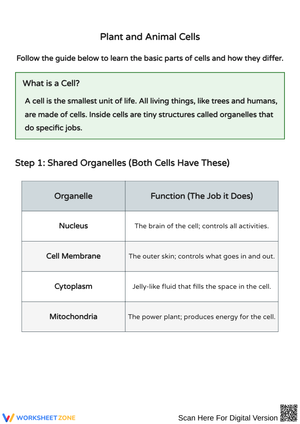
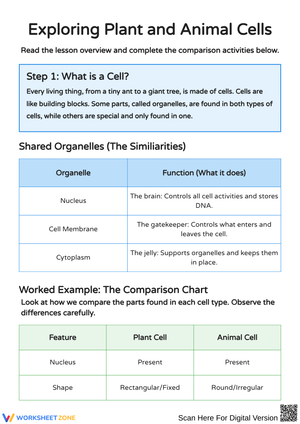
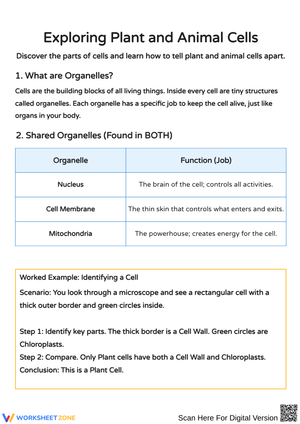
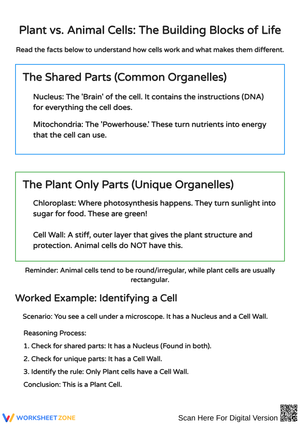
Before comparing different types of cells, students must first understand what they share in common. Both plant and animal cells are classified as eukaryotic. This means they contain a defined nucleus and membrane-bound organelles. According to resources like National Geographic: Cell Theory and Structures, understanding these shared characteristics is a foundational step in biology. In a typical 6th-grade science curriculum, students learn about several core organelles present in both cell types.
The nucleus acts as the control center, housing the genetic material that dictates cellular activities. The cell membrane serves as a semi-permeable barrier, regulating what enters and exits the cell. Inside, the cytoplasm provides a jelly-like substance where all other organelles are suspended. Mitochondria are often referred to as the powerhouses of the cell, generating the energy required for cellular processes. Ribosomes, though tiny, play a massive role in synthesizing proteins. By mastering these shared structures first, students build a strong knowledge base. Worksheets that focus on these commonalities help learners solidify their understanding before moving on to the more complex differences between specific cell types.
Meeting NGSS Requirements in Grade 6
For science educators, aligning lesson plans with established educational frameworks is essential. When using these resources, teachers can confidently meet the requirements of NGSS MS-LS1-2: From Molecules to Organisms. This specific standard requires students to develop and use a model to describe the function of a cell as a whole and the ways parts of cells contribute to the function.
Printable worksheets act as two-dimensional models that students can manipulate, label, and analyze. By engaging with these visual representations, learners demonstrate their ability to connect specific organelles to their broader biological roles. Whether they are tracing the path of energy production or identifying structural supports, students are actively participating in scientific modeling. This alignment ensures that classroom activities are not just busywork, but meaningful exercises that build critical thinking and scientific literacy.
Engaging Worksheet Activities
To keep students engaged, it is helpful to use a variety of worksheet formats. Here are a few highly effective options for the science classroom:
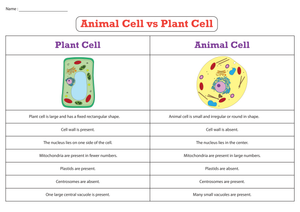
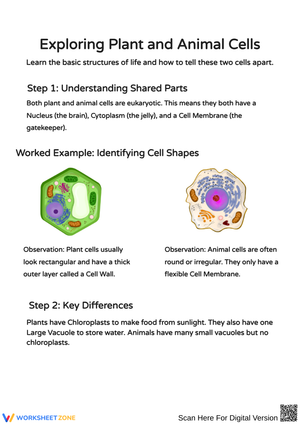
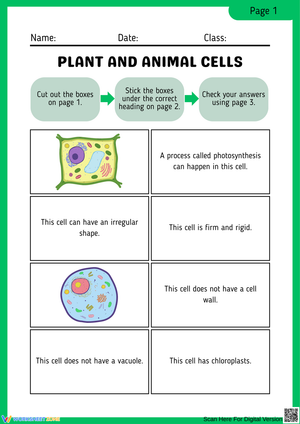
- Labeling Diagrams: Side-by-side illustrations of plant and animal cells allow students to visually compare the structures, drawing lines to identify the nucleus, mitochondria, and chloroplasts.
- Venn Diagram Comparisons: In this activity, students categorize a list of organelles into three sections: plant only, animal only, or both. This sorting exercise reinforces memory and highlights the evolutionary divergence of these organisms.
- Organelle Function Match-up: These activities challenge students to connect vocabulary words with their definitions. For example, they might draw a line connecting mitochondria to energy production or cell wall to structural support.
- Cell City Analogy: This is a highly popular and creative worksheet format. Students map cell organelles to city infrastructure, such as comparing the nucleus to city hall, the mitochondria to a power plant, and the cell membrane to city limits. This metaphorical thinking helps solidify abstract concepts into relatable, everyday ideas.
Classroom Implementation
Integrating these resources into your daily lesson plans can significantly enhance student comprehension. Begin by introducing the basic concepts through direct instruction or a multimedia presentation. Once the foundation is laid, distribute the worksheets for guided practice.
To maximize retention, have students use a consistent color-coding system across all their cell worksheets throughout the unit. For example, if they color the mitochondria red and the chloroplasts green on their first labeling assignment, require them to use those exact same colors on their cell city analogy and study guides. This consistent visual repetition builds strong associative memory, making it much easier for students to recall organelle functions during their final assessment.
Encourage collaborative learning by having students work in pairs to complete Venn diagrams or match-up activities. This allows them to discuss their reasoning and correct each other's misconceptions in real-time. For independent assessment, use a blank labeling diagram as a quick exit ticket or a formal quiz. By varying the types of worksheets used, you cater to different learning styles and keep the material fresh and engaging.
Frequently Asked Questions
1. What are the three primary differences between plant and animal cells?
The three main differences are the presence of a cell wall, chloroplasts, and the size of vacuoles. Plant cells have a rigid cell wall for structural support and chloroplasts for photosynthesis, neither of which are found in animal cells. Additionally, plant cells typically have one large central vacuole for water storage, while animal cells have smaller, temporary vacuoles.
2. Why do plant cells have a cell wall while animal cells only have a cell membrane?
Plants need a rigid structure to grow upward and reach sunlight, as they do not have a skeletal system. The cell wall provides this necessary support and protection. Animals have skeletons (endoskeletons or exoskeletons) to support their bodies, so their cells only need a flexible cell membrane, which allows for movement and various cell shapes.
3. Do animal cells have vacuoles, and how do they differ from plant vacuoles?
Yes, animal cells do have vacuoles, but they are much smaller and often temporary compared to those in plant cells. In animal cells, vacuoles are primarily used for storing waste products or transporting materials. In plant cells, the large central vacuole is essential for storing water and maintaining the internal pressure that keeps the plant upright.
4. Which organelles are responsible for energy production in each cell type?
In both plant and animal cells, mitochondria are responsible for generating usable energy through cellular respiration. However, plant cells also have chloroplasts, which capture light energy from the sun and convert it into glucose during photosynthesis. The mitochondria then break down this glucose to release energy for the plant cell.












 Interactive Worksheet Maker
 Quiz Maker
 Word Search Maker
 Crossword Puzzle Maker
 Word Scramble Generator
 Sentence Scramble Generator
 Handwriting Worksheet Generator
 Name Tracing Generator
 Fill In The Blank Generator