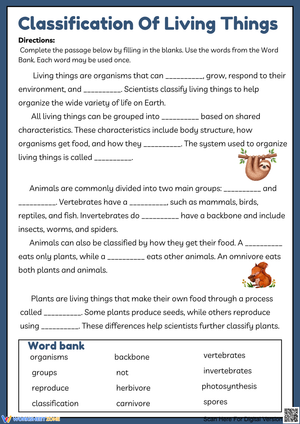
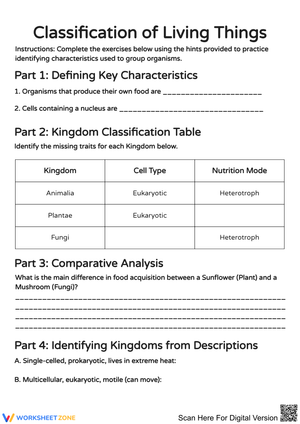
Classification of Living Things printable worksheets for 6th Grade
These classification of living things worksheets for 6th grade give students structured, repeated practice with the skill that trips up even motivated learners: holding the full taxonomic hierarchy in mind while simultaneously applying it to a specific organism. The set moves from broad conceptual work — sorting organisms by domain and kingdom — through progressively finer distinctions, ending with binomial nomenclature and dichotomous key interpretation.
What's Inside the Set
Each worksheet targets a distinct layer of taxonomy rather than surveying all of them at once. That's a deliberate design choice: when students encounter Domain, Kingdom, Phylum, Class, Order, Family, Genus, and Species on the same worksheet, they often memorize the mnemonic without building any actual schema for what each level means. These worksheets separate the levels so students anchor each concept before the next one is introduced.
Across the set, students practice skills including:
- Placing organisms within the three-domain system by identifying whether cells contain a nucleus — the diagnostic question that separates Bacteria and Archaea from Eukarya
- Matching kingdom-level organisms to their defining traits: cell type, cell number, and feeding strategy (autotroph vs. heterotroph vs. absorptive feeder)
- Tracing a single organism — the gray wolf is a recurring example — through all eight levels from Domain Eukarya down to Canis lupus, so students see the hierarchy as a narrowing funnel rather than a disconnected list
- Reading and applying binomial nomenclature conventions: genus capitalized, species lowercase, full name italicized or underlined
- Working through dichotomous keys by selecting between binary descriptors until a unique identification is reached
- Sorting organisms by observable traits — presence of cell walls, reproductive method, body plan — using classification tables and branching diagrams
Standard Alignment
These worksheets align with NGSS MS-LS4-2, which calls for students to apply scientific ideas to construct an explanation for the anatomical similarities and differences among modern organisms and between modern and fossil organisms. At the 6th-grade level, this standard is typically introduced through the classification framework — students can't reason about shared ancestry without first understanding what shared characteristics are used to group organisms. The domain and kingdom worksheets build that foundation directly. MS-LS4-2 is sometimes mistakenly treated as a pure evolution standard and held until a dedicated evolution unit; in practice, classification of living things is the natural entry point for the concept, and introducing it here gives students a conceptual anchor they'll return to when evolutionary relationships become the explicit focus.
Mistakes Students Make That These Worksheets Help You Catch
The most consistent error in student work at this level is conflating Archaea and Bacteria. Both are prokaryotes, both are single-celled, and many students assume they're interchangeable — until they encounter the question of environment. When a worksheet asks students to identify which domain an organism from a deep-sea hydrothermal vent belongs to, many confidently write Bacteria, because that's the prokaryote they've heard of most. The distinction — that Archaea thrive in chemically extreme environments and have cell membrane chemistry unlike either Bacteria or Eukarya — requires more than one exposure before it holds.
Binomial nomenclature produces its own predictable errors. Students who correctly capitalize Panthera in one sentence will write panthera leo in the next without the italics, because the formatting rule hasn't yet become automatic. A worksheet that requires students to rewrite incorrectly formatted names — rather than just write new ones — surfaces this inconsistency in a way that a fill-in exercise doesn't. Similarly, students regularly interpret the shared genus between Panthera leo and Panthera tigris as evidence that lions and tigers are the same species. Building in an explicit question about what shared genus does and does not indicate catches that misconception early.
How to Build These Worksheets Into Your Lesson Plans
The domain-and-kingdom worksheets work well as the structured close of a direct instruction lesson — the 12–15 minutes after you've modeled the sorting logic at the board and before students move into group work. At that stage, students need individual accountability before the concepts scatter. Waiting until homework to find out whether they understood the Fungi/Protista distinction costs you a full day of reteaching.
Dichotomous key worksheets are better positioned as the entry task on a day when students have already seen a key modeled but haven't applied one independently. The Monday-morning warm-up slot, after a weekend break, is particularly useful here: it reactivates the prior lesson without requiring a full re-explanation, and it tells you within the first eight minutes which students need scaffolding before the day's lab activity.
For the binomial nomenclature worksheet, consider pairing it with a brief gallery of scientific name corrections — common errors pulled anonymously from previous classes — before students work independently. Seeing the errors in someone else's work before making them yourself is one of the more efficient uses of the minutes before independent practice begins.
Adjusting the Worksheets for a Range of Learners
Students who are still building vocabulary fluency benefit from completing the kingdom-sorting worksheet with a reference card showing each kingdom's defining traits. The reference card doesn't make the task trivial — students still have to match the organism's description to the right kingdom — but it reduces the working memory load enough that the reasoning itself becomes the focus. Remove the card once students demonstrate reliable sorting across two or three attempts.
For students who move through the material quickly, the most productive extension is having them construct their own dichotomous key for a group of six to eight organisms of their choosing. This requires them to identify which observable traits are truly diagnostic (that is, shared by some organisms in the group but not others) and to sequence the questions so that no branch leads to a dead end. It's a harder task than it looks, and it exposes gaps in understanding that a completed worksheet never would.
One honest limitation of the dichotomous key worksheets: students who tend to freeze when presented with an unfamiliar organism — particularly students who rely heavily on background knowledge rather than observable traits — sometimes stall at the first branch. Having a partner verbalize the decision-making aloud before the student records an answer helps more than any written scaffold does.
Frequently Asked Questions
Which mnemonic works best for 6th graders trying to memorize the taxonomic hierarchy?
"Dear King Philip Came Over For Good Soup" is the most widely used in middle school classrooms, and it holds up because the sentence is silly enough to be memorable without being so absurd that it becomes a distraction. Two alternatives — "Do Kings Play Chess On Fine Green Silk?" and "Dumb Kids Playing Chicken On Freeway, Go Slow" — work equally well for different classes. Pick one and stick with it for the unit; switching mnemonics mid-lesson because one student prefers another is the fastest way to ensure no one retains any of them.
How do I explain the three-domain system without losing students in the cell biology?
Anchor the explanation to a single structural question: does the cell have a nucleus? Bacteria and Archaea do not — their DNA is loose inside the cell. Everything in Eukarya does. Then distinguish Bacteria from Archaea by habitat: Bacteria are widespread; Archaea tend to live where almost nothing else can, such as near hydrothermal vents or in highly acidic environments. That's enough for 6th graders to work with before the more nuanced membrane chemistry conversation happens in later grades.
What's the fastest way to check whether students actually understand binomial nomenclature formatting versus just copying it correctly?
Give them three intentionally wrong scientific names — wrong capitalization, no italics, reversed genus and species — and ask them to identify and correct each error. Students who are copying mechanically can produce a correct name when the slot is blank; students who understand the convention can identify why a formatted name is wrong. The correction task takes about five minutes and gives you reliable formative data before the end of class.
Can students who have no prior exposure to taxonomy use these worksheets without a full introductory lesson?
The kingdom-sorting and hierarchy-tracing worksheets assume students have seen the material presented at least once. They're designed for guided or independent practice, not initial instruction. The dichotomous key worksheets are the exception — students can work through a key using only observable traits and the key itself, with no prior knowledge required. That makes the key worksheets a reasonable assessment of scientific reasoning even at the start of a unit.
Clear All