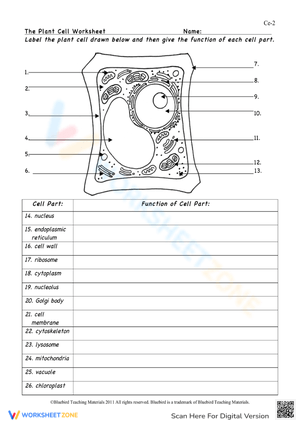
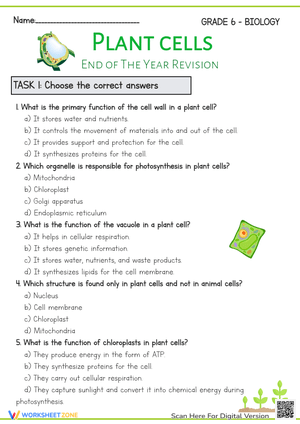
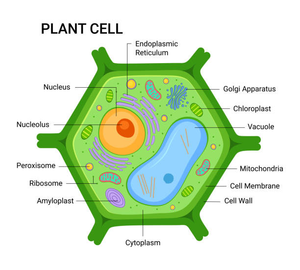
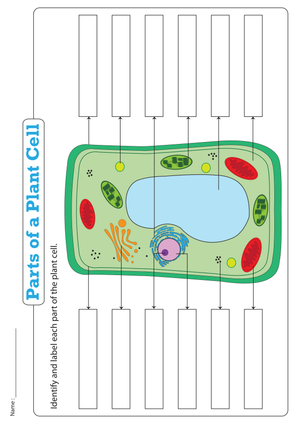
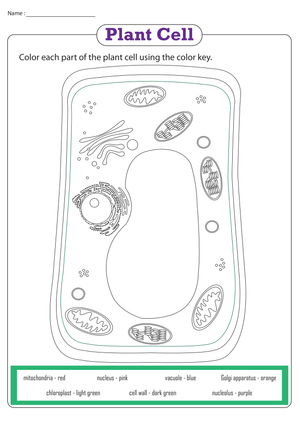
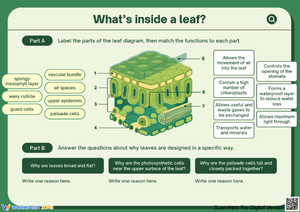
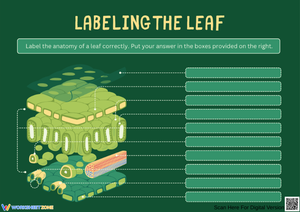
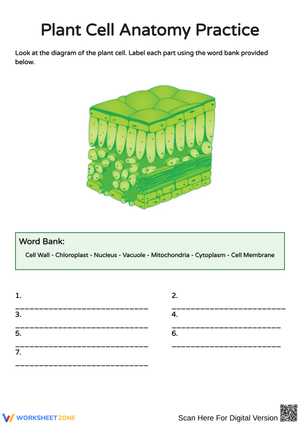
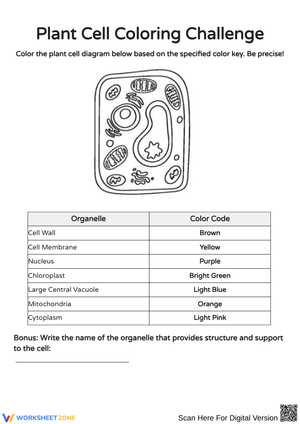
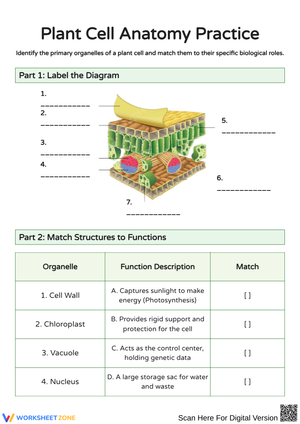
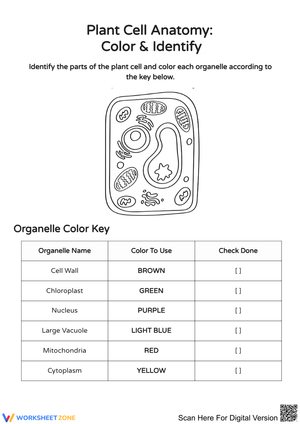
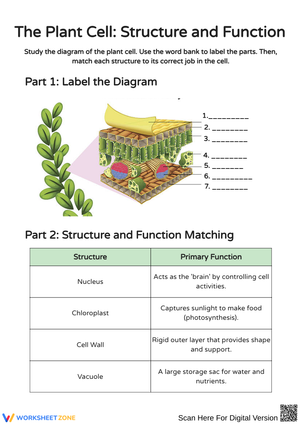
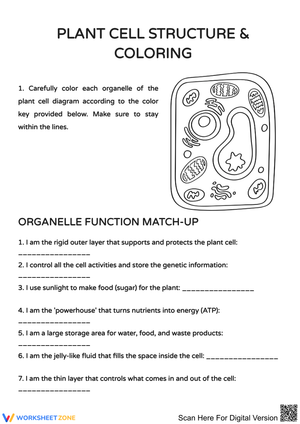
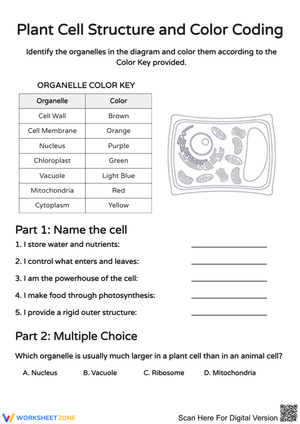
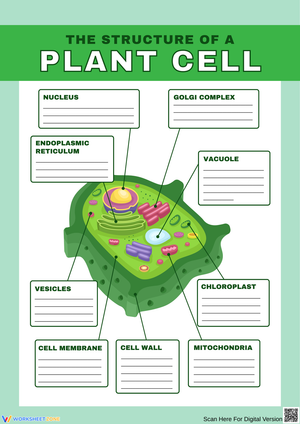
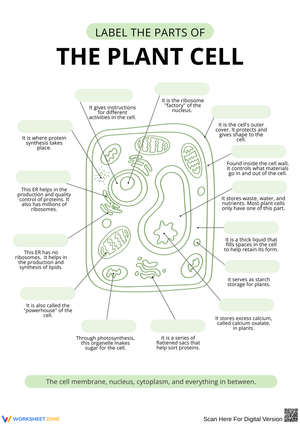
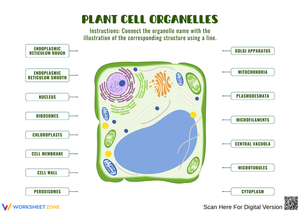
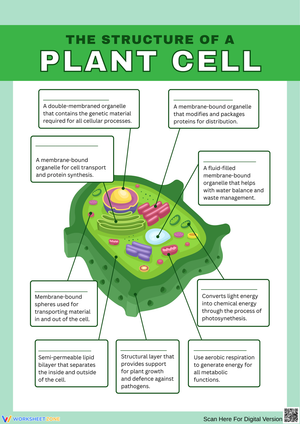
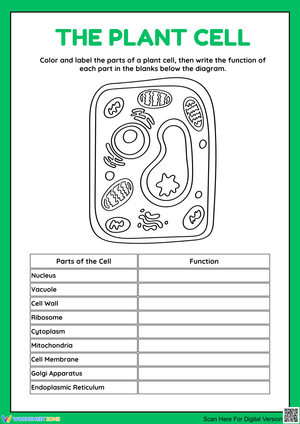
These 6th grade plant cells printable worksheets give middle school science teachers labeled and unlabeled cell diagrams, organelle matching tasks, and short writing prompts that ask students to explain what each part actually does. The set moves past naming organelles and pushes students to connect structure to function — why a cell wall holds a plant upright, why chloroplasts make the leaf green, what happens inside the central vacuole when a plant goes too long without water.
What Each Worksheet Asks Students to Do
The work is built around the structures that separate plant cells from animal cells. Students label the cell wall, chloroplasts, and central vacuole, then write a sentence or two tying each one to the plant's survival. Some worksheets stop at identification; others ask students to predict what would go wrong if a single organelle stopped working — a leaf that can't photosynthesize, a stem that loses its rigidity.
The recurring three structures show up in nearly every task because they are the ones sixth graders confuse most often:
- Cell wall — the rigid cellulose layer outside the membrane that gives the cell its boxy shape and lets a plant grow tall without bones.
- Chloroplasts — the green organelles where photosynthesis happens; students mark their location in the cytoplasm and note that chlorophyll is what captures sunlight.
- Central vacuole — the large water-filled sac that presses outward against the wall to keep the cell firm.
Shared organelles — nucleus, mitochondria, ribosomes, cell membrane — appear too, usually in comparison tasks where students sort which parts belong to plants only and which belong to both cell types.
Working With the Three Plant-Only Structures
The cell wall is the easiest to teach and the one students remember, partly because the building-wall analogy lands so well. Comparing it to the brick exterior of a building makes the protective, shape-holding job obvious. Chloroplasts take a little more work. The "tiny solar panels" comparison helps, but students need to see that chloroplasts sit inside the cytoplasm rather than floating on the cell's surface, which is why the coloring and location tasks matter.
The central vacuole is where understanding usually breaks down, and it's worth slowing down for. I use a cardboard box with a balloon inside it: the box is the cell wall, the balloon is the vacuole. Inflate the balloon and it pushes the box walls tight and stiff. Let the air out and the box stands there but caves under any weight. That single demonstration explains why a thirsty plant wilts even though every cell wall is still intact — students stop treating turgor pressure as a vocabulary word and start seeing it as a thing they can picture.
How to Build the Set Into Your Week
These worksheets fit several spots in a cell unit. A labeled diagram works for a whole-class walkthrough at the start; the matching unlabeled version becomes a quick formative check the next day. They also hold up as a quiet station in a rotation, or as independent practice after direct instruction. The 6th grade plant cells printable worksheets pair especially well with lab days — have students complete a labeling task before they put onion skin or elodea under the microscope, so they walk in knowing what a cell wall and nucleus should look like.
After the lab, send students back to the same diagram to compare what they actually saw against the textbook version. Real elodea never looks as tidy as the drawing, and that gap is the teaching moment. Comparing a model to live evidence is exactly the kind of inquiry sixth graders are supposed to be practicing, and it keeps the worksheet from feeling like busywork. For a longer project, the Cell City framework turns the same content into design work — the nucleus becomes city hall, the chloroplasts become the power plant or farm, the cell wall becomes the perimeter fence.
Frequent Errors Worth Catching Early
The most common mistake is treating the cell wall and cell membrane as the same thing, or assuming a plant cell has only one of them. Students will erase the membrane entirely once they learn about the wall. They need both labeled, and they need to articulate that the membrane controls what moves in and out while the wall handles structure. The comparison tasks in these 6th grade plant cells printable worksheets force that distinction onto the page.
Another predictable error: students place chloroplasts in animal cells. It shows up constantly on Venn diagram tasks — a student will correctly put the nucleus in the shared middle section and then drop chloroplasts there too. The fix is connecting chloroplasts to food. If a cell makes its own food, it has chloroplasts; if it eats other things, it doesn't. Once students attach the organelle to that idea, the sorting errors drop off. A third one to watch: students describe the vacuole as "where the cell stores stuff" and stop there, missing turgor pressure entirely. Push them to explain the pushing-against-the-wall job, not just storage.
Adjusting the Worksheets Across Ability Levels
For students who need more support, start with the fully labeled diagram and a word bank, and let them copy and explain rather than recall cold. The balloon-box demonstration helps these learners most, because it gives them something physical to anchor an abstract idea. For students ready for more, hand over the unlabeled version with no word bank and add the prediction prompts — what happens to the plant if the central vacuole empties, why a cell with a broken cell wall might burst. The comparison and Cell City extensions give faster finishers somewhere to go without rushing the rest of the class.
Standard Alignment
The set supports NGSS MS-LS1-2, which asks students to develop and use a model describing how the parts of a cell contribute to the function of the cell as a whole. The labeling and function-explanation tasks are the modeling work that standard calls for — students aren't just memorizing a parts list, they're showing how the nucleus directs activity, how mitochondria release energy, and how the wall, membrane, and vacuole work together to keep the cell stable. That systems view, where the cell reads as a coordinated unit rather than a pile of separate pieces, is exactly what sixth graders need before they hit more demanding biology later on. The 6th grade plant cells printable worksheets give you the concrete diagrams and prompts to document that progress.
Frequently Asked Questions
Which structures do plant cells have that animal cells don't?
Three: a rigid cell wall, chloroplasts for photosynthesis, and a large permanent central vacuole. Animal cells sometimes have small, temporary vacuoles, but they have no wall, no chloroplasts, and no large central vacuole providing structural support through turgor pressure.
Why does a plant cell need both a cell membrane and a cell wall?
They do different jobs. The membrane is thin and flexible and controls what passes in and out of the cell. The wall is thick and rigid and supplies the mechanical strength a plant needs to grow upright. One regulates traffic; the other holds the shape. Students need both labeled and need to explain the difference, since this is where most of them blur the two.
How does the central vacuole keep a plant standing up?
When the vacuole fills with water, it swells and presses outward against the cell wall. That internal pressure — turgor pressure — makes each cell firm. Multiply that across thousands of cells and the stem and leaves stay rigid. Lose too much water and the vacuoles shrink, the pressure drops, and the plant wilts even though every cell wall is still in place.
Can these worksheets be used before a microscope lab?
Yes, and that's one of their stronger uses. Having students label a diagram first means they recognize the cell wall and nucleus when they see onion skin or elodea under magnification, instead of staring at an unfamiliar blur. Afterward they compare what they observed to the diagram, which builds the model-versus-evidence thinking the grade calls for.












 Interactive Worksheet Maker
 Quiz Maker
 Word Search Maker
 Crossword Puzzle Maker
 Word Scramble Generator
 Sentence Scramble Generator
 Handwriting Worksheet Generator
 Name Tracing Generator
 Fill In The Blank Generator